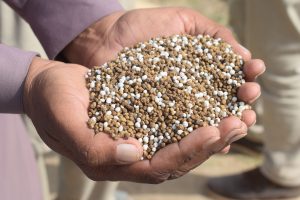
By December, most fields are quiet. Machinery is parked, invoices are piling up, and many farmers are asking the same question:
“How do I keep my fertilizer program strong next year without blowing the budget?”
One of the simplest and most powerful answers is also one of the least expensive: a good winter soil test.
Soil testing is not just paperwork for compliance. It is a decision tool that tells you where to invest, where you can safely cut back, and which nutrients are truly limiting your yield. Regular soil tests improve nutrient use efficiency, help sustain long term soil fertility, and support better yields with less waste.
In this article, we will look at why winter is such a smart time to sample, how to read a soil test through the lens of your fertilizer budget, and how Supply Solutions products can fit into the plan for farmers, home gardeners, and landscape professionals.
Why soil testing is one of your highest ROI habits
What a soil test actually tells you
A properly collected soil test gives you:
- pH and liming needs
- Levels of key nutrients such as phosphorus (P), potassium (K), calcium (Ca), magnesium (Mg), and sulfur (S)
- Organic matter and sometimes cation exchange capacity (CEC)
- In some cases, nitrate nitrogen and micronutrients
University and private labs use these numbers, along with calibration studies, to convert results into fertilizer recommendations. The goal is not to chase a “perfect” number, but to match your fertilizer rates to what the soil and crop actually need.
In simple terms, a soil test keeps you from guessing. Guessing is usually expensive.
How soil testing protects the fertilizer budget
Several recent analyses point in the same direction: when growers base fertilizer decisions on soil test data, they often cut unnecessary applications and capture savings without sacrificing yield.
For example:
- Extension studies on deep soil testing have shown potential fertilizer savings ranging from about 13 to nearly 190 dollars per acre in some systems when residual nitrogen is measured and credited before planting.
- Other economic evaluations of soil health and testing point to lower overall input costs and improved profitability when nutrient programs are designed around actual soil status, not assumptions.
For a grower managing hundreds or thousands of acres, even a modest reduction of 10 to 20 dollars per acre in unnecessary fertilizer quickly adds up. For a home gardener or landscaper, fewer unneeded bags still mean real money saved and less risk of burning plants or contributing to runoff.
Why winter is a smart time to sample soils
More time, less pressure
Winter is planning season. Fields are not calling for sprays, irrigation, or harvest runs, so you have time to:
- Pull representative samples from each management zone
- Wait for the lab results
- Talk through recommendations with your agronomist or with the Supply Solutions team
- Update fertilizer budgets and place orders before spring rush
Many extension guides note that late fall and early winter are excellent windows for soil sampling because you can get results back in time to plan the coming season.
Stable nutrient levels
For most nutrients and pH, soil test values do not swing dramatically over the year, unless there has been a recent application of fertilizer, lime, or manure.
That means a soil test collected after harvest and before major new applications is a solid baseline for:
- Phosphorus and potassium levels
- pH and lime requirements
- Organic matter trends
There are a few exceptions. For example, nitrate nitrogen on light, sandy soils can leach or change more quickly, so some labs recommend specific timing for nitrate tests.
A note on frozen ground
Sampling on frozen soil is possible, but only if you can take a uniform core to the proper depth. Extension publications emphasize that chipping a few chunks off the surface with a shovel is not good enough. You need a consistent core so the sample represents the full plow layer.
If frozen conditions make that impossible, it is better to wait for a short thaw than to collect poor samples that lead to misleading recommendations.
Who should be testing soils in winter?
1. Row crop and forage farmers
For larger farming operations, soil testing every one to three years is commonly recommended. That interval may be shorter on sandy soils or where high value crops justify very tight nutrient management.
Winter is a good moment to:
- Sample each field or management zone
- Check how previous fertilizer or manure programs have changed soil test levels
- Decide if you can hold, increase, or safely reduce rates of P, K, lime, and some secondary nutrients
2. Home gardeners
Many home gardeners apply fertilizer based on what is on sale or a neighbor’s recommendation. A simple soil test can prevent over application of nutrients such as phosphorus, which may already be abundant in many garden soils.
Winter testing lets a gardener:
- Plan balanced spring feeding for lawns, vegetable beds, and fruit trees
- Decide whether they truly need a higher phosphorus “bloom booster” or just a balanced NPK such as
3. Landscapers and turf managers
For landscapers responsible for parks, sports fields, and high value turf, winter soil tests support:
- More efficient spring nitrogen and potassium programs
- Strategic use of amendments such as gypsum where compaction, sodium, or drainage are issues
- Documentation for clients that fertilization plans are evidence based
How to take a good winter soil sample
Regardless of scale, the basic principles are the same.
Step 1: Define sample areas
- Split the farm, yard, or property into zones that are reasonably uniform in soil type, slope, and management history. Avoid mixing eroded hilltops with rich bottomland in one sample bag.
- For lawns or gardens, separate visibly different areas, such as a shady lawn corner and a sunny vegetable bed.
Step 2: Collect cores correctly
Most university guides recommend:
- Sampling the top 6 to 8 inches for most agronomic crops and turf
- Taking 10 to 20 cores per field or area, walking in a zigzag pattern
- Mixing those cores in a clean plastic bucket, then sending a subsample to the lab
On frozen ground, a powered or heavier duty probe may be needed to get consistent cores. If you cannot achieve a uniform depth, postpone sampling.
Step 3: Avoid contamination
- Use clean tools that are free of fertilizer dust or rust
- Do not sample immediately after fertilizer, manure, or lime applications
- For gardens, avoid spots with ash piles, pet urine, or recent compost additions unless those reflect the entire area
Step 4: Fill out the forms fully
On the Supply Solutions home page, you can download their soil testing form, which is designed to capture the information needed to give practical, product linked recommendations.
Include:
- Crop history and intended crop
- Typical yield goals
- Irrigation type
- Recent fertilizer and manure history
The more context you provide, the more useful the report will be.
Reading your soil test with your fertilizer budget in mind
Once the lab report comes back, it is easy to feel overwhelmed by numbers. Let us break it down into the main sections that matter for fertilizer planning.
1. Soil pH and lime needs
Soil pH influences how available many nutrients are to plants. Most field crops do best in a slightly acidic to neutral range. Horticulture crops vary, but extreme acidity or alkalinity usually hurts yield and quality.
When you see:
- Very acidic pH (for example below 5.5)
- Very alkaline pH (for example above 7.8)
it may be more cost effective to correct pH first before chasing deficiencies with large fertilizer rates. In some systems, pH issues are addressed with lime or, for high pH and sodium issues, with calcium sources like gypsum applied according to soil tests and crop needs.
Budget tip: Money spent on correcting pH often improves the effectiveness of every pound of fertilizer you apply later.
2. Phosphorus and potassium
Most soils have some natural P and K, but repeated cropping without adequate replacement will draw them down. At the same time, many long farmed fields and gardens already have medium to high levels, which may allow you to hold or reduce rates for a season.
Soil test interpretation guides categorize P and K levels as very low, low, medium, high, or very high. Fertilizer recommendations are often highest when levels are low and taper as levels approach the “build” or “maintenance” range. OSU Extension Service+1
For many fields, potassium is the nutrient most likely to limit stalk strength, water use efficiency, and winter hardiness. If soil test K is below the critical threshold for your soil type, it can pay to prioritize a K source in the budget.
Supply Solutions offers several potassium containing options such as:
Always match your selection and rate to the soil test, crop removal, and the product label.
3. Nitrogen and sulfur
In many systems, nitrogen is the biggest single fertilizer cost and the nutrient most closely tied to yield. Sulfur needs have also increased where atmospheric deposition has decreased and high yielding crops remove more S.
Some labs report residual nitrate nitrogen at deeper depths. Others provide general nitrogen recommendations based on crop and yield goal. Deep soil testing for nitrogen before planting has been shown to significantly reduce unnecessary N applications where residual N is higher than expected.
Supply Solutions products that may enter the nitrogen and sulfur discussion include:
- Supply Solutions Ammonium Sulfate 21-0-0 + 24 percent Sulfur for fields and landscapes where both N and S are needed and where soil and crop are suited to ammonium sulfate.
- Organic leaning or slow release programs that use products like Nutri-Proganic in combination with other sources for smaller or diversified operations, when appropriate by label.
Because nitrogen behavior is complex, it is especially important not to guess rates. Use the lab’s nitrogen recommendations, local extension guidelines, and, if needed, contact the Supply Solutions team with your soil test report so they can help you match products to your plan.
4. Organic matter and CEC
Organic matter and CEC are “capacity” indicators. Higher organic matter and CEC generally mean:
- Better water holding capacity
- Stronger buffering against pH swings
- More nutrient holding sites
University guidance notes that organic matter content gives insight into how productive a soil can be and how well it will retain water and nutrients. Lower organic matter soils may benefit from increased organic inputs.
For growers looking to improve soil health over time, this is where soil conditioners and carbon inputs enter the conversation. One example is Supply Solutions HumiPro(K) WSP humic and fulvic acid powder, which is designed to support soil structure, root development, and nutrient availability when used as directed.
Connecting your soil test to Supply Solutions fertilizers
Once you know where your soil stands, you can build a focused fertilizer plan that uses products efficiently instead of broadly.
Here are a few common scenarios:
Scenario 1: High magnesium, tight soils, drainage concerns
Soil test clues:
- Adequate or high magnesium
- Poor structure, surface sealing, or crusting
- Potential sodium issues in some fields
Discussion: In some systems, solution grade gypsum is used as part of a program to supply calcium and sulfur while helping improve soil structure and infiltration when combined with good agronomy practices.
Relevant Supply Solutions product:
Always follow the product label and consult local agronomic guidance about whether gypsum is appropriate for your soils and crops.
Scenario 2: Adequate phosphorus, low potassium
Soil test clues:
- Phosphorus in the medium to high range
- Potassium in the low to medium range for your crop and soil
- High yielding crops that remove a lot of K
Discussion: In this situation, you may be able to hold P application steady or even pause it for a season if recommended by your agronomist, and focus more dollars on potassium.
Relevant Supply Solutions product:
Scenario 3: Small acreage vegetables or mixed farm with many crops
Soil test clues:
- Mixed garden beds or small fields with varied needs
- Desire for a simple, starter friendly fertilizer option
Discussion: A balanced fertilizer like Supply Solutions 10-10-10 Complete Lawn & Garden Granular Fertilizer with Micronutrients can be a practical choice in small systems where detailed bulk blending is not feasible, provided the soil test does not show excessive levels of P or K.
Rates and timing always need to follow the product label and should be adjusted with the help of soil tests and local guidance.
Scenario 4: Building soil health over time
Soil test clues:
- Low to moderate organic matter
- Signs of structural issues or reduced water infiltration
- Desire to increase nutrient efficiency rather than only increase fertilizer rates
Discussion: Alongside good crop rotations and organic matter additions, humic and fulvic products such as HumiPro(K) WSP can be used to support nutrient availability and root growth when applied according to label directions, often in fall and early spring.
Again, the right choice and rate will vary by field. When there is any doubt, it is best to reach out directly to Supply Solutions with your soil test reports.
Practical tips for home gardeners and landscapers
While the agronomy principles are the same, home gardeners and landscapers often benefit from a simplified checklist.
For home gardeners
- Test every 2 to 3 years for vegetable beds, fruit trees, and lawns. Extension Resource Catalog+1
- Ask the lab for recommendations specifically for your crops.
- If phosphorus is already high, focus on nitrogen and potassium rather than buying “bloom booster” fertilizers that add more P. Extension Brown County+1
- Consider products like:
Always check the label for specific crops, rates, and safety instructions.
For landscapers and turf managers
- Use soil tests to justify and document your fertilization programs for clients.
- For high traffic turf, pay attention to potassium and soil structure along with nitrogen.
- Consider:
- Gypsum where soil testing and site conditions indicate value for structure or sodium management
- Ammonium sulfate where turf species and soil pH are suitable for a more acidifying nitrogen source
- HumiPro(K) where improved nutrient efficiency and soil conditioning fit your program
For any commercial work, confirm that all applications comply with local regulations and site specific requirements.
Bringing it all together: a winter action plan
Here is a simple winter checklist you can adapt:
- Download the soil test form HERE
- Map your fields or zones and decide how many samples you will pull.
- Collect representative cores from each zone using proper techniques.
- Send samples to the lab with full background information.
- Review results with a focus on:
- pH and lime
- P and K levels
- Nitrogen and sulfur recommendations
- Organic matter and CEC
- Match your needs to products, such as:
- Adjust your fertilizer budget to prioritize the nutrients your soil truly needs and reduce or pause products where levels are already adequate.
- When unsure, ask for help. Never guess at application rates or crop suitability. Always follow the product label and consult a qualified agronomist or the Supply Solutions team.
Final thoughts: small step, big impact
Winter soil testing is not glamorous. There are no drone flyovers, no dramatic before and after photos, and no new shiny equipment involved.
Yet it is exactly the kind of quiet, disciplined habit that separates “inputs by default” from “inputs that pay.”
Whether you are managing thousands of acres of corn and wheat, a mixed market garden, or a small suburban lawn, a winter soil test:
- Reduces guesswork
- Protects your fertilizer budget
- Supports better plant health and yield
- Helps you use products like gypsum, potash, ammonium sulfate, HumiPro(K), and 10-10-10 where they do the most good
If you would like a second set of eyes on your soil reports or help choosing which Supply Solutions products fit your fields, you are always welcome to reach out.