Orchards and berry fields look quiet in winter, but they are anything but “off.”
Roots are alive. Buds are formed. Reserves are being protected or depleted. By the time you see the first white or pink blossoms and cane growth, the season’s foundation has already been poured underground.
That is why the transition from winter to spring is such a critical window for:
- Apples, pears, and stone fruit
- Grapes and cane berries
- Blueberries and other acid-loving small fruits
- Backyard fruit trees and mixed berry patches
- Landscape trees and flowering shrubs
In this article, we will walk through a practical spring fertility approach that uses:
The goal is to help you feed perennial fruit crops in a way that:
- Respects the soil test
- Protects root health and structure
- Supports yield and fruit quality
- Keeps rates and products aligned with their labels
No guessing, no “more is always better.” Just thoughtful, spring-focused planning.
What Winter Really Does To Fruit Crops
Roots and buds wake up before you do
In most orchards and berry plantings, roots begin to stir as soon as:
- Soil temperatures creep above the mid-40s °F
- Days begin to lengthen
- The soil profile holds enough oxygen for active roots
This often happens before you see significant changes above ground.
That means:
- The root system is already exploring the soil you left it in last fall.
- Any compaction, poor drainage, or nutrient imbalances are being “felt” by the plant weeks before you are out there with a sprayer or spreader.
Your spring fertility and soil-conditioning decisions are less about “reacting to what you see” and more about anticipating what the crop will find in the next 4 to 10 weeks.
Winter depletion and removal
Each year, orchard and berry crops remove:
- Nitrogen and sulfur in fruit, prunings, and leaf fall
- Significant potassium in harvested fruit or stored roots and crowns
- Calcium, magnesium, and micronutrients in tissues and fruit
On top of that, trees and perennial canes draw from stored reserves through late winter and early spring.
If you do not keep up with:
- Potassium replacement
- Sulfur and nitrogen balance
- Calcium and structure in the root zone
then you slowly drift into a situation where:
- Fruit size, color, or firmness declines
- Canes and shoots are more disease-prone
- Stands decline earlier than they should
Spring is the moment when you can still influence the outcome of this season’s shoot growth, bloom, and fruit set.
Step 1: Read The Soil Test Before You Touch The Fertilizer Shed
Whether you manage 5 acres of blueberries or 5 trees in the backyard, the process starts the same way: with a soil test.
For orchards and berries, you want a test that includes at least:
- pH
- Organic matter
- Phosphorus (P)
- Potassium (K)
- Calcium and magnesium
- Sulfur (S), if available from your lab
- Cation balance and, where relevant, sodium
Once you have results, ask yourself:
- Is pH in the right range for my crop?
- Blueberries and some small fruits want acidic conditions.
- Many fruit trees and grapes like a slightly acidic to neutral range.
- Are P and K truly low, or just “not perfect”?
- Heavy fruit crops are K hungry.
- Many older home sites already have plenty of P from past fertilizer use.
- Is sulfur low or marginal?
- Modern conditions mean sulfur is often short, especially in coarse soils.
- Are there structural or salinity hints?
- High sodium or very high magnesium can hinder structure.
- Very low organic matter and poor tilth show up in infiltration, not just numbers.
These answers will determine where each Supply Solutions product fits, and where it does not.
If you are uncertain how to read your test, it is always safer to contact Supply Solutions with a copy of the results and ask for help, rather than guessing at rates.
Step 2: Decide What Your Primary Spring Job Really Is
Spring fertility for fruit crops usually falls into one or more of these jobs:
- Top up nitrogen and sulfur for new shoots and leaves
- Correct or maintain potassium for fruit size, color, and stress tolerance
- Supply or maintain calcium and structure in the root zone
- Support long-term organic matter and soil biology
- Fine-tune phosphorus and micronutrients only if they are truly low
You will rarely do all five equally on every block or tree.
A simple way to think about it:
- If the soil test screams “K low,” then potassium deserves extra focus.
- If sulfur is borderline and you know you are pushing yield, you may prioritize an N+S source.
- If roots are drowning or the soil seals over, structure and drainage upgrades (gypsum, humics, traffic control) may do more than any single nutrient.
Once you know your main job(s), you can match tools more accurately.
Step 3: Use Nutri-Proganic 4-3-2 As The Organic Foundation, Not The Whole House
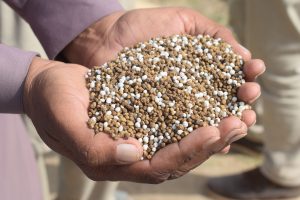
4-3-2 Nutri-Proganic Pellet is an organic fertilizer made from chicken manure. It provides:
- 4 percent nitrogen
- 3 percent phosphorus
- 2 percent potassium
- Organic matter and a spectrum of micronutrients
In orchards, vineyards, and berry fields, Nutri-Proganic works well when you treat it as a base layer:
- Broadcast or band it under the drip line or in the tree row before active growth, at label rates.
- Let soil microbes steadily mineralize nutrients as soils warm.
- Use it to build long-term fertility and carbon, not as your only answer to high-yield nutrient removal.
Best fit situations:
- Young orchards or berry fields where you are building soil quality and root systems.
- Mixed organic and conventional systems where you want a “slow, steady” base plus some soluble nutrients as needed.
- Home orchards and berry patches where organic matter and “forgiveness” are highly valued.
Limitations:
- Release is slower in cold, wet soils. Do not expect overnight color change.
- The N, P, and K concentration is modest; high-yield blocks may still need supplemental N, K, or S.
So, let Nutri-Proganic handle part of your N, P, K, and carbon. Then layer in more targeted products based on the soil test and crop demand.
Step 4: Match Nitrogen And Sulfur To The Crop And Soil
Nitrogen drives shoot growth, canopy development, and, indirectly, yield potential. Sulfur makes that nitrogen more efficient, supports protein and enzyme systems, and is increasingly short in many regions.
Supply Solutions Ammonium Sulfate 21-0-0 + 24% Sulfur is a granular fertilizer that:
- Provides 21 percent ammoniacal nitrogen
- Provides 24 percent sulfur in the sulfate form
- Has an acidifying effect in soil over time
This combination is particularly valuable in:
- Blueberries and other acid-loving berries
- Rhododendrons, azaleas, and ornamental acid lovers in landscapes
- Fruit trees or grapes on slightly alkaline soils where mild acidification is welcome and the label allows
Ways to use ammonium sulfate in spring:
- As a broadcast in the tree or vine row when buds are just swelling or at early leaf-out, within label rates.
- As a nitrogen and sulfur source for blueberries and brambles that like a slightly lower pH.
- As part of a broader N plan on mixed or conventional orchards, combined with other N sources if needed.
Points to remember:
- Always count the N from ammonium sulfate in your total nitrogen plan.
- On already acidic soils or very light textures, avoid long-term overuse that could drive pH too low.
- For pure legume berry systems (like some clover alley covers), you may need less N but still benefit from sulfur.
If your soil test suggests sulfur is adequate and pH is already low, you may use ammonium sulfate more modestly or rely on other N sources while focusing more on K and calcium.
Step 5: Protect Fruit Quality And Stand Life With Potassium
Potassium often becomes the “limiting silent partner” in perennial fruit systems.
It is crucial for:
- Fruit size, color, and firmness
- Disease tolerance and stress resilience
- Winter hardiness and cane or shoot health
- Water regulation within the plant
Sulfate of Potash 0-0-50 Plant Fertilizer gives you:
- A chloride-free, concentrated potassium source (0-0-50)
- Sulfur in sulfate form
- No nitrogen and no phosphorus
That matters in spring because:
- You can correct or support K without pushing more N or P into a system that does not need them.
- Sensitive crops (some berries, grapes, and ornamentals) generally appreciate chloride-free potassium sources.
Where Sulfate of Potash fits best:
- Orchards and vineyards with soil test K below or near the critical threshold.
- Berry crops where fruit quality and shelf life matter for direct markets.
- Home orchards that have seen years of N-heavy fertilization but little attention to K.
Spring strategies:
- Broadcast under the drip line or in the fruiting row at soil-test-based rates.
- Time applications early enough that moisture can carry K into the active root zone before peak demand.
- In drip or fertigation systems (where label allows and equipment is appropriate), plan for K applications aligned with fruit sizing phases, adjusting rates carefully.
Always match rate and timing to the label and local recommendations. Too much K can antagonize magnesium or calcium uptake, so precision matters.
Step 6: Use Gypsum To Help Roots Breathe And Soil Drain
If your orchard or berry block has:
- Heavy, tight soils
- Surface sealing or crusting
- High sodium or very high magnesium levels
- Ponding after moderate rains
then structural problems may be holding your crops back more than any single nutrient.
Supply Solutions Gypsum Powder – Purest and Soluble is a high purity calcium sulfate product that:
- Supplies calcium without raising pH
- Supplies sulfur in the sulfate form
- Helps improve soil structure and infiltration in suitable soils
Gypsum is especially useful in:
- Orchard and vineyard rows where years of traffic, rain, and irrigation have tightened the top 6–12 inches.
- Berry plantings on heavier soils where roots struggle to get enough oxygen in wet springs.
- Landscapes where fill soils or sodium-affected irrigation create poor structure.
Spring timing:
- Apply gypsum before or early in the active growth period, so spring rains or irrigation can dissolve and move it into the topsoil.
- Combine with controlled traffic (stay off wet ground), mulch or cover crops, and, where appropriate, HumiPro(K) to build stable aggregates.
Gypsum is not needed everywhere. It shines where:
- Soil tests and field observations indicate structure and sodium or Mg/Ca balance problems.
- You can realistically improve traffic patterns and residue management at the same time.
Always follow the label and, where possible, confirm with soil tests or local guidance that gypsum is an appropriate amendment for your soil type.
Step 7: Help The Soil Hold More Of What You Apply With HumiPro(K)
Even if your nutrient plan is perfect on paper, it can fall short in the field if the soil:
- Cannot hold water and nutrients in the root zone
- Has low biological activity
- Lacks stable aggregates and pore space
Humic and fulvic acids are not fertilizers in the NPK sense, but they are important allies in making your fertilizers work harder.
HumiPro(K) WSP humic and fulvic acid powder is a concentrated, water-soluble humic and fulvic blend designed to:
- Be mixed as a concentrate and then diluted
- Be applied in fall, early spring, and during the growing season
- Support soil structure, nutrient holding capacity, and root development when used as directed
In orchards and berry systems, HumiPro(K):
- Helps increase cation exchange capacity in low organic matter soils, improving holding of K, Ca, Mg, and micronutrients.
- Supports microbial activity that drives nutrient cycling, especially around root zones.
- Encourages deeper, more branched root systems that explore more of the soil profile.
Spring is an ideal window to:
- Apply HumiPro(K) as a soil drench under the drip line or through compatible fertigation systems, following the label.
- Use it alongside Nutri-Proganic pellets, ammonium sulfate, or sulfate of potash so the soil can “grab and manage” those nutrients more effectively.
Always respect mixing and water quality instructions on the label. If you plan to tank mix HumiPro(K) with other fertilizers, run a jar test first to check compatibility.
Step 8: Where 10-10-10 Or 7-0-26 Make Sense In Trees And Berries
Not every operation needs a complex blend of individual products. Sometimes a simpler approach, backed by the soil test, is best.
10-10-10 Complete Lawn & Garden
Supply Solutions 10-10-10 Complete Lawn & Garden Granular Fertilizer with Micronutrients is a balanced option when:
- Soil P and K are genuinely low to moderate.
- You are managing small home orchards and mixed landscape beds.
- You want a single, easy-to-understand product, and you are following the label for rates around trees, shrubs, and berry plants.
It is not the right fit when:
- Soil test P is already high.
- You are trying to fine-tune K or N only.
In those cases, N- or K-focused products such as ammonium sulfate, 7-0-26, or sulfate of potash may be more appropriate.
7-0-26 Nitrogen Fertilizer
Supply Solutions 7-0-26 Nitrogen Fertilizer is a water-soluble N+K fertilizer, with zero phosphorus, that works well when:
- Soil test P is adequate or high.
- K needs support, especially in intensive systems.
- You are fertigating grapes, berries, or high-value tree fruit and want to keep N modest but K strong.
Used properly, 7-0-26 can:
- Help avoid overloading soil with phosphorus.
- Support fruit quality and stress tolerance through potassium.
- Let you adjust feeding rate quickly during changing spring weather.
As always, follow label rates and integrate 7-0-26 into your total nutrient plan on paper before you put it in the tank.
Step 9: Practical Examples For Different Growers
Example A: Commercial blueberry block on slightly high pH soil
Soil test:
- pH slightly above ideal for blueberries
- P medium
- K low to medium
- S low
- Organic matter moderate
Spring plan:
Example B: Mixed apple/pear orchard on heavy soil with poor infiltration
Soil test:
- pH in the acceptable range
- P adequate
- K borderline low
- S borderline
- Ca moderate, Mg high
- Visible ponding between rows
Spring plan:
Example C: Backyard fruit trees and berry patch
Conditions:
- Unknown fertilizer history, but manure and “all-purpose” fertilizers likely used over the years.
- Mixed apples, cherries, raspberries, and a small strawberry bed.
- Some compaction under the trees.
Spring plan:
A Simple Spring Orchard And Berry Checklist You can adapt this for a commercial block, a small farm, or a home planting.
- Pull or review soil tests by block or planting area.
- Confirm pH is right for your species (especially blueberries).
- Rank your needs:
- N + S
- K
- P
- Ca and structure
- Organic matter and biology
- Match products to needs:
- Write a block-by-block or tree-by-tree plan:
- Product, rate, timing, and purpose.
- Cross-check everything against labels.
- Adjust in-season based on shoot growth, leaf color, and tissue tests, not just habit.
Final Thoughts: Strong Fruit Starts With The Root Zone You Build Now
Blossoms, fruit set, and harvest are the visible parts of the story. The invisible part is what you build into the root zone between winter and spring.
When you:
- Read your soil test honestly
- Decide your main jobs (N+S, K, Ca/structure, organic matter)
- Use products like Nutri-Proganic, ammonium sulfate, sulfate of potash, gypsum, HumiPro(K), 10-10-10, and 7-0-26 in ways that match those jobs and their labels
- Combine fertility with good pruning, water, and traffic management
you give your orchards and berry fields the best chance to wake up strong and carry that strength into bloom, fruit fill, and winter hardiness.
If you would like help translating your soil tests and block maps into a detailed spring plan, the Supply Solutions team is ready to walk through options with you and connect you with the products that fit your crops, soils, and budget.
Connect with Supply Solutions: