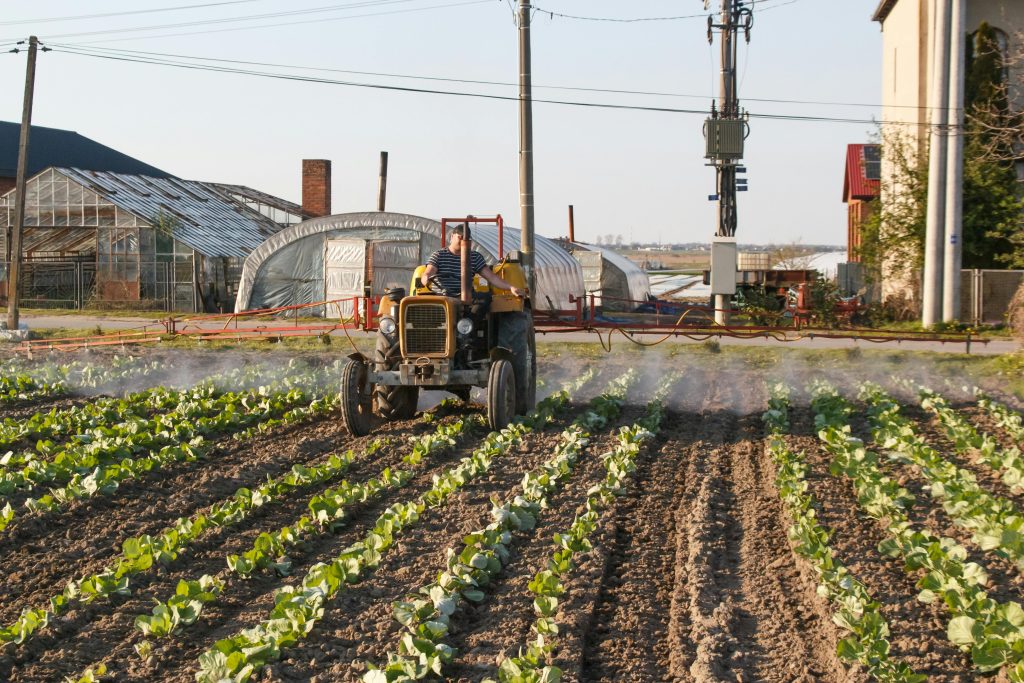
There’s a point in early spring where everything looks like it should be working, but the crop hasn’t quite responded yet.
The ground is workable. Moisture is there. Temperatures are trending upward. But emergence feels uneven, early growth lacks consistency, and fields don’t always respond the way they should. April has a way of creating that disconnect between expectation and reality.
A lot of it comes back to balance.
Not just in the fertilizer itself, but in how nutrients interact with soil conditions that are still stabilizing. Early in the season, it’s rarely a single nutrient deficiency that limits growth. It’s usually a combination of restricted availability, uneven soil conditions, and timing mismatches.
This is where balanced fertility becomes more important than trying to target one specific nutrient too early.
In April, soils are still transitioning from winter patterns. Microbial activity is increasing, but not yet at full capacity. Nutrients may be present in the soil, but not all are available at the same time. Moisture patterns can shift quickly, affecting how nutrients move and where they settle.
Under those conditions, applying a single-nutrient fertilizer often solves less than expected.
A crop may respond in one area while lagging in another, not because the fertilizer is ineffective, but because the system it’s entering is still uneven.
Balanced fertilizers help stabilize that system.
When nutrients are applied together in proportion, the plant is less likely to be limited by a single factor during early development. Instead of pushing one function, balanced fertility supports multiple processes at once.
This becomes especially important during establishment.
- Roots are developing but still limited in reach
- Nutrient uptake is influenced by temperature and moisture
- Soil variability affects how nutrients behave across the field
In that environment, balance reduces the risk of early-stage bottlenecks.
But balance in April is not just about NPK ratios.
It also includes how nutrients are made available.
Liquid and biologically active fertilizers begin to play a more visible role during this period, particularly where soils are slower to respond.
Products like Supply Solutions Pacific Bounty Fish Fertilizer fit into this window because they contribute more than just nutrient content.
Fish-based fertilizers provide a combination of:
- Readily available nutrients in smaller amounts
- Organic compounds that support microbial activity
- Trace elements that contribute to early plant development
In April conditions, where soil biology is still ramping up, that combination helps bridge the gap between what the soil can supply and what the crop needs to establish.
Rather than replacing a base fertilizer program, inputs like this work alongside it, supporting early activity in the root zone.
This is particularly noticeable in fields where soil feels slow to respond.
Even when nutrients are present, early growth may lag due to limited biological activity. Supporting that system early allows nutrients to become more available as conditions improve.
At the same time, improving nutrient efficiency becomes just as important as nutrient supply.
This is where products designed to enhance uptake begin to fit into April programs.
Materials like Supply Solutions Humic Acid Soil Conditioner are often used to improve how nutrients interact with the soil.
Humic substances influence several early-season processes:
- Increasing nutrient availability from both soil reserves and applied fertilizers
- Improving soil structure, allowing better root movement
- Enhancing water retention in lighter soils and drainage in heavier soils
In early spring, when nutrients can be present but not fully accessible, improving availability often has more impact than increasing application rates.
That’s where balance extends beyond just the fertilizer blend.
It becomes a combination of:
- Nutrients supplied
- Nutrients made available
- Conditions that allow roots to access them
This layered approach tends to produce more consistent results than relying on a single input to do everything.
Field variability reinforces this idea.
In April, differences across a field become more visible as conditions change. Some areas may warm faster, others may remain cooler. Moisture distribution is rarely even, and soil types influence how quickly nutrients move.
A balanced approach helps manage that variability.
- Nutrients are available across multiple functions
- Soil conditions are supported, not just supplemented
- Root development is encouraged rather than forced
Trying to correct early-season variability with targeted fertilizers often leads to uneven responses. Supporting the system as a whole tends to create more consistent establishment.
There’s also a timing element that makes balance more important in April than later in the season.
Once crops begin active growth, nutrient demand becomes more defined. Nitrogen demand increases, and targeted applications become more effective. But early in the season, demand is spread across multiple processes.
Focusing too heavily on one nutrient during that period can create imbalances that show up later.
For example:
- Excess nitrogen early can outpace root development
- Limited phosphorus can restrict establishment even when nitrogen is present
- Insufficient potassium can affect water regulation as conditions shift
Balanced fertility reduces the risk of these mismatches.
It allows the crop to develop steadily until conditions support more aggressive growth.
As the season progresses, that balance can shift.
Nitrogen applications may increase as vegetative growth accelerates. Specific nutrient needs may become more apparent based on crop type and field conditions. But those adjustments are more effective when they build on a stable early foundation.
April is where that foundation is set.
Using a combination of balanced fertilizers and supporting inputs like Supply Solutions Pacific Bounty Fish Fertilizer and Supply Solutions Humic Acid Soil Conditioner allows growers to address both nutrient supply and nutrient availability at the same time.
This approach reflects how soils actually behave in early spring.
It acknowledges that not everything is fully active yet, and it works with that reality instead of trying to force rapid change.
Balanced fertility in April is less about maximizing growth immediately and more about removing the limitations that prevent growth from happening evenly.
That difference often becomes visible later, when crops establish more uniformly and respond more predictably to additional inputs.
Supply Solutions works with growers to build fertilizer programs that reflect these early-season dynamics, combining nutrient sources with soil-supporting inputs to improve overall efficiency.
As you move through April, focus on how nutrients are working together rather than how much of any single nutrient is being applied. Using products like Supply Solutions Pacific Bounty Fish Fertilizer to support early biological activity, along with inputs like Supply Solutions Humic Acid Soil Conditioner to improve nutrient availability, can help create a more balanced system during this transitional period.
Always review product labels before application, and if you need guidance on how to structure your fertilizer program for early-season conditions, reaching out to Supply Solutions can help ensure your approach supports steady, efficient crop development from the start.