
Uncategorized
How to Read a Fertilizer Grade: What N-P-K Numbers Actually Tell You
Walk into a fertilizer warehouse, farm supply store, greenhouse, or garden center and the first thing most people notice on a fertilizer bag is a
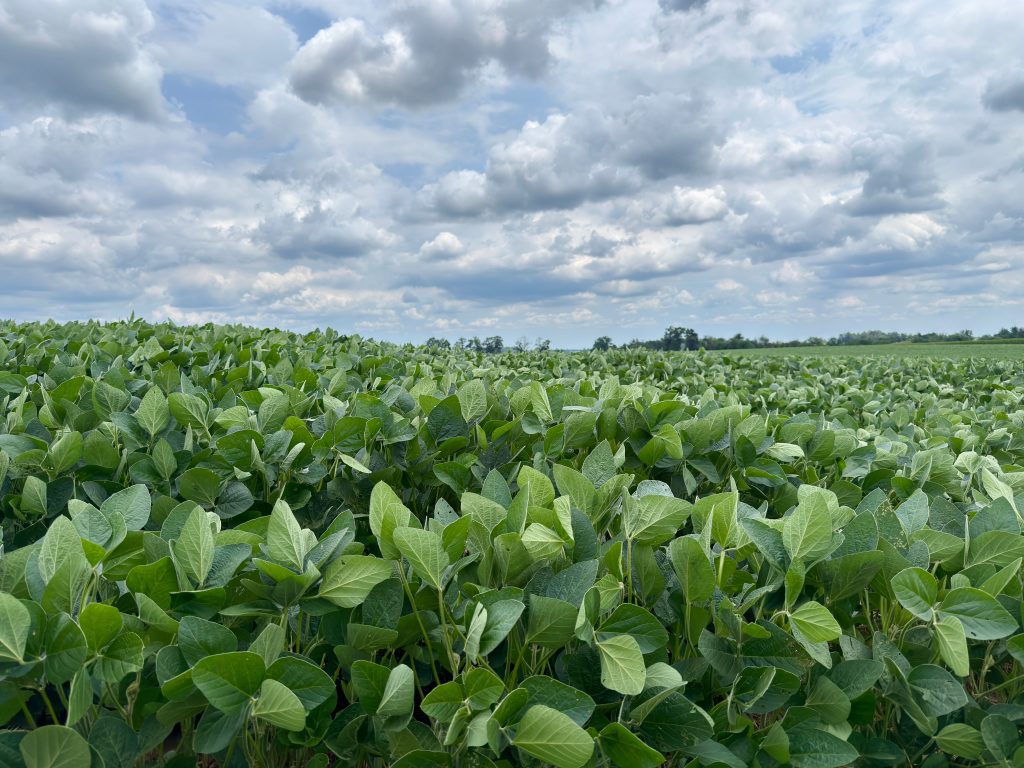
Potassium deficiency often becomes much more noticeable when August turns hot and dry.
Corn leaves may begin yellowing along the margins before those edges eventually turn brown. Soybean leaflets can develop similar yellowing around the outside edge. In severe areas, the canopy can appear burned while nearby portions of the field remain green.
The obvious conclusion is that the soil needs potassium.
Sometimes that conclusion is correct.
Sometimes it is not.
Potassium is one of the nutrients most strongly affected by the interaction among soil moisture, root development, soil structure, and actual soil-test fertility. A plant can show potassium-deficiency symptoms even when a soil test indicates that plenty of K is present.
That makes August an important time to diagnose what the crop is experiencing rather than simply reacting to leaf color.
Current 2026 conditions make that lesson particularly relevant. Iowa State Extension reported sharply variable August rainfall, with some areas receiving beneficial precipitation while other fields continued experiencing moisture stress. Corn was progressing rapidly through dough and dent, while soybeans were in important pod- and seed-filling stages.
In Minnesota, Extension specialists were still reporting dry or very dry conditions in portions of the state late in August and reminding growers that corn and soybean crops can continue using meaningful amounts of water before maturity.
When soil moisture becomes limiting during those reproductive stages, potassium uptake can become limiting as well.
Potassium plays several important roles in corn and soybean physiology. It contributes to enzyme activation, water regulation, movement of carbohydrates, stomatal function, and numerous other processes necessary for normal growth.
However, a plant cannot use potassium simply because K exists somewhere in the soil profile.
The nutrient has to reach an active root.
Much of the potassium reaching the root surface moves through diffusion. As roots remove potassium from the soil immediately around them, more potassium must move from areas of greater concentration toward that depleted zone.
Moisture is necessary for that movement.
As soil dries, the water films surrounding soil particles become thinner and less connected. Potassium movement slows. Root activity in dry soil also declines, reducing the amount of soil the crop can explore effectively.
Iowa State Extension has repeatedly documented this relationship and notes that dry topsoil can produce potassium-deficiency symptoms even when soil-test K levels and previous fertilizer applications appear adequate.
The plant may truly be potassium deficient at that moment, but the deficiency may be caused by lack of access rather than lack of potassium in the soil.
Because potassium is mobile within the plant, true deficiency usually appears first in older corn leaves.
The symptom commonly begins near the tip of the leaf and spreads down the margins. Yellow tissue eventually becomes brown and necrotic as the deficiency progresses, while the central portion of the leaf may remain greener for a time.
This pattern is different from classic nitrogen deficiency, which generally produces V-shaped yellowing extending from the tip down the midrib.
Iowa State notes that corn potassium demand increases rapidly after approximately the V6 stage, which helps explain why symptoms may become more obvious once crop demand rises.
By August, the crop has accumulated substantial biomass and potassium demand has already been high for weeks. Weak areas that managed to remain visually acceptable earlier can become much more obvious once drought, grain fill, or restricted root activity increases stress.
In soybeans, potassium deficiency generally causes yellowing around leaflet margins. As deficiency worsens, the margins can become brown and necrotic.
Earlier in the season, symptoms are commonly associated with older leaves.
However, late-season soybean K deficiency can appear higher in the canopy. Iowa State has documented upper-leaf symptoms during reproductive stages, particularly in low-testing or drought-affected soils.
That creates an important diagnostic challenge because several soybean diseases can also produce yellow or brown areas in the canopy during August.
Sudden death syndrome, brown stem rot, and other diseases should not be confused with fertilizer problems. Stem discoloration, root condition, lesion pattern, field distribution, and laboratory diagnosis may be necessary when the cause is uncertain.
A fertilizer application will not correct a disease, and treating the wrong problem can waste money while the actual cause goes unmanaged.
Potassium uptake requires an active root system capable of exploring enough soil.
Anything that restricts rooting can therefore reduce K uptake.
Compaction is one of the most common examples. Dense soil can reduce pore space, limit oxygen, restrict root penetration, and reduce water infiltration. Iowa State Extension specifically lists reduced potassium uptake among the nutrient problems associated with soil compaction.
Sidewall compaction at planting can also restrict roots months before visible symptoms appear. Rootworm feeding can reduce effective root mass in corn. Root diseases can limit both corn and soybean uptake. Herbicide injury or other plant stress can further reduce root activity.
This is why potassium deficiency sometimes appears in regular field patterns.
Headlands may be worse because of traffic.
Wheel tracks may show stress.
Eroded slopes may have thinner topsoil and less available moisture.
Sandy zones may dry faster.
Poorly structured areas may produce shallower roots.
When the symptom follows one of those patterns, a blanket fertilizer rate across the entire field is unlikely to be the most precise response.
One of the most important points in potassium management is that drought-induced K symptoms do not necessarily improve simply because more K is applied.
Iowa State Extension has specifically cautioned that potassium applied to soil or foliage during drought may not improve uptake when soil moisture is the primary limitation.
That makes physiological sense.
If the soil is too dry for potassium to move effectively and roots are not actively exploring the treated zone, adding more fertilizer does not correct the delivery system.
Rainfall or irrigation may improve uptake much more quickly than another K application where soil-test K is already adequate.
This does not mean potassium is unimportant during drought. Adequate K nutrition supports normal plant water regulation and many metabolic processes. A crop that is genuinely potassium deficient is dealing with an additional stress that could have been avoided.
However, adequate potassium nutrition and emergency potassium application are two different concepts.
Potassium should be in the soil at appropriate levels before severe stress arrives.
When August symptoms appear, review recent soil-test results before deciding how to respond.
Consider the soil-test category, the age of the sample, the yield history since sampling, and how much potassium has been removed through harvested crops.
A field that tested very low or low and has received limited K fertilizer presents a fairly straightforward fertility concern.
A field that tested high, received an appropriate potassium application, and only developed symptoms after several weeks of drought requires a more cautious interpretation.
Sampling strategy also matters.
A whole-field composite can hide areas with very different fertility levels. Eroded slopes, old livestock areas, former manure application zones, and differences in soil texture can create substantial K variability.
If symptoms are clearly concentrated in certain areas, plan to sample those areas separately after harvest.
A field that tested adequately several years ago may not remain adequate forever.
Crops remove potassium at harvest. High-yielding crops remove more nutrients than lower-yielding crops, and repeated production without sufficient replacement can gradually reduce soil-test K.
Soybean and corn grain remove potassium, although forage crops generally remove even larger amounts because much more plant material leaves the field.
That is why fertilizer history should be evaluated alongside yield history.
If yields have increased but potassium applications have remained unchanged for a decade, the old program may no longer match the amount of nutrient leaving the farm.
August symptoms can be an early warning that a field has moved into a more responsive soil-test category.
When soil testing confirms inadequate potassium and the fertility program does not need additional nitrogen or phosphorus, Supply Solutions Sulfate of Potash 0-0-50 provides a concentrated potassium source.
The reason to use it is to correct a confirmed potassium shortage. The appropriate timing depends on the cropping system, soil conditions, regional recommendations, and how soon the crop needs access to the nutrient.
For mature corn or soybeans already well into August reproductive development, an immediate broadcast application should not be assumed to restore yield that has already been lost. In many situations, the better approach is to use the visible deficiency as a guide for postharvest soil sampling and then correct low K before the next crop reaches peak nutrient demand.
The problem Sulfate of Potash solves is inadequate potassium fertility. It should not be presented as a treatment for drought itself.
That difference keeps the recommendation agronomically sound.
Some soils have multiple nutrient limitations.
Where soil or tissue testing shows that potassium, magnesium, and sulfur are all needed, Supply Solutions 0-0-22 Pro-Mag Trio provides all three nutrients without adding nitrogen or phosphorus.
The reason to use a multi-nutrient product is not simply that supplying more nutrients sounds better.
It should be selected because the specific nutrient combination matches the field.
Magnesium is central to chlorophyll and several metabolic processes, while sulfur supports amino acid and protein formation. Both can limit crop growth under the right soil conditions. If the soil already contains adequate magnesium and sulfur, however, there is little agronomic reason to pay for those nutrients merely because potassium is needed.
This is why product selection should follow diagnosis rather than precede it.
Plant tissue testing is sometimes useful when visual symptoms are difficult to interpret.
However, drought changes both plant growth and nutrient uptake, which can make tissue concentrations harder to interpret.
When growth slows dramatically, the concentration of certain nutrients in the remaining tissue can rise even though total nutrient uptake is low. Other nutrients may decline because the roots are unable to acquire them.
Iowa State cautions that drought and excess moisture can both complicate tissue-test interpretation and recommends using plant analysis together with soil tests and field observations rather than treating tissue numbers as standalone answers.
If tissue samples are collected, compare affected plants with nearby healthy plants of the same growth stage. Follow the laboratory’s sampling instructions carefully so that the same plant part is collected in both areas.
The comparison often provides more useful information than one isolated sample from a damaged patch.
If dry weather is causing the uptake restriction, rainfall may change what the crop does next.
Leaves that are already brown will not recover, but new tissue and less severely affected leaves may function more normally once moisture returns.
If symptoms stop progressing after rainfall and the field has adequate soil-test K, drought-induced deficiency becomes more likely.
If symptoms continue spreading despite restored moisture, a true fertility shortage, root problem, disease, or other limitation deserves closer investigation.
The crop’s response to changing conditions becomes part of the diagnosis.
Drought can influence postharvest soil-test potassium.
Iowa State has noted that dry soil conditions can temporarily affect soil-test P and K values and that potassium tends to be particularly sensitive to these changes.
That does not make fall soil testing useless after drought.
It means results should be interpreted alongside weather and previous soil-test history.
Use consistent sampling depths. Try to sample at a similar time of year from one sampling cycle to another. If an unexpected result appears dramatically different from previous tests and does not fit crop response, a confirmation sample may be justified before making a major fertilizer investment.
A stressed crop often reveals field variability better than a comfortable crop.
Low-testing zones become visible.
Compaction shows itself.
Eroded slopes behave differently.
Root injury becomes more consequential.
Drought-prone soils reveal where water availability and nutrient uptake fail first.
Those observations should be recorded while the differences are obvious.
Map affected zones and compare them with the yield monitor at harvest. Then soil sample those areas separately.
If low soil-test K and reduced yield consistently line up with the August symptoms, the case for correcting potassium becomes much stronger.
If soil K remains adequate while compaction or drought explains the pattern, the correct investment may lie elsewhere.
Potassium management works best when growers separate a plant shortage from a soil shortage. August leaf margins can tell you that the plant is struggling to obtain K, but they cannot tell you why without additional investigation. When soil testing confirms that potassium itself is limiting, Supply Solutions Sulfate of Potash 0-0-50 offers a targeted way to build K fertility, while Pro-Mag Trio can fit fields that also need magnesium and sulfur. Supply Solutions can help growers select the appropriate source, but the strongest recommendation begins with the soil, the roots, and the field pattern rather than the color of a single leaf.
Walk into a fertilizer warehouse, farm supply store, greenhouse, or garden center and the first thing most people notice on a fertilizer bag is a
When fertilizer prices are high, farmers naturally want every pound of nutrient they purchase to contribute as much as possible to crop production. That makes
Give us a call or visit our store, and we’ll help you find the right solution for your business.