

Uncategorized
How to Read a Fertilizer Grade: What N-P-K Numbers Actually Tell You
Walk into a fertilizer warehouse, farm supply store, greenhouse, or garden center and the first thing most people notice on a fertilizer bag is a
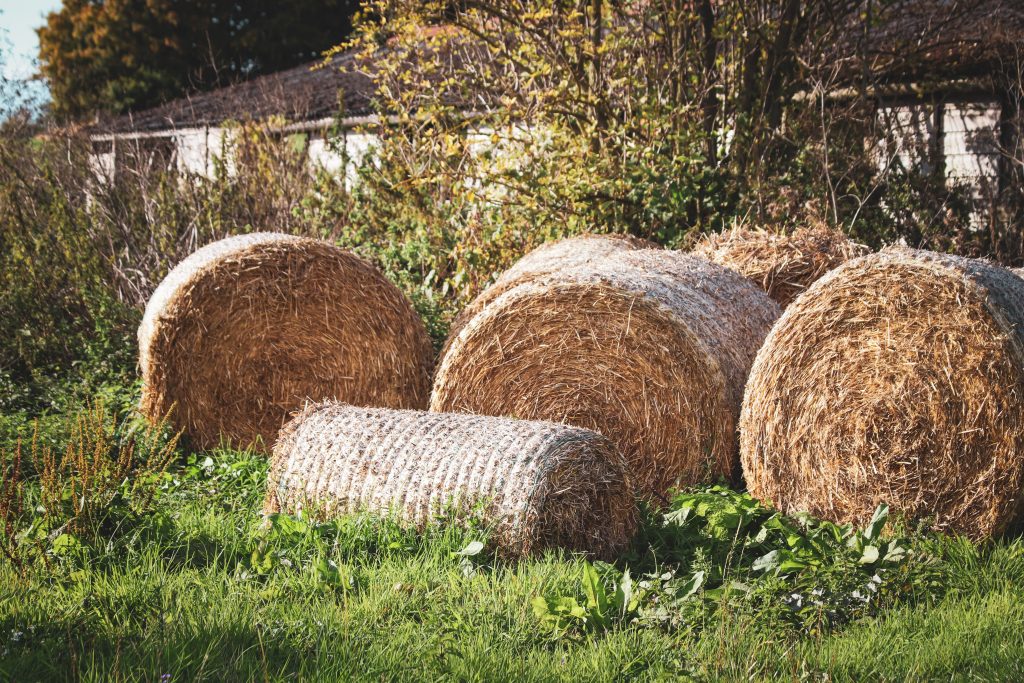
Every load of grain leaving a field carries more than corn, soybeans, or wheat to the elevator. It also carries nutrients that originally came from the soil and fertilizer program. The same is true for every bale of hay hauled to another farm, every load of corn silage placed in a bunker, and every ton of crop residue removed from a field.
That nutrient movement is easy to overlook because it happens gradually. A field does not suddenly become potassium deficient after one good soybean crop, and a productive hayfield does not normally collapse after one cutting. Over several seasons, however, consistently removing more phosphorus or potassium than the fertility program replaces can draw soil-test levels downward.
The opposite can happen as well. Applying a standard “replacement” rate every year without considering soil-test levels can continue building phosphorus or potassium in a field that already has more than enough to support the crop.
This is why crop removal belongs in the fertility conversation, but it should not be treated as a simple bookkeeping formula. Nutrient removal provides useful information about what leaves the field. Soil testing tells farmers much more about whether the soil is likely to respond to additional fertilizer.
The strongest fertility decisions use both.
This distinction is particularly important as growers prepare for fall fertility decisions following the 2026 crop. Iowa State University Extension’s current phosphorus and potassium guidance emphasizes that crop removal and soil-test trends are related over the long term, but that year-to-year changes are influenced by rainfall, nutrient recycling from residue, and changes among different soil nutrient pools. Extension specialists caution against making large fertilizer changes based on one unusual yield or one unusual soil-test value without considering longer-term trends.
Farmers should therefore understand nutrient removal well enough to use it as context rather than turning every harvested bushel into an automatic fertilizer bill.
One of the most important distinctions in fertility management is the difference between nutrient uptake and nutrient removal.
Crop uptake refers to all of the nutrients contained in the plant during growth. That includes nutrients in grain, leaves, stalks, stems, roots, pods, and other tissues.
Crop removal refers only to the nutrients physically taken away from the field when a harvested product leaves.
The difference can be substantial.
A corn plant may accumulate a large amount of potassium during the growing season, but much of that K remains in leaves and stalks after grain harvest. When the residue stays in the field, a large share of the potassium contained in that residue can eventually return to the soil as plant material decomposes and rainfall leaches soluble K from the tissue.
If that same corn crop is harvested as silage, most of the aboveground plant is removed. The field therefore loses considerably more potassium than it would have lost from grain harvest alone.
Soybeans provide another useful example. Iowa State data illustrate that nutrients are present in both soybean grain and vegetative tissue. At a 50-bushel yield in the example data, the soybean grain contains substantially more potassium than the grain of many crops, while additional K remains in stems and other residue. If only the beans leave the field, much of the nutrient contained in the residue stays behind.
This is why nutrient budgeting cannot be based only on what the crop absorbed during the season.
A plant may take up a nutrient and later return much of it to the soil through residue. Fertility planning should focus much more closely on what is actually exported from the field.
Grain systems often allow a substantial amount of crop residue to remain in the field.
Corn grain harvest removes the ear and grain while leaving stalks, leaves, husks, and roots behind. Soybean harvest removes the seed while leaving stems, pods, and roots. Small-grain harvest normally removes grain but may leave straw unless it is baled.
Because much of the vegetative material remains, nutrient removal per acre is considerably different from systems where nearly the entire aboveground crop is harvested.
Penn State nutrient-management data provide a useful illustration. Their typical removal estimates list corn grain at approximately 0.4 pound of phosphate, expressed as P₂O₅, and 0.3 pound of potash, expressed as K₂O, per bushel. A 150-bushel crop in that example removes about 60 pounds of P₂O₅ and 45 pounds of K₂O per acre in harvested grain.
Those values should not be treated as universal constants for every farm. Grain nutrient concentration varies with genetics, soil fertility, environment, yield level, and other factors.
University of Minnesota Extension analyzed a large set of corn and soybean grain samples and found meaningful variation in actual phosphorus and potassium concentrations. Extension specialists specifically caution farmers against treating removal coefficients as though every bushel carries exactly the same amount of nutrient.
The practical lesson is that removal estimates are useful planning tools, but they are still estimates.
They are most valuable for understanding long-term nutrient movement rather than calculating a supposedly exact fertilizer replacement for every individual crop.
Soybeans deserve particular attention in potassium budgets.
A strong soybean crop removes considerable potassium in the harvested seed. Penn State’s typical nutrient-removal values estimate approximately 1.4 pounds of K₂O and 1 pound of P₂O₅ per bushel of soybean yield. Using those figures, a 50-bushel soybean crop would remove about 70 pounds of K₂O per acre.
Actual values vary, and regional recommendations should always be used when planning fertilizer. Still, the comparison helps explain why potassium soil-test levels can decline over time in high-yielding corn-soybean rotations when K applications do not keep pace with soil-test needs.
A farmer can easily focus most fertilizer attention on nitrogen because corn responds visibly and dramatically to N. Potassium drawdown is often quieter. Soil K can decline gradually over several rotations before symptoms become obvious.
Once a field moves into a responsive soil-test category, crops may begin showing marginal leaf yellowing, premature senescence, weaker drought performance when true K deficiency is present, or other symptoms associated with inadequate potassium nutrition.
This is why soybean yields belong in the potassium discussion after harvest.
A field producing strong soybean yields year after year can export substantial K even though the crop does not receive the same fertilizer attention as corn.
If grain harvest is a relatively selective nutrient export, hay harvest is much closer to a whole-plant removal system.
Leaves and stems are cut, dried, baled, and removed from the field. Nutrients that would otherwise return to the soil through residue decomposition leave with every ton of forage.
Potassium is particularly important.
Penn State Extension estimates that many perennial forage crops remove approximately 45 to 60 pounds of K₂O per ton of hay equivalent, depending on forage species. Their maintenance guidance lists alfalfa at roughly 50 pounds of K₂O per ton and cool-season grasses at approximately 45 pounds per ton.
Consider what that means in a productive field.
A five-ton alfalfa crop using Penn State’s typical values would remove about 250 pounds of K₂O per acre in the harvested forage. The same example removes approximately 75 pounds of P₂O₅ per acre.
Those are substantial nutrient exports.
This explains why forage fields that produce well for several years can experience rapid declines in soil-test potassium if fertility is not monitored.
The field may have started with a comfortable K reserve, but every cutting removes another portion of that reserve from the farm.
This also explains why fertilizer programs designed for grain fields cannot simply be transferred unchanged to hay production. The amount of plant material leaving the field is completely different.
High-yielding bermudagrass hay production provides one of the clearest examples of potassium removal.
University of Georgia forage specialists note that each ton of bermudagrass hay can contain the equivalent of more than 40 pounds of K₂O. Productive bermudagrass systems may produce many tons per acre, resulting in very large seasonal K removal. UGA specifically identifies potassium deficiency as a frequent concern in intensively hayed bermudagrass because of this nutrient export.
The key word is hayed.
A grazed bermudagrass pasture behaves differently because livestock consume forage and return a large portion of the nutrients through manure and urine. Distribution may be uneven, especially around shade, water, and feeding areas, but much less potassium permanently leaves the pasture compared with a system where every cutting is baled and sold.
This difference has major fertility implications.
Two neighboring bermudagrass fields can have similar yield potential and completely different potassium requirements simply because one is grazed and the other is harvested repeatedly for hay.
The soil test needs to reflect that management history.
Grazing systems are sometimes discussed as though livestock “remove” all of the fertility contained in the grass they eat.
In reality, a large portion of the nutrients consumed by grazing animals returns to the pasture through manure and urine. Only the nutrients contained in animal weight gain, milk, wool, or animals physically sold from the farm represent permanent exports.
Penn State illustrates this difference with a comparison between hay production and grazing. Their example shows that harvesting cool-season grass hay can remove large quantities of nitrogen, phosphorus, potassium, calcium, magnesium, and sulfur, while nutrient export in livestock products is much smaller.
This does not mean grazed pasture never needs fertilizer.
Nutrients can still be lost through leaching, runoff, volatilization, erosion, or animal movement. Nutrient return is also uneven because livestock concentrate manure and urine in certain areas.
However, the overall fertility budget differs significantly from a hayfield where every bale physically carries nutrients away.
For farmers managing both hay and grazing acres, soil tests should be interpreted according to how each field is actually used rather than assuming that all forage ground has the same maintenance requirement.
Crop residue has value beyond organic matter and soil protection. It also contains nutrients.
When corn stalks are baled for bedding, feed, or sale, phosphorus and potassium that would normally remain in the field leave with the residue.
Iowa State estimates that corn stover contains approximately 4.8 pounds of P₂O₅ and 18 pounds of K₂O per ton of residue removed. In its example, removing 1.8 tons of corn stalks per acre exports an additional 8.6 pounds of P₂O₅ and more than 32 pounds of K₂O per acre beyond what already left in the grain.
That additional nutrient removal should be considered when planning long-term fertility.
The same principle applies to soybean residue, wheat straw, and other crop residues that are harvested rather than left on the field.
Nutrient removal is not the only concern with residue harvest. Removing large amounts of residue can also affect erosion protection, soil organic carbon inputs, soil moisture, and long-term soil physical properties.
A farmer therefore should not look at the fertilizer replacement cost alone when deciding whether residue should leave the field.
However, if residue is removed, the nutrients leaving with it belong in the fertility budget.
Farmers who sell hay often think primarily about the value of the forage itself. Fertility replacement needs to be part of the selling-price calculation.
Penn State Extension notes that grass hay can remove large amounts of nitrogen, potassium, and phosphorus in each ton of dry matter harvested. Using fertilizer prices available at the time of its analysis, Penn State estimated that the nutrients contained in each ton of hay represented meaningful fertilizer value.
The exact dollar value changes with fertilizer markets.
The agronomic principle does not.
A buyer purchasing hay is not merely purchasing fiber, protein, and energy. Nutrients that came from the seller’s soil are also leaving the field.
If the hay price does not account for the cost of maintaining that soil fertility over time, a producer can gradually mine the field while believing the hay enterprise is profitable.
This is particularly important for potassium because forage removes so much of it.
The cost of producing hay should therefore include not only mowing, conditioning, raking, baling, storage, and transportation, but also the long-term fertility required to keep the stand productive.
At this point, nutrient budgeting can sound deceptively simple. If the crop removes 70 pounds of K₂O, apply 70 pounds of K₂O. If hay removes 200 pounds, apply 200 pounds.
That approach can be useful in certain maintenance programs, but it should not be treated as a universal rule.
Soil fertility is not a checking account where every pound withdrawn must immediately be deposited again.
University of Minnesota Extension specifically cautions against treating removal-based P and K strategies with that level of precision. Actual grain nutrient concentration varies, and soils contain reserves that are not represented perfectly by a single soil-test value.
Iowa State’s current 2026 guidance makes a similar point. Long-term crop removal is related to changes in soil-test phosphorus and potassium, but the relationship is not precise from one year to the next because rainfall, residue recycling, and equilibrium among soil nutrient pools create substantial short-term variation.
This is why soil testing remains the foundation.
If soil-test potassium is already high, automatically replacing every pound removed may keep building or maintaining a nutrient reserve that provides little immediate economic return.
If soil-test K is low, simply replacing this year’s removal may not be enough to correct the deficiency.
The fertilizer recommendation needs to reflect both the existing soil reserve and the crop’s nutrient removal.
A low soil-test value means the soil has a greater probability of producing a yield response to fertilizer according to the calibration system used by the farmer’s state.
In that situation, merely replacing what the current crop removed may leave the field at the same inadequate fertility level.
If the objective is to improve soil fertility, the recommended application may include enough nutrient to support crop production while gradually increasing soil-test values toward the desired range.
The exact rate and strategy depend on the state’s recommendation system.
Some regions emphasize sufficiency approaches, where fertilizer is focused primarily on what the crop needs for the next growing season. Others use build-and-maintain concepts where low-testing soils receive additional nutrient to increase soil-test levels over time.
Farmers should follow the calibrated recommendation used in their region rather than assuming one philosophy applies everywhere.
What matters is understanding that crop removal alone cannot tell you whether the soil is deficient.
A 200-bushel corn crop removes nutrients regardless of whether the field began the season low, optimum, or high in soil-test potassium.
The soil test determines whether that removal represents a problem that needs immediate correction.
The other side of the fertility budget is equally important.
A field testing high in phosphorus or potassium may be able to support several crops without fertilizer for that nutrient while soil-test levels gradually decline.
Iowa State’s 2026 P and K guidance specifically notes that high-testing soils can provide opportunities to reduce or withhold fertilizer when nutrient prices are unfavorable because the probability of a yield response is low. Extension specialists recommend following long-term soil-test trends rather than assuming every pound removed must immediately be replaced.
This is not the same as mining the soil indefinitely.
Eventually, continued crop removal will lower soil-test levels enough that fertilizer response becomes more likely.
Regular soil sampling tells the farmer when that point is approaching.
The advantage is flexibility. During years when fertilizer prices are high or cash flow is tight, already high-testing fields can sometimes provide room to redirect fertilizer dollars toward more responsive acres.
That is a more precise strategy than reducing every field by the same percentage.
Preseason fertilizer plans often use expected yield because actual production is unknown.
After harvest, the farmer has better information.
A drought-affected corn crop that produced 130 bushels per acre did not remove the same amount of nutrients in grain as the 220-bushel crop originally expected.
Likewise, a soybean field that exceeded its historical average may have exported more potassium than the fertility plan anticipated.
Using actual harvest data improves removal estimates.
Yield-monitor information can refine the calculation even further because nutrient export rarely occurs uniformly across the field. High-yielding areas remove more grain nutrients than poor areas.
However, one season’s yield should not dictate a major fertilizer change by itself. Iowa State’s current guidance warns that unusually high or low annual yields can create misleading conclusions when growers react too strongly instead of looking at prevailing yield levels and long-term soil-test trends.
A better approach is to combine the current harvest with several years of production history.
This is particularly useful in variable-rate fertility programs, where management zones can be evaluated according to both soil-test status and realistic long-term productivity.
A farmer might reasonably expect soil-test potassium to decline by a predictable amount after a large crop removes substantial K.
In practice, year-to-year changes are much less predictable.
Rainfall affects how quickly potassium is released from residue. Soil moisture influences exchange among different K pools. Drying and rewetting affect clay minerals differently depending on soil type.
This is why a field can produce a large crop without showing the expected immediate decline in soil-test K, while another year may produce an unexpectedly low test after drought.
Iowa State’s long-term research indicates that soil-test trends make more sense over several years than they do when farmers try to match one year’s crop removal with one year’s soil-test movement.
This does not reduce the value of removal estimates.
It changes how they should be used.
Crop removal explains the direction of nutrient export. Soil testing measures whether the field is moving toward a responsive range. Weather and soil processes explain some of the noise between those two measures.
The fertility decision should account for all three.
Phosphorus is important in forage production, but potassium often becomes the nutrient that surprises producers because of the quantity removed.
Penn State estimates that alfalfa can remove about 50 pounds of K₂O per ton of hay equivalent. A productive five-ton field could therefore export approximately 250 pounds of K₂O per acre in one season.
A grower who harvests that kind of production repeatedly without monitoring K may see soil-test levels decline quickly.
Adequate potassium is important for normal plant water regulation, carbohydrate movement, enzyme function, and stand performance. In alfalfa and many forage crops, maintaining appropriate K fertility also becomes part of supporting persistence and stress tolerance.
However, growers should resist the opposite mistake of assuming that every hayfield requires enormous annual potassium rates.
Penn State provides an example where a field with sufficiently high soil-test K may receive no fertilizer K recommendation even though the hay crop removes a large amount of potassium, because the existing soil reserve remains above the desired range.
Again, soil testing determines whether removal needs immediate replacement.
When soil testing shows that potassium needs to be supplied and the crop is suitable for a chloride-containing potassium source, Supply Solutions Muriate of Potash 0-0-60 provides a concentrated K fertilizer without adding nitrogen or phosphorus. Supply Solutions lists the product as a 0-0-60 potassium source, making it useful where potassium is the nutrient the fertility program needs to address.
The reason to use a concentrated potassium source in a high-removal system is that repeated harvest can draw soil-test K downward when fertilizer and soil reserves do not keep pace. Hayfields, silage ground, and high-yielding grain rotations are examples where potassium export deserves close attention.
Application timing should still follow soil testing, soil type, crop needs, and regional recommendations. In intensively hayed fields, large seasonal potassium needs are sometimes divided among multiple applications rather than placing the entire amount on at once. UGA forage specialists specifically recommend split K applications in heavily harvested bermudagrass systems to support nutrient management and reduce the risk of excessive uptake.
The problem Muriate of Potash solves is inadequate potassium fertility. It should not be applied simply because a field produced a lot of hay. A productive field that still tests high in K may not require the same rate as an equally productive field that has already moved into a deficient soil-test category.
That is why yield and removal should inform the recommendation rather than replace the soil test.
Not every crop or soil situation is best served by the same potassium source.
Where soil testing confirms a K requirement but the cropping system calls for a sulfate-based or lower-chloride potassium source, Supply Solutions Sulfate of Potash 0-0-50 provides another option. Supply Solutions lists it as a high-potassium fertilizer within its agricultural product line.
The reason to consider sulfate of potash is not that it contains a longer list of benefits than another fertilizer. The decision should come from crop sensitivity, chloride considerations, sulfur management, soil characteristics, economics, and the actual K requirement.
For broad-acre corn, soybean, and many forage systems, muriate of potash is commonly used when it fits the agronomic situation. For crops or environments where chloride management deserves more attention, sulfate-based potassium may provide a better fit.
The important part of the decision comes first: determine whether potassium needs to be applied at all.
Product selection follows that diagnosis.
Corn stalks are sometimes treated as a free byproduct after the grain has been harvested.
They are not free from a fertility standpoint.
Every bale contains phosphorus and potassium that would otherwise remain in the field. Iowa State estimates around 18 pounds of K₂O per ton of corn stover removed, along with approximately 4.8 pounds of P₂O₅.
The economic value of those nutrients changes with fertilizer prices, but the removal occurs regardless of price.
Farmers selling stalk bales should therefore consider both the baling revenue and the cost of replacing nutrients over time. Soil protection and organic matter also belong in the calculation, particularly on erosion-prone soils.
Residue removal can make sense in certain systems, especially where livestock needs, excessive residue, or other management goals justify it.
The important point is that the fertilizer plan should recognize what left the field.
A field where grain and several tons of residue are removed has a very different nutrient budget from a field where only the grain leaves.
Expected yield plays an important role in forage fertilizer recommendations because nutrient removal increases directly with the amount of hay harvested.
Penn State emphasizes that accurate expected-yield estimates are important when soil tests use crop removal to calculate maintenance P and K recommendations. Overestimating yield can result in excessive fertilizer recommendations, while underestimating yield can fail to account for what is actually being removed.
Forage producers should therefore use realistic production records rather than optimistic yield goals.
Bale counts can help when bale weight is known reasonably well. Weighing representative loads provides better information than assuming every round bale weighs the same.
A field that produces three tons of hay should not receive a removal calculation based on six tons simply because six tons is the desired yield.
Likewise, a field consistently producing six tons should not be managed as though it removes only three.
Fertility planning works best when expected production reflects what the field is actually capable of producing under the farm’s management.
A nutrient budget is useful, but the soil test ultimately shows whether the long-term strategy is maintaining fertility.
Suppose a farmer estimates potassium removal carefully and applies approximately the same amount each rotation. If soil-test K continues declining over several sampling cycles, the maintenance estimate or application strategy may not be keeping pace with the field.
The opposite can happen as well.
If phosphorus is steadily increasing despite removal-based applications, the farm may be applying more P than necessary to maintain the desired soil-test range.
This is why sampling every few years using consistent methods is so valuable.
The farmer does not need to calculate every nutrient pound with laboratory precision. The soil-test trend provides feedback on whether the overall fertility program is moving in the right direction.
Iowa State’s 2026 guidance encourages growers to compare current yield and soil-test results with trends over time and notes that sampling more frequently can improve management when fertilizer costs are high.
The fertilizer program should respond to those trends rather than remain unchanged for decades.
When fertilizer prices rise, the nutrients leaving the farm become more valuable.
That is particularly obvious in hay and residue sales.
A buyer may pay for a ton of hay according to forage quality and market conditions, but the seller eventually has to manage the soil fertility that produced it.
If the selling price does not account for nutrient export, the farm can slowly transfer soil fertility to another operation without recovering enough value to replace it.
The same principle applies to corn stover.
A stalk-bale price that appears attractive at first may look different once baling, labor, fuel, storage, transportation, nutrient replacement, and soil-management consequences are considered.
This does not mean hay or residue should not be sold.
It means nutrient removal belongs in enterprise budgets.
Fertilizer is part of the cost of producing another ton next season.
Crop-removal estimates are most useful when they improve the questions farmers ask about soil fertility.
If soybean yields have increased substantially over the last decade, has potassium management kept pace?
If an alfalfa field is producing five tons per acre, how quickly is it exporting K?
If corn stalks are baled every year, is the fertilizer program accounting for nutrient removal beyond the grain?
If a high-testing field has received maintenance fertilizer annually, could some applications be postponed while soil tests remain above the responsive range?
If a low-testing field receives only enough fertilizer to match current removal, is the program actually correcting the deficiency?
Those questions lead to better fertility decisions than simply multiplying yield by a removal factor and spreading the answer.
Removal estimates provide the context. Soil testing provides the response probability. Yield history shows the scale of nutrient export. Fertilizer economics determine how aggressively the farmer can maintain or build soil-test levels.
Good nutrient management brings those pieces together.
Harvest removes more than a crop from a field. Grain, hay, silage, straw, and crop residue all carry nutrients away, and high-yielding systems can export significant amounts of phosphorus and especially potassium over time. Hay production deserves particularly close attention because harvesting the entire aboveground forage removes far more potassium than grain harvest alone, while grazed systems recycle much more nutrient back to the soil.
The goal is not to replace every harvested pound automatically. Instead, farmers should use crop removal to understand the direction and scale of nutrient export while relying on regular soil testing to determine whether phosphorus or potassium is actually moving toward a responsive range. When soil testing confirms that potassium needs to be replenished, Supply Solutions Muriate of Potash 0-0-60 provides a concentrated K source for appropriate crops and soils, while Sulfate of Potash 0-0-50 offers another potassium option where the production system calls for it.
A good fertility budget should explain where nutrients are going, but the field still gets the final vote. Track what leaves in the crop, watch soil-test trends over time, and direct fertilizer toward the acres where declining fertility is most likely to limit production. Supply Solutions can help growers match the potassium source to a confirmed soil need so that nutrient replacement supports long-term productivity instead of becoming an automatic expense after every harvest.
Walk into a fertilizer warehouse, farm supply store, greenhouse, or garden center and the first thing most people notice on a fertilizer bag is a

When fertilizer prices are high, farmers naturally want every pound of nutrient they purchase to contribute as much as possible to crop production. That makes
Give us a call or visit our store, and we’ll help you find the right solution for your business.