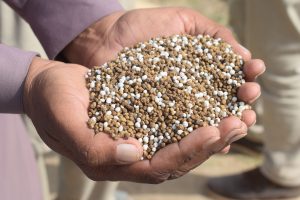
Winter is when the soil finally gets quiet enough for you to hear what it has been trying to tell you all year.
Those stacks of lab reports on the dash or kitchen table are not just paperwork. They are:
- A record of what your crops removed
- A map of where your fertility dollars are working hard, and where they are just “showing up”
- A warning light for nutrients that are slowly slipping out of the optimum range
- A hint about which fields, lawns, and beds are ready for a strong spring, and which need structural help first
The challenge is that most soil reports are written in a way that can feel more like a lab memo than a practical field guide.
This article is about turning those numbers into a clear, written plan for spring using products you already know, including:
We will look at three different situations:
- Row crop and forage farms
- Market gardens and home vegetables
- Lawns, landscapes, and orchards
The goal is simple: by the time you are done, you have a short written game plan that ties each field or area to specific products, rates, and priorities for spring.
Step 1: Sort Your Soil Tests Into “Families”
If you manage more than a few acres or beds, you probably have a pile of soil reports. The first step is not to stare at each one. It is to group them.
For each sample, jot down:
- Field or area name
- Crop grown last year
- Planned crop for next year
- A quick note: “good yield,” “mixed,” or “disappointing”
Then sort your tests into 3 “families”:
- Row crops and forages
- Corn, small grains, alfalfa, grass hay, pasture, silage fields
- Vegetables and specialty crops
- Market garden blocks, high tunnels, home vegetable beds
- Perennials and turf
- Orchards, vineyards, berries, lawns, sports fields, landscape beds
Within each family, you are usually looking for patterns more than single numbers. Often, half the fields are telling you the same story.
Step 2: Circle The “Power Trio”: pH, Organic Matter, And Structure Clues
Before you look at any single nutrient, check the foundation. For each test, circle:
- pH
- Organic matter (OM)
- Any notes about texture, CEC, sodium, or salinity
Ask three questions for each field or area.
1. Is pH in the right ballpark for what I am growing?
Very roughly:
- Most field crops and vegetables like pH in the 6.0–7.0 range
- Alfalfa prefers the upper end of that range
- Blueberries and some ornamentals like it more acidic
You are not trying to correct pH overnight, but you are trying to decide:
- Which fields are close enough that you can work with them this year
- Which ones might need lime or careful use of acidifying fertilizers over time
- Which areas need extra care with product choice so you do not make pH problems worse
Products like Supply Solutions Ammonium Sulfate 21-0-0 + 24% Sulfur are helpful on slightly high pH soils because they gently acidify the fertilizer band over time. On already acidic soils, you may lean more on other N sources or use ammonium sulfate carefully and in balance with your liming plan.
2. Is organic matter helping me, or holding me back?
Organic matter is your soil’s:
- Savings account for nutrients
- Sponge for water
- Home base for biology
If OM is low, you know:
- Nutrients move more quickly with water
- The soil may crust, compact, or “go tight” under traffic
- A bigger share of your budget should go to organic inputs and humic support
That is where 4-3-2 Nutri-Proganic Pellet and HumiPro(K) WSP become long-term tools, not luxuries.
3. Are there structural red flags?
Even if your test does not say “structure” in plain words, there are clues:
- High sodium (Na)
- Very high magnesium (Mg) relative to calcium (Ca)
- Notes about salinity or poor infiltration
Those are fields and beds that may benefit from Supply Solutions Gypsum Powder – Purest and Soluble where local guidance supports gypsum use.
Circle those tests and mark “structure work” in the margin. They will not respond to fertilizer the same as your better-structured soils until you address that bottleneck.
Step 3: Highlight The Big Four Nutrients For Spring Decisions
Once the foundation is clear, move to the nutrient section and highlight four pieces on every report:
- Phosphorus (P)
- Potassium (K)
- Sulfur (S) (if your lab reports it)
- Any notes on micronutrients that look extreme (very high or very low)
You can think of them this way:
- P helps get roots and early growth going, but is often already high in long-fertilized ground
- K quietly supports yield, stand life, and stress tolerance
- S is nitrogen’s often-forgotten partner in protein and enzyme systems
- Micros matter, but they do not usually deserve the first line of your spring budget
For each test, mark P, K, and S as:
- Low
- Borderline
- Adequate or High
Now, the pattern starts to emerge. Many farms discover that:
- P is adequate or high on most fields
- K is all over the map
- S is quietly low on many lighter or lower OM soils
Lawns and home gardens often show the same thing: generous P, mixed K, and very little attention to sulfur.
That pattern is what makes products like:
so useful: they let you feed what is actually short without stacking more phosphorus where it is not needed.
Step 4: Create A One-Line “Diagnosis” For Each Field Or Area
Now you are ready to translate numbers into plain language. For every field, bed, or managed area, write one honest sentence that starts like this:
“This field is basically… ”
For example:
- “This field is basically K-hungry with decent P and low S, on medium OM soil.”
- “This garden bed is basically high P, borderline K, low S, and light on organic matter.”
- “This lawn is basically okay on P and K, but tired, compacted, and short on sulfur.”
- “This hayfield is basically strong on P, weak on K and S, with some compaction in the lower spots.”
You do not need perfect agronomy language. You just need to be able to look at that one line and remember what matters.
That one line becomes the anchor for your spring plan.
Step 5: Match Fertility Priorities To Each “Family”
Now we start building the actual playbook, one family at a time.
A. Row crops and forages: corn, small grains, hay, pasture
Common winter soil test stories in these fields:
- P: medium to high on many acres
- K: drifting low on high-removal fields (hay, silage, grain)
- S: often low, especially on lighter soils or low OM ground
- Structure: compacted headlands, sodium or Mg issues in some fields
For each field, pair your one-line diagnosis with a short list:
- If K is low or borderline
- If S is low or borderline and the crop is N-hungry
- If P is already adequate or high
- Avoid blanket applications of complete NPK blends just because “we always do”
- Lean on products that supply N, K, and S without adding more P, such as ammonium sulfate, sulfate of potash, and Supply Solutions 7-0-26 Nitrogen Fertilizer in fertigation or fine-tuning programs
- If OM is low or structure is poor
You do not have to do everything on every field. Instead, circle the top 1–2 priorities per field and write them down:
- “Field A: correct K with sulfate of potash, use ammonium sulfate for N + S, add HumiPro(K) in low OM areas.”
- “Field B: structure work (gypsum + traffic changes), moderate N with ammonium sulfate, hold off on P.”
- “Field C (alfalfa): prioritize K with sulfate of potash, consider Nutri-Proganic and HumiPro(K) in thinned areas, minimal N.”
Those notes become your spring ordering list and application map.
B. Vegetables and specialty crops: gardens, market plots, tunnels
Soil test stories here often look like:
- P: frequently high from years of manure, compost, or complete fertilizers
- K: variable; often low in high-removal beds or raised beds
- S: rarely tracked, often low
- OM: sometimes wonderful, sometimes surprisingly low in intensively worked beds
For each vegetable bed or block, use your one-line diagnosis to choose among:
- Organic base fertility
- Where OM is low to moderate or you want to support biology, plan 4-3-2 Nutri-Proganic Pellet as a base layer
- Apply ahead of heavy feeders, lightly incorporated or banded, so it can mineralize as soils warm
- Balanced NPK for genuinely low P and K soils
- Nitrogen + sulfur for specific crops and low S soils
- Potassium for fruiting and root crops
- In beds where K tests low or borderline, especially for tomatoes, peppers, potatoes, carrots, and beets, plan Sulfate of Potash 0-0-50 Plant Fertilizer at soil-test-guided rates
- This lets you support quality and stress tolerance without adding more P
- Fine-tuning with soluble N + K
- In tunnels or irrigated systems, where fertigation is available, keep Supply Solutions 7-0-26 Nitrogen Fertilizer in mind for in-season adjustments when soil P is already adequate
- Use low, frequent doses rather than big slugs
- Structure and nutrient holding
Write your plan right on the soil report or in a notebook:
- “Tunnel 1: high P, low K, low S – Nutri-Proganic base, sulfate of potash, ammonium sulfate, HumiPro(K). No 10-10-10.”
- “Bed 3: medium P and K, low OM – 10-10-10 plus Nutri-Proganic, HumiPro(K).”
Now the numbers have turned into a specific spring play.
C. Perennials and turf: orchards, berries, lawns, landscapes
Here, soil tests often show:
- P: adequate or high
- K: low where there has been long-term removal and little replacement
- S: seldom measured, often low
- pH: sometimes drifting out of the comfort zone of the crop
- Structure: tired rows, compacted alleys, and salt-affected turf edges
For each block or turf area, aim for:
- Nitrogen with sulfur and restraint
- Potassium for quality and stress tolerance
- In tree fruit, berries, and turf with borderline K, plan Sulfate of Potash 0-0-50 Plant Fertilizer where soil tests justify it
- For high-value turf and landscaping, potassium supports drought resistance, wear tolerance, and disease resilience
- Balanced fertilizer where P and K are low to moderate
- Organic fertility and carbon
- On tired orchard floors, berry rows, and high traffic turf, use 4-3-2 Nutri-Proganic Pellet to add organic matter and slow-release nutrients
- Combine with mulches where appropriate to protect soil and roots
- Structure and salt management
For each block or turf area, you might write:
- “North orchard: P fine, K borderline, S low – ammonium sulfate + sulfate of potash + Nutri-Proganic under canopies + HumiPro(K).”
- “Home lawn: P and K moderate, S low – 10-10-10 base early, ammonium sulfate light mid-season, gypsum + HumiPro(K) along street edge.”
Again, the soil report becomes a shopping list and application plan, not an intimidating chart.
Step 6: Put Everything On One Simple Planning Sheet
Now that each field or area has a one-line diagnosis and a short list of priorities, bring it all together.
Make a simple table or page with columns like:
- Field / Area
- Planned crop or use
- Main issues (from your one-line diagnosis)
- Priority nutrients (P, K, S, OM, structure)
- Products to use
- General timing (preplant, early season, mid-season)
An example for a mixed operation might look like:
- Field 1 – Corn
- Issues: Low K, low S, moderate OM
- Priorities: K, S, early N
- Products: Ammonium sulfate, sulfate of potash, HumiPro(K)
- Timing: Preplant and sidedress
- Hayfield A – Mixed grass/alfalfa
- Issues: Low K, decent P, some compaction
- Priorities: K, structure
- Products: Sulfate of potash, gypsum in wet lane areas, HumiPro(K)
- Timing: Early spring before growth
- Market garden Bed 2 – Tomatoes
- Issues: High P, low K, low S, low OM
- Priorities: K, S, OM
- Products: Nutri-Proganic, sulfate of potash, ammonium sulfate, HumiPro(K)
- Timing: Preplant base, in-season sidedress and drench
- Home lawn
- Issues: Moderate P and K, low S, salt damage on edges
- Priorities: S, edge repair, OM in weak spots
- Products: Ammonium sulfate, 10-10-10 where justified, gypsum on edges, Nutri-Proganic + HumiPro(K) on thin patches
- Timing: Spring green-up and repair period
Now you have:
- A clear sense of what to order
- A map of where each product truly belongs
- A plan that respects what your soil tests actually said
That is much calmer than trying to remember everything from a pile of lab sheets when spring rush starts.
Step 7: Use The Same Process Every Winter (It Gets Easier)
The first time you go through this exercise, it takes some focus. The second year, you already know your pattern:
- Which fields tend to slip on K
- Which beds always seem low in S
- Which lawns or orchards fight compaction no matter what
Each winter, you can simply:
- Update soil tests
- Adjust your one-line diagnoses
- Tweak which products get more or less emphasis
Over time:
- Your K trend stabilizes instead of drifting down
- Sulfur is no longer the silent limiter
- Organic matter and structure gradually improve on your priority acres
- Balanced fertilizers are used where they fit, not as a default everywhere
That is how winter soil tests become a quiet but powerful tool for your spring success.
Final Thoughts: The Soil Test Is The Story, Your Plan Is The Next Chapter
Soil tests by themselves do not change a field or garden. They are just the story of what has happened so far.
The real change happens when you:
- Sort tests into families instead of staring at them one by one
- Focus on pH, organic matter, and structural clues first
- Highlight P, K, and S and see the patterns
- Write a one-line “this field is basically…” diagnosis for each area
- Match those diagnoses to the right combination of products and timing
When you put that together with practical tools like:
your winter planning gives your spring applications a clear purpose instead of just repeating last year’s habits.
If you would like help walking through your soil tests and building a simple, field-by-field or bed-by-bed plan, the Supply Solutions team is ready to sit down with you, look at the numbers, and translate them into a product and timing plan that fits your operation.
Supply Solutions is a veteran owned fertilizer and industrial supplier serving farmers, growers, and green industry professionals across the Pacific Northwest and beyond. From ammonium sulfate, sulfate of potash, 7-0-26, 10-10-10, and soluble gypsum to humic solutions and organic 4-3-2 pellets, our team is here to help you feed smarter and grow stronger.
Connect with Supply Solutions: