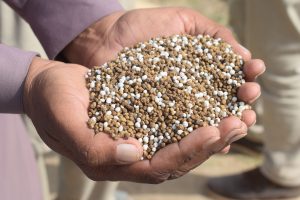
Greenhouses and containers change how fertilizer behaves.
In the ground, soil gives plants some buffer. Roots can explore a larger area. Nutrients may be held by clay, organic matter, and soil structure. Moisture changes more slowly. A missed watering or light feeding may not show right away.
Containers and greenhouse crops are different.
The root zone is smaller. Water moves through faster. Nutrients leach with every irrigation. Potting media usually has less natural nutrient reserve than field soil. Roots fill the container quickly. Hanging baskets dry from all sides. Greenhouse benches warm up fast. Patio pots may sit on concrete or black plastic. Plants are often grown close together, under high light, with frequent watering and high expectations for appearance.
That is why water-soluble fertilizers matter.
They give growers a way to feed actively growing plants through the same water system that keeps roots alive. They can be adjusted as crop stage changes. They move quickly into the root zone when applied correctly. They are especially useful when plants are growing fast, blooming heavily, or being watered often enough that dry fertilizer alone cannot keep up.
But water-soluble fertilizer is not just “mix and pour.”
It requires timing, dilution, moisture awareness, drainage, crop knowledge, and restraint. A greenhouse tomato, a petunia basket, a patio pepper, a tray of herbs, a mixed annual planter, and a blooming container of geraniums do not all need the same formula at the same time. Some need balanced feeding. Some need petunia-specific nutrition. Some need bloom support after roots are established. Some need plain water before they need fertilizer. Some need leaching because salts have built up.
In June, these details matter more because heat and watering frequency increase.
A basket that was watered every other day in May may need water daily in June. A container crop may begin flowering and fruiting. A greenhouse may become hotter and more humid. Water quality may begin affecting media pH. Nutrients that were available at planting may be gone. Fertility mistakes show faster because the plant has less soil buffer.
For this June greenhouse and container topic, three Supply Solutions products fit naturally: Jack’s Classic 20-20-20 All Purpose Water-Soluble Fertilizer, Jack’s Classic 20-6-22 Petunia Feed Water-Soluble Fertilizer, and Jack’s Professional 10-30-20 Blossom Booster Water-Soluble Fertilizer. Each product fits a different point in the container and greenhouse feeding conversation. The key is using the right one for the crop, stage, and root-zone condition.
Why Containers Have Less Fertility Buffer
A container is a small growing system.
Everything the plant needs must come from the media, the water, and the fertilizer program. Once roots fill that space, there is no deeper soil to explore. When water drains out the bottom, soluble nutrients can leave with it. When the pot dries out, nutrient uptake slows. When the pot stays wet, roots lose oxygen and stop feeding well.
This is why container plants often look good early and then fade quickly.
The plant may have started with fertilizer in the potting mix. It may have looked full at purchase. It may have carried nutrition from the greenhouse. But after several weeks of watering, warm weather, and active growth, that reserve can drop. The plant begins showing pale leaves, fewer blooms, smaller new growth, or faster wilting. In hanging baskets, the change can happen especially fast because roots fill the basket and water use increases sharply.
Water-soluble fertilizers help because they deliver nutrients in a form that can move with irrigation water into the active root zone.
That does not mean every watering should be a strong feeding. It means containers need a more regular, responsive fertility program than ground plantings. The grower has to replace what watering and plant growth remove.
Greenhouse Crops Grow Under Higher Demand
Greenhouse and protected crops often grow faster than outdoor crops.
Light, temperature, humidity, spacing, irrigation, and crop scheduling all increase demand. A greenhouse grower may be producing annual color, vegetable starts, herbs, bedding plants, nursery liners, hanging baskets, patio tomatoes, peppers, cucumbers, or flowering containers. These crops are expected to look uniform and respond quickly.
Uniformity is hard without consistent fertility.
If one bench dries faster than another, nutrient uptake changes. If media pH drifts, certain nutrients become unavailable. If feeding is inconsistent, plants show uneven color. If salts build up, roots stress. If nitrogen is too high, plants stretch. If potassium is too low, plants may not hold up through heat. If bloom support comes too early, roots may not be ready. If bloom support comes too late, plants may fade before the next flush.
Water-soluble fertilizers give greenhouse growers control, but that control cuts both ways.
A well-matched program can keep crops steady. A poorly timed or overmixed program can create stress quickly. Greenhouse plants respond fast because the root zone is limited and growth is active.
June greenhouse feeding should be steady, observed, and adjusted as crops move from growth to sale, bloom, fruiting, or outdoor transition.
Jack’s 20-20-20 Fits Broad Balanced Feeding
Jack’s Classic 20-20-20 All Purpose Water-Soluble Fertilizer fits containers and greenhouse crops that need balanced nutrition.
Its 20-20-20 analysis supplies nitrogen, phosphorus, and potassium evenly. This makes it useful when plants need general support for leaves, roots, and overall growth. It can fit mixed containers, bedding plants, vegetables, herbs, nursery starts, patio plants, and greenhouse crops where a broad water-soluble feed is appropriate.
The problem Jack’s 20-20-20 helps solve is general nutrient depletion in a limited root zone. This can show up as pale growth, slow recovery after watering, weak new leaves, reduced vigor, or plants that have used up the initial fertility in the potting mix.
The timing is June when containers are actively growing and being watered frequently. It is especially useful after plants are established, after transplant recovery, when mixed planters begin losing color, or when greenhouse crops need consistent nutrition through active growth.
The caution is that 20-20-20 contains meaningful nitrogen. It can support growth well, but it can also push soft growth if used too heavily, especially in heat or low light. A plant that is already lush and leafy may not need more balanced nitrogen. A fruiting or blooming plant may need a more targeted formula depending on its stage.
Jack’s 20-20-20 is a practical baseline feed, not a universal answer for every container problem.
Petunia Feed Fits Iron-Hungry Annuals
Petunias and calibrachoa are some of the clearest examples of why specialized water-soluble feeding matters.
They are heavy feeders. They grow fast. They bloom hard. They are often placed in hanging baskets or containers that dry quickly. They can become pale when media pH rises or when iron availability becomes limited. They can fade badly after several weeks of daily watering. A basket that looked full and colorful in late May can look washed out by late June if feeding and watering are inconsistent.
Jack’s Classic 20-6-22 Petunia Feed Water-Soluble Fertilizer fits these crops because it is designed for petunias and other iron-hungry annuals.
The problem Petunia Feed helps solve is pale new growth, fading color, reduced vigor, and declining performance in petunias, calibrachoa, and similar annuals grown in containers, baskets, and greenhouse systems. Its formula supports active growth while also fitting the needs of plants that commonly struggle with iron availability and container leaching.
The timing is June when petunia-type crops are actively growing, blooming, and being watered often. It is best used before the plant is badly exhausted. A basket that is still rooted, active, and only beginning to pale can usually respond better than a basket that has dried hard repeatedly and lost much of its leaf mass.
The caution is root-zone condition. Do not feed a dry, wilted basket first. Rehydrate the root ball. Make sure drainage is open. Trim if the plant is leggy. Then feed according to directions.
Petunia Feed is not just a bloom feed. It is a crop-specific feed for plants with a known tendency to fade under container conditions.
Blossom Booster Fits Established Blooming Plants
Jack’s Professional 10-30-20 Blossom Booster Water-Soluble Fertilizer fits established flowering plants that are ready for bloom support.
Its 10-30-20 analysis supplies lower nitrogen, higher phosphorus, and strong potassium. That makes it useful when the plant has roots, leaves, and enough structure to support flowering, and the goal is to encourage or maintain bloom rather than push heavy foliage.
The problem Blossom Booster helps solve is reduced bloom performance in established plants that are healthy enough to respond. It can fit flowering containers, annual planters, greenhouse color crops, hanging baskets after grooming, flowering ornamentals, and mixed containers that need bloom-cycle support.
The timing is important. Blossom Booster belongs after plants are established and actively growing. It is not the first choice for a newly transplanted container with weak roots. It is not a rescue for drought-stressed plants. It is not a cure for poor light, waterlogged roots, pest damage, or exhausted baskets that need trimming and recovery first.
The caution is that high phosphorus does not create flowers by itself. The plant still needs light, water, roots, potassium, foliage, and proper temperature. If a plant is pale and generally underfed, Jack’s 20-20-20 may fit better first. If the crop is petunia or calibrachoa showing pale new growth, Petunia Feed may be the better fit. Blossom Booster is best used when bloom support is the actual need.
Bloom feeding should follow plant readiness.
Formula Choice Should Follow Crop Stage
Water-soluble fertilizers are useful because they can be matched to crop stage.
That is where many growers make mistakes. They choose one product and use it on everything, regardless of stage. A young transplant, an actively growing herb, a petunia basket, a tomato container, and a flowering annual display are not asking for the same nutrient balance.
A young plant often needs steady balanced nutrition and root support. A vegetative container may need enough nitrogen to build leaf area. A petunia basket may need a formula that supports iron-hungry growth and potassium demand. A blooming annual may need bloom support after establishment. A fruiting plant may need potassium and calcium attention in addition to nitrogen. A stressed plant may need plain water first.
This is why product selection matters.
Use Jack’s 20-20-20 when the plant needs balanced nutrition for general growth.
Use Jack’s Petunia Feed when petunias, calibrachoa, and similar annuals need targeted support through active growth and frequent watering.
Use Jack’s Blossom Booster when established flowering plants need bloom support and are healthy enough to respond.
The right formula depends on what the plant is doing now.
Water-Soluble Does Not Mean Stronger Is Better
One of the biggest mistakes with water-soluble fertilizer is mixing too strong.
Because the product dissolves and the response can be fast, growers may think a stronger mix will fix problems faster. In containers and greenhouses, that approach can backfire. A small root zone can only buffer so much. Excess salts can burn root tips, brown leaf edges, slow uptake, and make plants wilt even when media is moist.
More fertilizer is not the same as better feeding.
A consistent, correctly diluted program usually works better than occasional strong applications. Plants need steady access to nutrients, not shocks. This is especially important in hanging baskets, small pots, seedling trays, herbs, tender annuals, and greenhouse crops under heat.
If a plant is pale because it has been underfed, a proper feeding may help. If it is pale because roots are damaged, stronger fertilizer will not repair the roots. If a basket is dry and wilted, stronger fertilizer may stress it further. If media is already salty, adding more fertilizer can make the problem worse.
Follow label directions. Measure carefully. Apply to moist media. Watch plant response. Leach with plain water when needed and when drainage allows.
Water-soluble feeding should be precise, not aggressive.
Feed Moist Roots Not Dry Roots
Dry containers should be watered before they are fertilized.
This is one of the most important practical rules for greenhouse and container feeding. When potting media dries hard, it may shrink away from the container wall. Water or fertilizer solution can run down the sides and out the drainage holes without wetting the full root ball. Dry roots are also more vulnerable to fertilizer concentration.
A wilted basket does not need fertilizer first.
It needs water. Water slowly and thoroughly. Let the plant recover. Then feed later when the media is moist and roots are functioning.
This applies to Jack’s 20-20-20, Jack’s Petunia Feed, and Jack’s Blossom Booster. All three perform best when the plant can actually take up water and nutrients.
This matters even more in June because containers dry faster. A basket may be fine in the morning and dry by late afternoon. Feeding should happen when the plant is not under peak drought stress.
Moist roots feed better and safer.
Drainage Controls Fertilizer Safety
Good drainage is part of good fertility.
A container without drainage is not a good home for regular water-soluble feeding. A saucer that stays full can keep roots wet. A decorative pot can trap water around a nursery pot. A greenhouse crop sitting in saturated media may look pale because roots are oxygen-starved, not because nutrients are missing.
If the root zone is waterlogged, fertilizer response will be weak.
Roots need oxygen to take up nutrients. When media stays saturated, roots slow down or decline. Leaves may yellow. Growth may stall. The grower may apply more fertilizer and see little improvement because the plant cannot use it.
Before feeding, check drainage.
Does water leave the pot? Does the basket dry at a reasonable rate? Are pots sitting in trays of water? Is the media too heavy? Is the crop overpotted in a large wet container? Are greenhouse benches draining? Is irrigation too frequent for the weather?
Water-soluble fertilizer should move through a healthy, aerated root zone. It should not sit around roots in stagnant water.
Drainage makes fertilizer usable.
Frequent Watering Leaches Nutrients
The same water that keeps containers alive can remove nutrients.
This is especially true in June. Hanging baskets, patio pots, greenhouse crops, vegetable containers, nursery cans, and annual displays may need frequent irrigation. Every time water drains from the container, some soluble nutrients may leave with it. Over time, even a well-planted container can become depleted.
That is why water-soluble feeding often becomes more important as summer begins.
A grower may not see the issue right away. The plant begins by using the fertilizer already in the media. Then it starts relying more on the grower’s feeding program. If the program is inconsistent, the plant fades.
Jack’s 20-20-20 fits containers that need broad nutrition after repeated watering has reduced fertility.
Jack’s Petunia Feed fits baskets and containers of petunias, calibrachoa, and similar annuals that leach nutrients quickly and commonly pale in June.
Jack’s Blossom Booster fits established flowering plants after the first bloom flush when bloom support is needed.
Frequent watering should be matched with consistent, appropriate feeding.
Salt Buildup Can Happen Even With Good Products
Leaching removes nutrients, but insufficient leaching can create another issue: salt buildup.
This happens when fertilizer salts accumulate in the root zone. It can occur when feeding is too strong, pots are watered too lightly, drainage is poor, or water quality contributes dissolved salts. Symptoms may include brown leaf edges, root stress, wilting despite moist media, stunted growth, or general decline.
The grower may think the plant needs more fertilizer, but the plant may need a plain-water flush.
In containers with good drainage, occasional watering with plain water can help move excess salts out of the root zone. This is especially important when using water-soluble fertilizers regularly. Do not let runoff sit in saucers. Do not flush containers that cannot drain properly.
This caution applies to all water-soluble products.
Jack’s 20-20-20 should be measured carefully. Jack’s Petunia Feed should be used consistently but not excessively. Jack’s Blossom Booster should not be applied heavily to stressed containers.
Good fertilizer still needs good water management.
Water Quality Affects Fertilizer Performance
Water quality matters in greenhouse and container production.
High alkalinity water can raise media pH over time. This can reduce availability of nutrients such as iron, especially in sensitive crops like petunias, calibrachoa, blueberries, and certain ornamentals. Hard water can interact with fertilizer programs. Low alkalinity water can move pH differently. Well water, municipal water, rainwater, and pond water can all behave differently.
A grower may be feeding correctly and still see pale new growth if water quality is pushing the media out of range.
This is one reason petunia-type crops often need special attention. Petunias and calibrachoa may pale when iron availability is limited by pH or media conditions. Jack’s Petunia Feed fits these crops because it is designed for petunias and iron-hungry annuals.
For general containers, Jack’s 20-20-20 can support balanced nutrition, but persistent pH-related issues may still require water and media testing.
For established blooming plants, Jack’s Blossom Booster may support bloom, but it will not fix a major pH or water quality issue by itself.
Water is part of the fertilizer program. It is not just the carrier.
Petunias And Calibrachoa Need Consistency
Petunias and calibrachoa are unforgiving when feeding becomes irregular.
They can grow and bloom heavily, but that performance requires steady support. Once baskets become root-filled and weather warms, they may dry daily. If they are watered often without feeding, nutrients decline. If they dry too hard, roots stress. If they are fed too strongly after drying, roots can burn. If media pH drifts, new growth pales.
A consistent program works better than occasional rescue.
Jack’s Petunia Feed should be used when these crops are actively growing and need targeted support. The best timing is before color fades badly. It can help maintain vigor, growth, and color in baskets, containers, and greenhouse crops when watering is frequent.
Petunias and calibrachoa also need grooming.
Leggy baskets often respond better when trimmed and then fed than when fertilizer is applied to long, exhausted growth. Remove spent blooms and dead material where appropriate. Improve airflow. Check for pests. Keep the root ball evenly moist.
Feeding matters, but basket management matters with it.
Mixed Containers Need The Middle Ground
Mixed containers are harder than single-crop pots.
A planter may contain petunias, verbena, coleus, geraniums, sweet potato vine, calibrachoa, salvia, ornamental grasses, herbs, or trailing foliage plants. These species may not all want the same feeding strength or moisture level. Some are heavy feeders. Some are more drought tolerant. Some prefer less nitrogen. Some dominate when fertility is high.
For many mixed containers, Jack’s 20-20-20 provides a practical balanced feed when the whole container needs general support.
If petunias or calibrachoa dominate the container and pale new growth is the issue, Jack’s Petunia Feed may be the better fit.
If the container is established and healthy but bloom has slowed, Jack’s Blossom Booster may be useful after grooming and moisture correction.
The caution with mixed containers is imbalance. Feeding to satisfy the heaviest feeder can overgrow the rest. Watch which plant is dominating, which plant is paling, and whether the container needs pruning as much as fertilizer.
A mixed container should be managed as a community, not a single plant.
Vegetables In Containers Need Stage-Based Feeding
Patio vegetables often need water-soluble fertilizer because container volume is limited.
Tomatoes, peppers, cucumbers, eggplant, herbs, lettuce, beans, and strawberries in pots all draw nutrients quickly. Watering increases in June, and nutrients leach faster. At the same time, fruiting vegetables need feeding that follows crop stage.
Early in growth, balanced feeding may be appropriate. Jack’s 20-20-20 can support container vegetables that need general nutrition for leaves, roots, and early vigor.
As fruiting begins, too much nitrogen can push soft growth, especially in tomatoes and peppers. Blossom Booster is not automatically the answer for vegetables, but bloom and fruiting stage should change how growers think about fertility. Fruiting vegetables also need calcium, potassium, and consistent moisture, which may require other products or program adjustments.
For container vegetables, water-soluble fertilizer is useful, but it should not be the only management tool. Pot size, drainage, mulch, watering consistency, pruning, and crop load all matter.
A patio tomato in a small pot cannot be fertilized into having the root volume of a large container.
Herbs Need Lighter Feeding Than Flower Baskets
Herbs are often overfed in containers.
Basil, parsley, cilantro, dill, chives, mint, oregano, thyme, rosemary, sage, and lavender do not all have the same nutrient demand. Basil and parsley can use steady feeding after harvest. Rosemary, thyme, sage, and oregano often perform better with leaner conditions and sharp drainage. Cilantro may bolt in heat regardless of fertilizer.
Jack’s 20-20-20 can fit herbs that need balanced support, especially after cutting or in containers that have been watered frequently. But use restraint.
Jack’s Petunia Feed is not normally the first choice for herbs unless they are in a mixed ornamental container where petunia-type plants dominate the feeding decision.
Jack’s Blossom Booster is usually not the main tool for culinary herbs because most herb management is about leaf quality, not bloom pushing.
Herbs should be fed for steady, usable growth, not soft excess growth.
Seedlings And Young Transplants Need Gentle Handling
Greenhouse seedlings and young transplants need careful feeding.
Small roots are sensitive. Media volume is small. Overfeeding can burn or stretch seedlings. Underfeeding can cause pale growth and weak starts. Watering mistakes show quickly in plug trays, cell packs, and small pots.
A balanced water-soluble feed like Jack’s 20-20-20 can fit young plants when used at appropriate rates and timing. It supports general growth once seedlings are ready for feeding.
Jack’s Petunia Feed fits young petunias and similar crops when their specific nutrient needs apply, but young plants still require careful dilution and moisture management.
Jack’s Blossom Booster is generally better suited after plants are established and ready for bloom support, not as the first feed for weak seedlings.
Seedlings should be grown sturdy, not forced. Light, temperature, spacing, and water management are just as important as fertilizer.
Bloom Support Should Come After Roots Are Ready
A plant cannot bloom well without roots that can support the demand.
That is why bloom fertilizer should not be used too early as a shortcut. A young transplant with limited roots may need balanced nutrition and establishment first. A dry, stressed container may need water. A root-bound plant may need pruning, repotting, or trimming. A shaded plant may need more light. A pest-stressed plant may need scouting and treatment.
Jack’s Blossom Booster fits when the plant is established and ready to support blooms. It is useful after roots are active, foliage is healthy, and the plant has enough energy to respond.
If bloom has slowed because the plant is generally hungry, Jack’s 20-20-20 may be a better starting point.
If bloom has slowed in petunia-type annuals because new growth is pale and the basket is leaching nutrients, Jack’s Petunia Feed may be the better fit.
Bloom support is most effective when the plant has the structure to use it.
Feeding Frequency Should Follow Watering Frequency
A plant watered once a week does not behave like a plant watered every day.
This is especially important in June. Hanging baskets and small containers may need water daily. Larger patio pots may need water every few days. Greenhouse crops under high light may be irrigated frequently. Shaded containers may dry more slowly. Cool weather reduces water use. Heat and wind increase it.
Feeding frequency should follow the crop’s actual water use and nutrient demand.
A daily-watered basket may need a regular, lower-strength feeding program. A large pot that is watered less often may need feeding less frequently. A crop that receives occasional heavy feeding may swing between deficiency and excess. A crop under constant low-level feeding may remain steadier when managed correctly.
This is why water-soluble products are useful. They allow growers to adjust feeding with irrigation. But the product should still match the crop.
Use Jack’s 20-20-20 for balanced feeding. Use Jack’s Petunia Feed for petunia-type annuals. Use Jack’s Blossom Booster when established flowering plants need bloom support.
Do not feed by habit. Feed by water use, crop stage, and plant response.
Watch New Growth For Response
New growth tells the best story after feeding.
Old damaged leaves may not fully recover. A scorched edge may stay brown. A pale leaf may remain pale. Spent flowers will not become fresh again. The question is what the plant does next.
After a correct feeding program, new leaves should show better color, new shoots should look stronger, bloom cycles should improve, and plants should recover more evenly after watering. Petunia baskets should begin producing healthier tips. Mixed containers should regain steadier growth. Greenhouse crops should become more uniform. Flowering plants should support the next flush better.
If new growth does not improve, keep diagnosing.
The issue may be pH, water quality, salt buildup, root damage, overwatering, underwatering, poor light, heat stress, pests, disease, or the wrong fertilizer formula. Water-soluble feeding is powerful, but it cannot fix every cause of decline.
Observation after feeding is part of the program.
A Practical June Greenhouse And Container Feeding Check
Start with the root zone.
Is the media moist, dry, or saturated? Does the container drain? Is the plant root-bound? Has the potting mix pulled away from the container wall? Are salts visible on the media surface or pot edge? Does the plant recover overnight after wilting?
Then check the crop.
Is it a petunia-type annual, a mixed container, a blooming plant, a vegetable, an herb, a young transplant, or a greenhouse crop? Is it vegetative, established, flowering, fruiting, or exhausted after a bloom flush?
Then check the symptom.
Is new growth pale? Are older leaves yellow? Are leaf edges brown? Are blooms slowing? Is growth too soft? Is the plant stretched? Is the basket dry every day? Is the media staying wet?
Then match the product.
Use Jack’s Classic 20-20-20 All Purpose Water-Soluble Fertilizer when containers or greenhouse crops need balanced nutrition for general growth, leaf color, root support, and overall vigor.
Use Jack’s Classic 20-6-22 Petunia Feed Water-Soluble Fertilizer when petunias, calibrachoa, and other iron-hungry annuals need targeted support during active growth, bloom, and frequent watering.
Use Jack’s Professional 10-30-20 Blossom Booster Water-Soluble Fertilizer when established flowering plants are ready for bloom support after roots and foliage are strong enough to respond.
Apply to moist media. Use proper dilution. Let containers drain. Avoid feeding drought-stressed or saturated plants. Watch new growth and adjust based on response.
Making Water-Soluble Feeding Work In Real Conditions
Water-soluble fertilizers matter because greenhouse and container plants live in small, fast-changing root zones.
They do not have the buffer of field soil. They depend on the grower for moisture, nutrition, drainage, and timing. In June, that responsibility becomes more important because heat increases water use and frequent irrigation increases nutrient loss.
The best programs are not complicated for the sake of being complicated. They are observant.
A balanced feed supports crops that need broad nutrition. A petunia-specific feed supports iron-hungry annuals that fade under frequent watering. A bloom booster supports established flowering plants when bloom demand is the real issue. Plain water is sometimes needed before fertilizer. Drainage is always part of the fertility program. Stronger mixes are not automatically better. New growth tells the truth after correction.
Supply Solutions offers practical water-soluble options for growers managing greenhouses, containers, baskets, and patio plants in June. Jack’s Classic 20-20-20 All Purpose Water-Soluble Fertilizer fits balanced feeding for mixed containers, greenhouse crops, vegetables, herbs, and plants that need general nutrition after frequent watering. Jack’s Classic 20-6-22 Petunia Feed Water-Soluble Fertilizer fits petunias, calibrachoa, hanging baskets, annual color, and iron-hungry plants that need targeted support as June watering increases. Jack’s Professional 10-30-20 Blossom Booster Water-Soluble Fertilizer fits established flowering containers and greenhouse crops that are ready for bloom support after roots and foliage are active. Used with proper dilution, moist roots, open drainage, good water quality awareness, and crop-stage timing, these products help greenhouse growers, gardeners, landscapers, nurseries, and patio growers keep container plants productive and attractive through early summer. Contact Supply Solutions for help choosing the right water-soluble feeding program for greenhouse crops, hanging baskets, mixed containers, annual color, herbs, vegetables, or patio plantings.