Potassium fertilizer is often purchased by comparing the number on the bag.
Muriate of potash commonly carries an analysis near 0-0-60.
Sulfate of potash is commonly near 0-0-50 and may also supply sulfur.
The higher-analysis material provides more potash per pound, but analysis alone does not determine the best source.
Chloride content, sulfur need, crop sensitivity, soil salinity, application timing, placement, price, and handling all matter.
Both sources can be agronomically correct.
Both can be misused.
Potassium Fertilizers Are Expressed as Potash
The third number in an N-P-K analysis represents soluble potash, expressed as K₂O equivalent.
It is not the percentage of elemental potassium.
A 0-0-60 fertilizer contains 60% K₂O equivalent by weight.
A 0-0-50 contains 50%.
Ten pounds of 0-0-60 supplies six pounds of potash.
Ten pounds of 0-0-50 supplies five pounds.
Product rates must be calculated from the recommended pounds of K₂O, not by assuming equal product weights are interchangeable.
Muriate of Potash Is Potassium Chloride
Muriate of potash, commonly abbreviated MOP, is potassium chloride.
It is widely used because it has a high analysis and is generally economical.
MOP supplies both potassium and chloride.
Chloride is an essential plant micronutrient, but crops need relatively small amounts.
Large chloride additions can create problems for sensitive crops or soils where chloride accumulates.
In many rain-fed field-crop systems, chloride moves through the profile and MOP performs well.
The source should not be rejected simply because it contains chloride.
Sulfate of Potash Is Potassium Sulfate
Sulfate of potash, or SOP, supplies potassium and sulfate sulfur.
It has a lower potash analysis than MOP and is usually more expensive per pound of K₂O.
Its major advantages are:
- Low chloride
- Added sulfur
SOP is commonly considered for:
- Chloride-sensitive crops
- Saline conditions
- High-value horticultural production
- Soils needing sulfur
Those advantages matter only where the field or crop benefits from them.
Paying for sulfur that is not needed or for low chloride where chloride poses no risk may not produce a return.
Crop Sensitivity Changes the Decision
Potatoes, tobacco, certain fruits, vegetables, ornamentals, and specialty crops may be more sensitive to chloride or may have quality responses related to potassium source.
That does not mean every field requires SOP.
Rate, soil, rainfall, timing in the rotation, and chloride history determine risk.
Sulfur Need Strengthens the Case for SOP
Sandy, low-organic-matter soil is more vulnerable to sulfur deficiency.
High-yielding crops and fields receiving little atmospheric sulfur or manure may also require supplementation.
SOP supplies sulfur as sulfate, which roots can absorb.
Where both potassium and sulfur are needed, one product can address two recommendations.
Where sulfur is adequate, the additional nutrient has less value.
Sulfate can leach from coarse soil, so timing may need to match crop uptake.
Salinity Requires Attention to Total Salt
Both MOP and SOP are soluble salts.
MOP generally has a higher salt effect and contributes chloride.
SOP is often preferred for salt-sensitive crops and certain fertigation situations.
No potassium source should be placed in concentrated contact with sensitive seed or roots.
Placement, rate, moisture, and soil texture matter as much as product name.
Dry Soil Reduces Uptake
Potassium moves toward roots largely through diffusion in soil water.
During drought, plants may show potassium-deficiency symptoms even where the soil contains adequate potassium.
Surface-applied fertilizer remains unavailable until enough moisture dissolves and moves it into the active root zone.
Do not expect an August potash application to rescue a crop whose main limitation is water.
Correct low soil potassium at a timing that provides moisture and root access.
Soil Test Determines the Amount
Select the source after determining whether potassium is needed.
A high-testing soil may require no application.
A very low soil may need a larger corrective rate.
Crop-removal estimates can maintain soil-test potassium in some systems, but testing should confirm the trend.
Judge response through:
- New growth
- Yield
- Tissue analysis
- Future soil tests
Potassium Removal Differs by Harvest Method
Grain harvest removes less potassium than silage or hay harvest because much of the plant potassium remains in stalks and leaves.
Alfalfa hay, grass hay, corn silage, vegetables, and fruit can export substantial potassium.
Fields with repeated biomass removal should be tested more frequently.
A potassium rate suitable for corn grain may not replace removal from a high-yielding hay field.
Do not use one rotation-wide rate without accounting for what leaves the field.
Timing Can Reduce Chloride Risk
In regions with adequate rainfall and drainage, fall application of MOP gives chloride time to move before a sensitive spring crop.
In dry regions, poorly drained soils, or irrigated systems with saline water, chloride may remain.
Regional recommendations should guide the strategy.
MOP May Be the Economical Field-Crop Choice
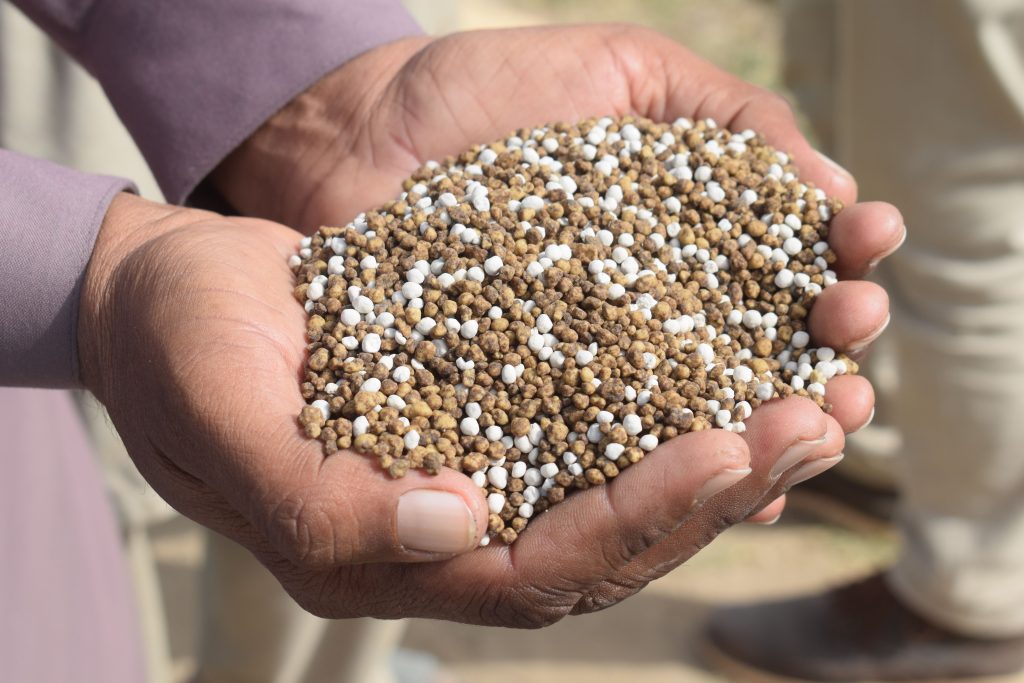
Supply Solutions Muriate of Potash 0-0-60 is a high-analysis granular potassium chloride fertilizer.
Why it is used: MOP supplies a high concentration of potassium at a generally economical cost per pound of K₂O.
When it should be applied: It fits crops and soils where potassium is needed, chloride is acceptable, salt placement is managed, and moisture can move the nutrient into the root zone.
What problem it solves: It corrects soil potassium deficiency economically. It does not fit every chloride-sensitive crop, saline root zone, seed-row placement, or dry-soil rescue attempt.
Calculate the product rate from its 60% potash analysis.
SOP May Fit Low-Chloride Programs
Supply Solutions Golden K-Max Sulfate of Potash 0-0-50 with Sulfur is a low-chloride potassium sulfate source that also supplies sulfur.
Why it is used: SOP supplies potassium with sulfur while limiting chloride input.
When it should be applied: It fits crops sensitive to chloride, soils or media where chloride or salinity is a concern, and fertility programs needing both potassium and sulfur.
What problem it solves: It corrects potassium deficiency while contributing sulfate sulfur and avoiding a large chloride addition. It does not justify application where soil potassium is already adequate or where the crop does not need sulfur.
Use the 50% potash analysis when calculating product weight.
Compare Cost per Pound of Nutrient
A lower bag price does not always mean a lower nutrient cost.
Calculate:
Product price ÷ pounds of K₂O in the package
Then include the value of:
- Sulfur
- Freight
- Application
- Storage
- Any crop-quality benefit
SOP may cost more per pound of potassium but provide value through sulfur or reduced chloride.
MOP may remain the best economic source for a tolerant field crop on well-drained soil.
The comparison should be field-specific.
Check the Physical Form
Granular materials spread differently from fine powders.
Particle size affects blend uniformity and spinner pattern.
Fine product may drift or segregate from coarser fertilizer.
Conduct a spreader-pattern test and calibrate by:
- Product density
- Particle size
Water-soluble or solution-grade SOP may fit fertigation, while granular MOP may fit broadcast field use.
The nutrient chemistry can be correct while the physical form is wrong for the equipment.
Blending Requires Compatibility
Dry blends should contain particles of similar size to reduce segregation.
Liquid and concentrated stock solutions require compatibility testing.
Calcium products can react with sulfate or phosphate and form precipitates.
High concentrations may plug emitters.
Do not assume that two soluble fertilizers remain soluble when mixed together.
Use separate stock tanks or injections when required.
Consider Soil Magnesium
Potassium and magnesium compete during plant uptake.
Large potassium applications can contribute to magnesium deficiency in vulnerable soils.
Review:
- Exchangeable magnesium
- Tissue status
Where both potassium and magnesium are low, potassium magnesium sulfate may be a better fit than either MOP or SOP alone.
Where magnesium is already high, another source may be preferred.
The product should match the full nutrient need.
Forage Requires Livestock Awareness
High forage potassium can reduce magnesium availability to grazing livestock and increase grass-tetany risk.
This is particularly important in cool, rapidly growing pasture used by lactating animals.
Do not apply potash to pasture solely because potassium is associated with stress tolerance.
Test:
Coordinate fertility with livestock mineral management.
The safest soil recommendation is not always the complete animal-nutrition plan.
Neither Source Replaces Root-Zone Management
A compacted, saturated, saline, or droughted root zone limits uptake.
Potassium fertilizer cannot restore roots destroyed by disease or waterlogging.
Improve:
- Drainage
- Irrigation uniformity
- Soil structure
- Rooting depth
A crop with healthy roots can access a larger volume of existing potassium.
The best source performs poorly when placed where roots cannot reach it.
The choice between sulfate of potash and muriate of potash is not a contest with one universal winner.
It is a decision based on soil-test potassium, chloride tolerance, sulfur need, salinity, crop value, and cost.
Supply Solutions can help growers compare Golden K-Max and Muriate of Potash using actual nutrient recommendations.
Contact the company before selecting a source for chloride-sensitive crops or salt-affected soil.
The correct product is the one that supplies the needed potassium without adding a problem the field does not need.