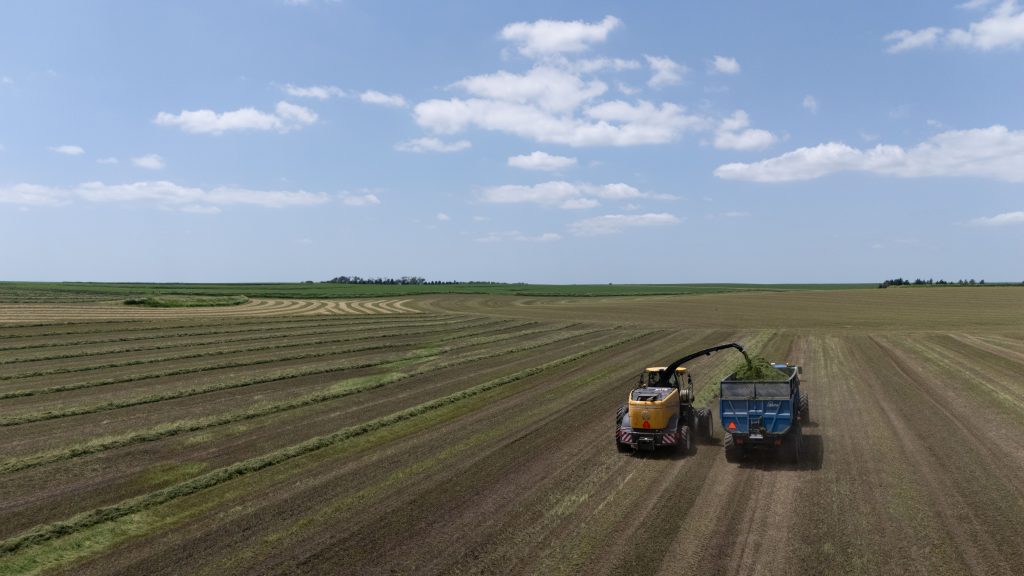
A corn silage field can look ready several days before it is actually ready to chop.
Leaves may be firing along the bottom of the plant. Husks may have lost their bright green color. Kernels may be denting, and the milk line may be moving. After a dry stretch, the entire field can take on the appearance of rapid maturity.
Those observations are useful, but none of them replaces a whole-plant moisture test.
Corn silage is not harvested only for the grain in the ear. The stalk, leaves, husks, cob, and kernels all enter storage together. Their combined moisture determines how well the crop can be chopped, packed, fermented, stored, and ultimately used by livestock.
Harvest too wet, and the crop may seep, ferment poorly, and lose valuable nutrients. Harvest too dry, and it becomes harder to pack, leaving oxygen trapped in the pile, bunker, bag, or silo. Poor packing raises the risk of heating, mold development, dry-matter loss, and reduced feed quality.
The correct harvest date is therefore the date when the whole plant reaches the moisture range suited to the storage system—not a date printed on a calendar and not a decision based only on the kernel milk line.
The Plant Does Not Dry Uniformly
Corn plants are made of tissues that mature at different rates.
The kernels may be adding starch while the stalk remains relatively wet. The leaves may brown from drought while the lower stalk still contains substantial moisture. A stay-green hybrid may hold green leaves even after kernels have advanced. Disease can cause rapid leaf death without producing the whole-plant dry matter expected from normal maturity.
This unevenness is why visual appearance can be misleading.
A field that looks dry from the road may test too wet for safe storage. Another field may have green upper leaves but already be approaching the dry end of the acceptable harvest range.
Drought creates some of the most difficult situations. When leaves turn brown, a grower may assume the entire plant is drying rapidly. In reality, drought-stressed corn with limited grain production can remain wetter in the stalk because less water and carbohydrate have been transferred into a well-filled ear.
That is why whole-plant moisture should be measured rather than assuming brown leaves mean the crop is ready to chop.
Milk Line Is a Scouting Tool, Not a Moisture Meter
The kernel milk line is useful because it shows the progression of starch deposition.
As a dented kernel matures, the solid portion expands from the crown toward the tip. The softer, milkier portion shrinks. Growers often describe this progression as one-quarter, one-half, or three-quarters milk line.
That stage provides a practical signal that whole-plant sampling should begin. It does not predict moisture precisely enough to make the final harvest decision.
Hybrids differ in the relationship between kernel maturity and whole-plant dry-down. Weather changes the rate at which leaves, stalks, and grain lose moisture. Plant population, ear size, disease, drought, and planting date also influence the relationship.
A grower who always begins chopping at one-half milk line may be on target in one field and several percentage points too wet or too dry in another.
The better approach is to use the milk line as an alert. Once the crop reaches the expected range, collect representative plants, chop them, and measure moisture.
Match Moisture to the Storage Structure
There is no single ideal moisture percentage for every corn silage system.
A crop stored in an upright silo generally needs to be somewhat drier than crop placed in a bunker or drive-over pile because excessive moisture creates seepage and pressure concerns.
Bags and bunkers can often handle silage in the mid-60% moisture range, provided the crop is chopped and packed correctly.
Approximately 65% to 67% whole-plant moisture is often a favorable range for fermentation, although the exact target should be adjusted for the storage structure and equipment.
The operating goal is to provide enough moisture for rapid fermentation while maintaining enough dry matter for effective packing and stable storage.
Silage that is too wet may:
- Produce excessive seepage
- Lose soluble nutrients
- Encourage undesirable fermentation
- Develop strong odors
- Reduce dry-matter intake
- Create safety concerns in certain storage structures
Silage that is too dry may:
- Resist packing
- Trap more oxygen
- Heat during storage or feedout
- Develop mold
- Lose dry matter
- Produce more sorting at the feed bunk
- Contain kernels that are harder to process
Storage design, packing tractor weight, filling rate, chop length, and feedout rate all affect how much risk a particular moisture level creates.
Take a Representative Whole-Plant Sample
The moisture test is only as useful as the sample.
Do not cut plants from one edge row or one convenient spot near the road. Field edges often differ in plant population, soil moisture, sunlight, insect pressure, and ear development.
Walk well into the field and collect plants from several representative locations. Where soil types or crop conditions vary sharply, sample those zones separately.
A field with sandy ridges and heavy low ground may need to be harvested in sections. A uniform average can hide corn that is already too dry on the ridges while the lower ground remains wet.
Select plants that represent the normal stand. Avoid choosing only the largest, healthiest, or driest plants.
Cut them at the intended harvest height. Changing the cutting height changes the moisture and nutrient composition because the lower stalk is generally wetter, higher in fiber, and sometimes higher in nitrate.
Chop the sample as uniformly as practical. Mix it thoroughly before removing the portion used for testing.
Moisture can be measured with a forage moisture tester, microwave method, forced-air dryer, commercial laboratory, or another validated procedure.
Follow the equipment instructions and repeat measurements when results appear inconsistent.
Start Testing Early Enough to Manage the Harvest Window
Corn silage can dry quickly during hot, dry, windy weather.
Waiting until the crop appears ready may leave little time to organize equipment, trucks, packing tractors, labor, and storage preparation.
Begin sampling before the expected harvest date.
Repeated measurements provide a field-specific dry-down rate.
For example, suppose a field tests 72% moisture on Monday and 69% on Thursday. That information is more useful than a general assumption about how many percentage points corn dries each day.
The rate can change with the weather.
Cool, humid conditions may slow drying. A hot, windy period can accelerate it. Rain may temporarily change the measured moisture without reversing crop maturity.
Schedule harvest from actual trends rather than one reading.
Fields with disease, drought damage, lodging, insect injury, or uneven maturity should be checked more frequently because they may not follow normal dry-down patterns.
Drought-Stressed Corn Requires Extra Caution
Drought changes both silage value and harvest risk.
Corn with poor pollination or limited kernel fill contains less starch. It may still have useful forage value, but the ration will differ from normal corn silage. A feed analysis becomes especially important.
Drought-stressed corn can also accumulate nitrate in the lower stalk.
Nitrate risk is often greatest near the base of the plant. Raising the cutting height may reduce the amount entering the silage, but it also reduces total harvested tonnage.
Nitrate risk can also increase when drought-stressed corn is harvested shortly after rain because renewed soil moisture can stimulate nitrate uptake before the plant has time to convert it into plant proteins.
Where nitrate accumulation is possible:
- Test representative plant material
- Consult a livestock nutritionist
- Consider increasing cutting height
- Avoid harvesting immediately after a drought-ending rain without evaluating risk
- Allow proper fermentation before feeding
- Retest the finished silage when necessary
Fermentation can reduce nitrate concentration, but it should not be treated as a guarantee that severely high nitrate levels will become safe.
Cutting Height Changes Yield and Quality
A standard cutting height of approximately 6 to 8 inches is commonly used because it balances tonnage and feed value.
Raising the header leaves more of the fibrous lower stalk in the field. This can improve silage digestibility and raise the proportion of grain in the harvested material.
It can also reduce nitrate concentration in drought-stressed corn.
The tradeoff is lost yield.
A high-chop strategy may fit farms prioritizing milk per ton, farms with adequate forage inventory, or fields with nitrate concerns. It may not fit an operation that needs maximum tons per acre.
Cutting height should be selected intentionally. It should not vary simply because the operator is trying to avoid rough ground.
Chop Length and Kernel Processing Must Work Together
Moisture influences the correct equipment settings.
Wetter corn may pack easily but can become overly fine if chopped too short.
Drier corn generally needs a shorter theoretical length of cut to improve packing, but excessively short material can reduce physically effective fiber in the ration.
Kernel processing becomes increasingly important as grain matures.
The goal is to break kernels and damage cobs enough to improve starch availability. Whole or nearly whole kernels can pass through the animal with limited digestion.
Check processing in the field rather than relying only on machine settings.
Collect a sample from the truck or pile, spread it out, and inspect the kernels. Adjust roller clearance, chop length, and machine speed when too many whole kernels remain.
Drier, more mature kernels require more aggressive processing than soft milk-stage kernels.
Equipment wear matters. Rollers that appear properly adjusted may not process consistently if surfaces are worn.
Packing Begins While the Chopper Is Running
Silage quality is influenced by the balance between delivery rate and packing capacity.
A chopper can deliver crop faster than one light tractor can compact it.
When thick layers are spread across a bunker, the tractor compresses the top but leaves oxygen in lower portions.
Apply forage in thin layers and pack continuously.
Increase packing weight or reduce delivery speed when density is inadequate.
Drier silage is less forgiving because stiff particles resist compression. It may require more packing time, thinner layers, and closer management.
Do not allow trucks to dump large piles that remain unpacked for extended periods.
The objective is to remove oxygen quickly so desirable fermentation can begin.
Every pocket of trapped air creates an opportunity for heating and spoilage.
Cover Bunkers and Piles Promptly
Once filling is finished, seal the surface as quickly as practical.
A high-quality oxygen-barrier film or properly installed plastic reduces air movement into the forage.
Weight the entire surface, not only the edges. Tires should touch or nearly touch when used.
Seal edges carefully and divert surface water away from the structure.
Monitor for damaged plastic during storage. Birds, rodents, wind, and equipment can create openings. Repair holes promptly.
Spoilage at the top and shoulders of a bunker is not an unavoidable part of silage production. It is commonly a sign of inadequate packing, delayed covering, poor sealing, or air entering during storage.
Feedout Management Protects the Work Done at Harvest
Even well-fermented silage can deteriorate when the face is poorly managed.
Remove forage evenly across the full face.
Avoid digging deep pockets that allow air to enter. Maintain a feedout rate fast enough to stay ahead of heating, especially during warm weather.
Keep the face tight and minimize loose material at the base.
Monitor silage temperature, smell, visible mold, and animal response.
Heating after exposure suggests yeast activity and aerobic instability.
Storage size should match the amount fed daily.
A large bunker opened for a small herd may have too little daily face removal to remain stable.
Fertilizer Cannot Correct Harvest Timing
By the time corn is ready for silage, the nutrient program has already influenced yield, stalk development, grain content, and plant health.
An August fertilizer application cannot make overmature silage wetter, improve kernel processing, or repair poor fermentation.
Applying nutrients because leaves are browning is unlikely to add useful forage when the crop is approaching harvest.
The immediate management priorities are:
- Measuring whole-plant moisture
- Checking nitrate risk
- Matching chop length to moisture
- Processing kernels
- Packing adequately
- Sealing promptly
- Testing the finished feed
After harvest, yield, plant symptoms, manure history, and soil tests can guide the next fertility plan.
Silage removes the entire aboveground plant, exporting much more potassium than grain harvest alone. Fields harvested repeatedly for silage should receive particular attention in the fall soil-sampling program.
The best silage does not come from chasing a date. It comes from measuring the crop, matching harvest to storage, and paying attention to the details from the cutter head to the feed bunk.
Supply Solutions can help growers review postharvest soil tests and replace nutrients removed by silage at rates matched to the field. Contact the company for guidance before building the next corn fertility program.