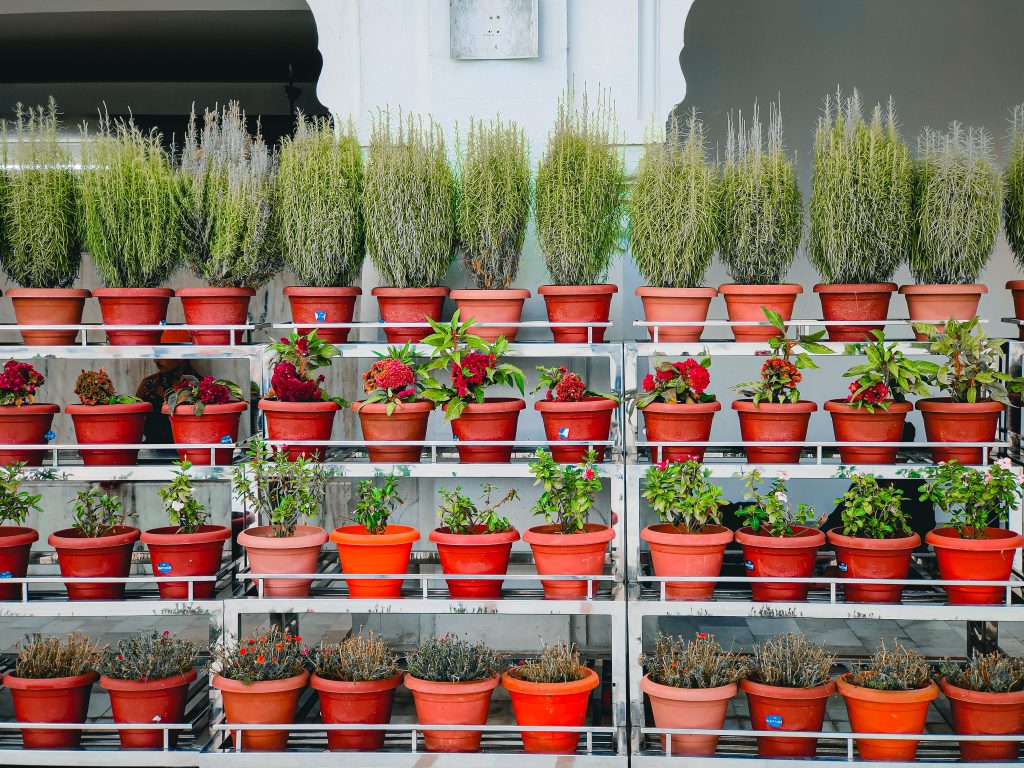
Container plants live in a small and rapidly changing root zone.
A garden bed may contain thousands of pounds of soil available to a plant.
A patio tomato, hanging basket, nursery shrub, or greenhouse crop may depend on only a few gallons of growing media.
That limited volume heats quickly, dries quickly, accumulates salts quickly, and loses nutrients with every drainage event.
By August, roots often fill much of the container, the plant canopy is large, and weather demand is high.
The same watering and fertilizing routine that worked in May may no longer support the crop.
The solution is not simply watering and fertilizing more often.
It is understanding how water, oxygen, salts, and nutrients are moving through the pot.
Container Size Determines the Margin for Error
Small pots hold less water and experience larger temperature swings.
A mature tomato in a small container may use nearly all available water before the end of a hot day.
A larger pot buffers moisture and temperature changes.
Container color matters.
Dark materials absorb more heat.
Pots on concrete, asphalt, decks, or south-facing walls can become considerably hotter than surrounding air.
Root growth slows when the media becomes excessively hot.
Water demand from the canopy may remain high, creating wilt even when irrigation is frequent.
Use containers sized for the mature plant, not the transplant.
Potting Media Is Not Field Soil
Good container media must hold water while draining enough to maintain air.
Ordinary field soil often becomes dense in a pot.
Its small pores remain saturated, limiting oxygen and root growth.
Commercial mixes commonly contain:
- Peat
- Coir
- Bark
- Perlite
- Vermiculite
- Compost
- Other components
Those materials change over time.
Organic particles decompose and settle.
Large pores shrink.
Roots occupy space.
Drainage may become slower by late summer.
Do not assume a pot drains well because it did in spring.
Check whether water exits freely and whether the lower media smells sour or appears black and saturated.
Water Thoroughly, Then Monitor
A small splash wets only the upper layer.
Roots concentrate in the moistened zone, leaving the rest of the container underused.
Repeated shallow watering creates a plant that wilts quickly.
Apply enough water to wet the full root ball and produce some drainage.
Then wait until the crop and media approach the appropriate moisture level before watering again.
The interval depends on:
- Plant species
- Container size
- Media
- Root density
- Temperature
- Wind
- Sun
- Crop load
- Humidity
A rigid daily schedule may overwater during cloudy weather and underwater during heat.
Check the media directly.
Extremely Dry Media Can Repel Water
Peat-based mixes may become hydrophobic after drying severely.
Water runs down the container wall or through a crack and exits immediately while the root ball remains dry.
The gardener sees drainage and assumes the pot is fully watered.
Lift the container before and after watering.
A pot that remains light has not absorbed enough.
Rewet slowly.
Apply water in several passes, allowing time between them.
Bottom soaking may help small pots, but do not leave them standing in water indefinitely.
Prevent repeated severe drying because each event damages fine roots.
Frequent Watering Leaches Nutrients
Water leaving the drainage holes carries soluble nutrients.
Even media containing starter or controlled-release fertilizer may become depleted during a long season of repeated watering.
This does not mean increasing fertilizer concentration.
Frequent, lower-rate feeding is often safer than occasional heavy applications because nutrient supply remains steadier and root-zone EC fluctuates less.
Fertilizer Salts Can Also Accumulate
Not every irrigation produces enough drainage to remove salts.
Fertilizer ions, hard-water minerals, and sodium can accumulate near the surface and container edge as water evaporates.
White crusts on the media, pot rim, or drainage holes provide a clue.
Other symptoms include:
- Brown leaf tips
- Marginal scorch
- Reduced growth
- Wilting in wet media
- Dead root tips
These symptoms resemble drought and nutrient deficiency.
Applying more fertilizer can worsen the problem.
A media EC test provides stronger evidence than appearance alone.
Leach When Drainage Is Adequate
Leaching means applying enough clean water to dissolve and move accumulated salts out of the root zone.
The container must have open drainage holes, and the drained water must be allowed to leave.
Do not leach a pot with blocked drainage.
The result would be saturation rather than salt removal.
Avoid softened household water because water softeners commonly replace calcium and magnesium with sodium, which can be harmful to plants over time.
Hard Water Changes Fertility
Hard water may contain calcium, magnesium, and bicarbonate.
Calcium and magnesium can contribute useful nutrients.
High bicarbonate can raise media pH and reduce iron, manganese, and other micronutrient availability.
White deposits on leaves or pots may come from hard water rather than fertilizer alone.
Test irrigation water where chlorosis, scaling, or pH drift continues.
Acidifying water is a technical treatment requiring proper equipment, calculation, and safety.
Do not add acid by guesswork.
Root-Bound Plants Behave Differently
By August, roots may circle the container and occupy most of the media.
Water moves rapidly through narrow channels without spreading.
The plant wilts soon after irrigation because little water-holding media remains.
Slide the root ball out carefully where possible.
A dense white or brown mat around the outer edge indicates restriction.
Dark, soft roots indicate rot.
Repot into a larger container when the season and plant type allow.
Gently loosen circling roots if appropriate.
A severely root-bound annual near the end of production may be managed with more frequent irrigation rather than repotting, but expectations should be realistic.
Where Jack’s 20-20-20 Fits
Jack’s Classic 20-20-20 All Purpose Water-Soluble Fertilizer provides equal percentages of nitrogen, phosphate, and potash along with micronutrients.
It should be used as a balanced nutrient source, not as an automatic August treatment.
Why it is used: It replaces nitrogen, phosphorus, potassium, and micronutrients lost through plant uptake and repeated irrigation.
When it should be applied: It fits actively growing container plants with a balanced nutrient requirement after the original media fertilizer has declined. Use a concentration and interval matched to the crop, media, water quality, and label.
What problem it solves: It addresses broad nutrient depletion in container media. It does not correct salt buildup, root rot, water repellency, restricted roots, high media pH, or heat damage.
Because it is highly soluble, incorrect concentration can raise EC quickly.
Measure accurately.
Do not assume twice as much produces twice the growth.
A Balanced Analysis May Still Add Unnecessary Phosphorus
Equal N-P-K numbers do not mean the plant needs equal pounds of each nutrient.
The analysis indicates the percentage by weight of nitrogen, phosphate, and potash in the product.
Many container crops use more nitrogen and potassium than phosphorus.
Media may already contain a starter phosphorus charge.
Repeated use of 20-20-20 can supply more phosphorus than needed in some programs.
Commercial growers should use media and tissue testing to select a formula.
Home gardeners should follow the product label and watch plant response rather than feeding at every watering indefinitely.
Do Not Fertilize a Dry Root Ball
Concentrated fertilizer applied to dry media increases salt stress.
Water the plant first when the root ball is dry, then fertilize after it has rehydrated, following label directions.
Avoid feeding severely wilted, heat-stressed plants during the hottest part of the day.
Move sensitive containers into temporary afternoon shade during extreme heat when practical.
Resume feeding after the plant has recovered and roots are functioning.
Match Fertilizer to Plant Stage
A foliage plant has a different requirement from a tomato carrying fruit.
A young annual needs nutrients for establishment.
A mature flowering basket may need continued nitrogen and potassium.
A plant approaching dormancy may need little feeding.
Excess nitrogen late in the season can create soft growth on perennials that should begin hardening.
Annual vegetables expected to produce until frost may continue receiving fertilizer while healthy.
Observe:
- New growth
- Leaf color
- Flowering
- Root condition
Diagnose Yellow Leaves by Position
Lower yellow leaves may indicate nitrogen or magnesium shortage, natural aging, shading, or root stress.
Young interveinal chlorosis may indicate iron or manganese unavailability, often related to high media pH.
Uniform yellowing with wet media suggests root damage.
Scorched margins may indicate salts, drought, potassium deficiency, or heat.
Remove the plant from the pot and inspect roots before adding another fertilizer.
The container hides the most important part of the diagnosis.
Improve Irrigation Uniformity in Groups of Containers
A hose operator may give each pot the same number of seconds even though pot size and crop demand differ.
Drip emitters can improve consistency, but emitters must be matched and checked.
Pressure variation, plugging, and tubing length affect output.
Group plants by water need.
Large fruiting plants should not share the same schedule as drought-tolerant herbs or small succulents.
Use catch measurements to compare emitters.
An automated system saves labor only when it applies the correct amount.
Protect Containers From Wind and Reflected Heat
Wind increases transpiration and can dry one side of a group faster than the other.
Walls, fences, and pavement reflect heat.
Rooftops and balconies may be hotter and windier than ground-level gardens.
Move containers where practical or create temporary shade that does not block necessary light.
Avoid placing black nursery pots directly on extremely hot pavement.
Pot feet or a light-colored outer container can reduce direct heat transfer.
Check hanging baskets first.
They have high exposure and limited media.
Test Container Media When Problems Repeat
Field-soil tests are not ideal for soilless mixes.
Container media require methods suited to their chemistry and physical properties.
A suitable container-media test can evaluate:
- pH
- Electrical conductivity
- Nitrate and ammonium nitrogen
- Phosphorus
- Potassium
- Calcium
- Magnesium
- Sodium
- Sulfur
- Micronutrients
Testing can reveal whether a pale plant needs fertilizer, has excessive salts, or is experiencing a pH-related micronutrient problem.
Reset the Root Zone Before Adding More Fertilizer
When a container declines in August, work through the likely causes in order:
- Check moisture
- Confirm drainage
- Inspect roots
- Look for salt crusts
- Review fertilizer concentration
- Test water quality
- Check media pH and EC
- Evaluate heat exposure
- Apply nutrients only after the root zone can use them
Supply Solutions can help growers determine whether Jack’s 20-20-20 fits a balanced feeding program or whether container-media testing points toward salts, pH, or another limitation.
Contact the company before increasing concentration.
In a container, small fertilizer mistakes become root-zone problems quickly.