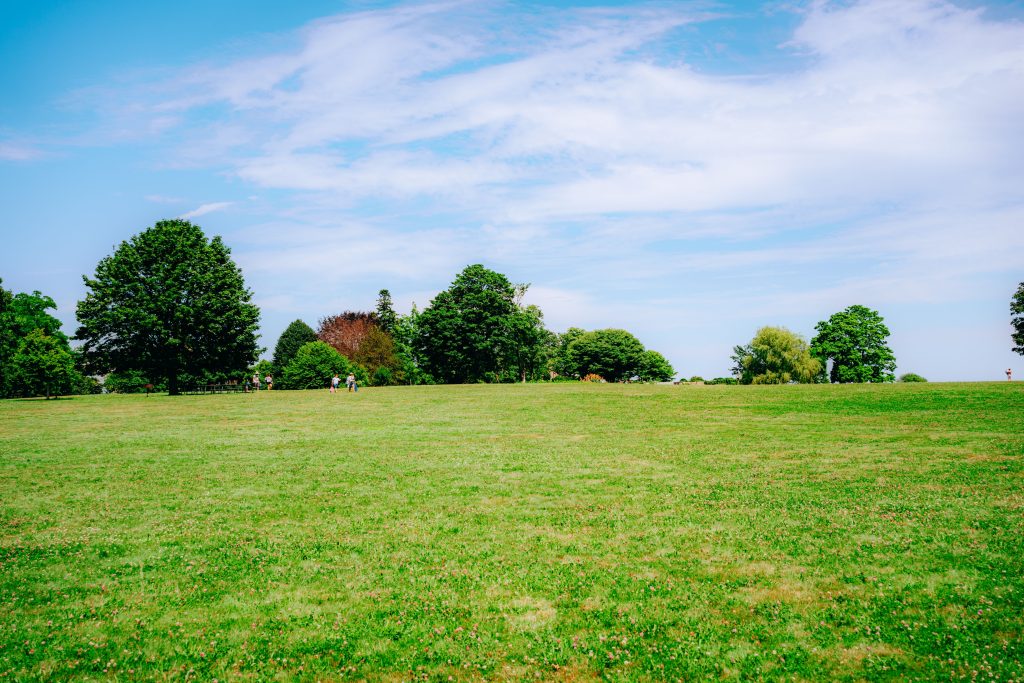
A localized dry spot is a small area that remains dry while nearby soil receives the same irrigation.
The grass may wilt, turn blue-gray, thin, or become brown.
Landscape plants may droop in one section of a bed while plants several feet away remain normal.
Running the irrigation system longer may wet the surrounding area more heavily without correcting the dry patch.
The problem may be:
- Uneven sprinkler coverage
- Water-repellent soil
- Thatch
- Compaction
- Buried construction material
- Shallow soil
- Tree-root competition
- A leaking edge
The correct treatment depends on the cause.
Begin With an Irrigation Audit
Operate the system and watch every head.
Check whether heads:
- Rotate fully
- Rise above the grass
- Overlap correctly
Inspect:
- Clogged nozzles
- Broken risers
- Low pressure
- Overspray
- Blocked patterns
Wind can distort distribution.
A sprinkler that appears to reach an area may apply very little usable water there.
Place identical catch containers in and around the dry spot.
Run the system for a measured period and compare the collected depth.
A large difference confirms a distribution problem.
Repair the system before changing the soil.
Dig Immediately After Irrigation
A shovel reveals how water moved.
Cut a cross-section through the dry area and an adjacent healthy area.
Look for:
- Wet surface over dry soil
- Irregular wet fingers
- Water traveling along cracks
- Thick thatch
- Dense compacted layers
- Gravel or construction debris
- Shallow soil over rock
- Tree roots
- Saturated subsoil
- Dry soil beneath one failed emitter
Hydrophobic soil often shows uneven fingered wetting, with water bypassing dry pockets.
Compaction commonly creates a shallow wet layer perched over dense soil.
The profile determines whether the solution involves a wetting agent, aeration, irrigation repair, or reconstruction.
Water Repellency Develops After Severe Drying
Organic compounds can coat soil and media particles.
When those coatings become strongly water repellent, water beads and follows preferential channels rather than spreading evenly.
Sandy turf soils, thatchy lawns, peat-based media, and areas beneath certain organic residues are especially vulnerable.
A severely dried area may become more difficult to rewet each time it cycles through drought.
Repeated short irrigation can reinforce the same channels.
Water enters one narrow pathway while most roots remain dry.
Thatch Contributes to Localized Drying
Excess thatch can become hydrophobic.
Water may remain within the thatch layer or move sideways before reaching mineral soil.
Roots growing in thatch dry quickly during heat.
Measure the layer.
Core aeration and appropriate vertical mowing can reduce excessive thatch over time.
Nitrogen and irrigation practices should also be reviewed because rapid shoot and stem production contribute to accumulation.
A wetting agent may improve water movement through thatch, but it does not remove the layer.
Compaction Is a Physical Restriction
Mechanical traffic compresses the soil and reduces large pores.
Water enters slowly and roots remain shallow.
Runoff may begin before the root zone receives enough moisture.
Use a soil probe or penetrometer at similar moisture conditions in healthy and damaged areas.
Look for:
- Roots turning horizontally
- Roots stopping at a dense layer
Core aeration helps compacted turf.
Landscape beds may need careful loosening, organic-matter management, and traffic changes.
A liquid surfactant cannot physically remove a traffic pan.
Tree Roots Create Strong Competition
Turf beneath and beyond tree canopies competes with tree roots for water.
The soil may also be:
- Shaded
- Compacted
- Covered with hydrophobic organic material
Increasing irrigation enough to maintain turf can overwater the tree or surrounding lawn.
Consider whether turf is the appropriate groundcover.
Mulch or a shade-adapted planting may create a more stable landscape.
Do not damage large tree roots through aggressive cultivation.
Buried Material Changes the Root Zone
Construction sites often contain:
- Gravel
- Concrete
- Plastic
- Subsoil
- Compacted fill
These areas dry quickly because available soil volume is limited.
No fertilizer or wetting agent can create several additional inches of root zone.
Probe the area and compare depth.
Small buried debris may be removed.
Large construction limitations may require soil replacement or a change in planting.
Dog Urine and Fertilizer Burn Can Resemble Drought
Concentrated salts draw water from roots and injure leaves.
Dog spots often have a brown center with a dark green ring where lower nitrogen concentration stimulated growth.
Fertilizer spills create sharp or irregular burns.
The soil may be moist even though leaves are brown.
Leach salts with clean water where drainage is adequate.
Remove concentrated granules.
Avoid adding more fertilizer.
A wetting agent is not the first treatment for a salt burn.
Disease Can Produce Isolated Patches
Summer patch, brown patch, dollar spot, fairy ring, and other diseases can create localized injury.
Fairy rings may produce:
- Dark green arcs
- Mushrooms
- Dead grass
- Water-repellent soil
Identify the disease before assuming the patch is simply dry.
A fungicide will not correct a broken sprinkler, and more irrigation can worsen certain diseases.
Where Aqua Drive Fits
Supply Solutions Aqua Drive is a nonionic surfactant and wetting-agent product designed to improve water penetration and distribution.
Its role is specific.
Why it is used: Aqua Drive reduces surface-tension-related wetting problems, helping irrigation spread through water-repellent soil or media instead of beading or following narrow channels.
When it should be applied: It fits a confirmed or strongly suspected hydrophobic root zone where water repeatedly runs off or bypasses dry pockets despite adequate irrigation coverage.
What problem it solves: It addresses uneven wetting and localized water repellency. It does not repair a broken sprinkler, remove mechanical compaction, replace missing topsoil, correct blocked drainage, cure turf disease, or eliminate thick thatch.
Apply according to the label and water-management plan.
Test a Small Area
Where diagnosis remains uncertain, treat a small portion and leave an untreated comparison.
Measure soil moisture at several depths after the next irrigation.
Observe whether the treated area wets more evenly and whether turf recovery begins.
A visible color response can take time, particularly where crowns or roots have been injured.
Do not judge only by surface appearance.
The useful question is whether the root zone received and retained water more uniformly.
Cycle-and-Soak Reduces Runoff
Slopes and fine-textured soils often receive water faster than they can absorb it.
Divide irrigation into shorter cycles with rest periods.
Several shorter applications separated by rest periods may allow more infiltration than one continuous run.
The exact cycle depends on:
- Slope
- Soil
- Nozzle
- System output
Cycle-and-soak does not reduce the total root-zone requirement.
It changes the application rate over time.
Use catch-can measurements and soil probing to confirm the result.
Core Aeration and Wetting Agents Serve Different Purposes
Core aeration creates physical channels by removing soil plugs.
A wetting agent changes the interaction between water and the soil or organic surface.
A lawn can need:
Hydrophobic sandy soil with little compaction may respond to a wetting agent without aggressive aeration.
A compacted sports area may need core aeration regardless of surfactant use.
Avoid describing the treatments as interchangeable.
Adjust Sprinkler Precipitation Rate
Some modern nozzles apply water rapidly.
Match nozzle type to soil and slope.
Pressure that is too high creates mist and drift.
Pressure that is too low reduces pattern coverage.
Ensure head-to-head overlap.
A wetting agent cannot compensate for an irrigation design that leaves dry gaps.
Landscapers should audit each zone after plants mature because shrubs and grass can block heads that were correctly installed years earlier.
Watch the Edges
Dry spots commonly occur beside pavement.
Concrete and asphalt reflect heat.
Soil may be shallow or compacted from construction.
Sprinklers may be adjusted to avoid overspray, leaving the edge under-watered.
Road salts and deicing materials can also injure turf.
Probe depth and test salts where damage repeats every year.
A narrow strip of drought-tolerant planting or mulch may be more practical than maintaining turf in a hostile edge.
Do Not Overwater Healthy Areas
A controller set to satisfy one dry patch may saturate the rest of the lawn.
Overwatering increases:
- Disease
- Shallow rooting
- Nutrient loss
- Mowing
Treat the patch as a separate diagnostic problem.
Repair the head, change the nozzle, adjust soil management, or hand-water the limited area while a long-term correction is made.
Recovery Depends on Living Crowns
After wetting improves, determine whether turf remains alive.
Living Kentucky bluegrass may spread into small areas.
Dead tall fescue bunches usually require seed.
Do not continue wetting bare soil and expecting fertilizer to create plants.
Prepare the site and reseed during the regional establishment window.
Correct water repellency and irrigation before planting so new seedlings do not fail in the same pattern.
Record Repeated Locations
Map localized dry spots.
If the same patches appear each summer, the cause is structural, hydraulic, or biological—not random weather.
Compare them with:
- Irrigation layout
- Soil depth
- Traffic
- Tree roots
- Construction plans
- Disease history
Repeated evidence supports a more permanent correction.
Supply Solutions can help homeowners and landscape professionals determine whether Aqua Drive fits a hydrophobic root zone or whether soil testing, aeration, irrigation repair, or drainage work is more appropriate.
Contact the company before treating a dry patch that may actually contain saturated subsoil, disease, or concentrated salts.
Better watering begins with understanding where the water went.