
Uncategorized
How to Read a Fertilizer Grade: What N-P-K Numbers Actually Tell You
Walk into a fertilizer warehouse, farm supply store, greenhouse, or garden center and the first thing most people notice on a fertilizer bag is a
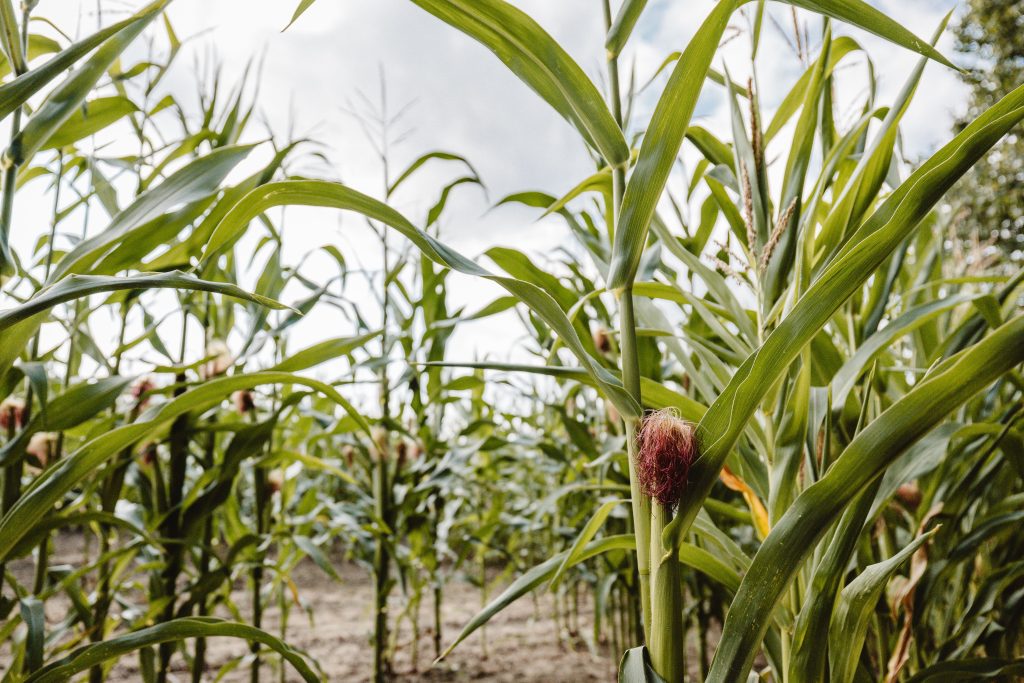
A corn field can carry an excellent-looking ear in August and still be developing a serious harvest problem.
The leaves may remain reasonably green, yet the roots are compromised. The stalk may look normal from the outside while internal tissue is beginning to deteriorate. A crop that survived drought, saturated soil, hail, disease, or nutrient stress can continue standing until one strong wind reveals how much stalk strength has already been lost.
Late-season lodging is rarely caused by a single event.
It usually develops from the interaction between crop stress, root health, carbohydrate supply, disease pressure, fertility, hybrid characteristics, plant population, and weather.
By August, the most useful management decision is often not another fertilizer application. It is identifying which fields are beginning to lose structural integrity and understanding why.
Iowa State’s corn field guidance identifies drought, saturated soil, severe foliar disease, hail damage, insect injury, insufficient sunlight, and low potassium relative to nitrogen among the stresses associated with stalk rot and lodging.
Those are all conditions that can influence how effectively a corn plant supports the ear during grain fill.
After pollination, the developing ear becomes a powerful sink for carbohydrates.
Leaves capture sunlight and manufacture sugars through photosynthesis. Those carbohydrates are moved into the kernels as dry matter accumulates.
When the canopy remains healthy, roots function properly, and moisture is adequate, the plant can generally support grain fill without severely weakening the stalk.
Problems develop when photosynthesis cannot keep up with kernel demand.
Drought can close stomata and reduce photosynthesis.
Foliar disease can destroy productive leaf tissue.
Hail can remove leaf area.
Nutrient deficiency can cause premature senescence.
Root damage can reduce water and nutrient uptake.
The ear does not immediately stop demanding carbohydrates when these stresses occur.
The plant can begin remobilizing stored carbohydrates from stalk tissue to support grain filling.
As those reserves decline, the stalk becomes more vulnerable to structural breakdown and invasion by stalk-rotting organisms.
Dry weather can weaken stalk integrity through several pathways.
The crop has less water for photosynthesis.
Nutrient uptake becomes more difficult.
Leaves may roll for long periods during the day.
Kernel filling can continue drawing on available resources.
Roots growing in dry soil may also become less active.
If the field developed shallow roots earlier in the season, drought can create even greater stress.
A deeply rooted plant has access to more water and nutrients, while a shallow-rooted plant may begin remobilizing internal reserves much sooner.
This explains why lodging often appears worse in specific soil zones rather than uniformly across a field.
Excessive moisture reduces root oxygen.
That weakens nutrient uptake and can injure root tissue.
Nitrogen can also be lost under saturated conditions.
A plant may survive the waterlogged period and appear to recover, but its root system can remain less capable of supporting grain fill and anchoring the stalk.
Iowa State specifically lists soil saturation as a stress associated with greater stalk-rot risk.
The 2026 season has produced both dry and excessively wet conditions in different parts of the Corn Belt, which means August stalk scouting is valuable regardless of whether the field struggled from too little water or too much.
Potassium does not create stalk tissue in isolation, but adequate K nutrition supports several processes that matter for plant health.
Potassium plays roles in water regulation, enzyme activity, movement of carbohydrates, and other physiological functions.
A plant that is truly deficient in K is therefore operating with an additional limitation during grain fill.
Iowa State lists low potassium in relation to nitrogen among factors associated with stalk lodging risk.
That relationship should not be oversimplified into the claim that applying potassium prevents lodging.
Hybrid genetics, disease, population, weather, root health, and nitrogen management all matter.
However, a field that consistently tests low in potassium should not be expected to perform like a field with balanced fertility when both are exposed to severe stress.
Nitrogen is essential to corn production, but a dark green canopy does not automatically mean the fertility program is balanced.
Applying nitrogen far beyond crop need does not guarantee stronger stalks or greater yield.
A crop with aggressive vegetative growth still needs adequate potassium, water, healthy roots, and productive leaf area to support the ear.
The goal is a balanced fertility program matched to realistic yield potential and soil supply.
When nitrogen and potassium are discussed together, the question should not be which nutrient is more important.
The question is whether either nutrient is limiting the crop.
Stalk strength begins below ground because roots have two essential jobs.
They anchor the plant and supply the water and nutrients needed to support the canopy and ear.
Corn rootworm feeding can reduce anchorage and nutrient uptake.
Compaction can restrict root spread.
Saturated soils can damage tissue.
Dry soil can limit active root function.
Dig representative plants in both healthy and stressed areas.
Look at root mass and depth.
Check whether roots penetrate downward or flatten across a dense layer.
Evaluate feeding injury.
Compare moisture availability around the root system.
A plant with a weak root system may lodge at the root rather than break at the stalk, but the harvest result can be equally costly.
Stalk scouting should begin before widespread lodging appears.
Iowa State recommends checking fields approximately 40 to 60 days after silking and paying particular attention to areas that experienced substantial stress during the growing season.
The pinch test is simple.
Squeeze the lowest aboveground internodes between your fingers.
Healthy stalk tissue should remain relatively firm.
A stalk that collapses easily has likely lost internal structural integrity.
Check many plants across representative areas rather than testing only the first few rows.
If weakness is concentrated in a particular soil or stress zone, expand the sample in that area.
Push the upper portion of the plant away from vertical and observe whether the stalk returns upright.
A healthy stalk should flex and recover.
A compromised plant may break or remain leaning.
Again, the value comes from sampling enough plants to understand the field, not from testing one convenient row.
Iowa State recommends checking at least 100 plants scattered across a field when evaluating stalk condition.
If more than a small percentage fail these tests, harvest priority deserves attention.
A stalk that looks healthy externally can contain degraded tissue.
Cut questionable stalks lengthwise.
Look for discoloration, shredding, hollow areas, or other evidence of internal breakdown.
Different stalk rots produce different signs and symptoms, so specific disease identification may require an Extension publication or diagnostic laboratory.
For harvest planning, however, the most important question is whether the stalk has lost enough integrity that wind could put the field on the ground.
Once structural tissue is destroyed, fertilizer cannot rebuild it before harvest.
Foliar disease reduces the amount of healthy leaf area available for photosynthesis.
If disease becomes severe before grain fill is complete, the crop may rely more heavily on stored stalk carbohydrates.
Stalk-rotting organisms can also take advantage of stressed tissue.
The relationship does not mean every disease automatically causes lodging, but disease should increase the priority of stalk scouting.
By the time internal stalk tissue has deteriorated, the appropriate fungicide timing has generally passed.
The remaining management tool is harvest timing.
Hail can remove leaf area and damage stalk tissue while grain still has weeks of filling remaining.
A crop with fewer functioning leaves has less photosynthetic capacity to support the ear.
If hail damage occurred during reproductive development, inspect those fields more frequently for premature senescence and stalk weakness.
Iowa State’s 2026 regional reports included localized hail and wind damage in August, illustrating why storm-affected fields should not be assumed to have the same harvest stability as unaffected acres.
When soil testing confirms inadequate potassium, Supply Solutions Sulfate of Potash 0-0-50 provides potassium without adding nitrogen or phosphorus.
The reason to use it is to correct a known soil K shortage so future crops are not operating under preventable potassium stress.
The appropriate timing is generally part of a planned fertility program based on soil tests, crop rotation, and regional recommendations.
The problem it solves is inadequate potassium nutrition.
It cannot rebuild a stalk that has already lost structural tissue in August, cure stalk rot, or repair rootworm feeding.
A weak August stalk should therefore trigger scouting and harvest planning first. If soil testing later confirms low K, that fertility limitation can be corrected for the next crop.
Farmers often think about harvest order primarily in terms of planting date and grain moisture.
Stalk quality should be part of that decision.
A field with significant stalk deterioration may need to be harvested earlier than a healthier field even when its grain is wetter.
Earlier harvest may increase drying cost, but down corn can create much larger losses through missed ears, poor gathering, slower harvest, and increased mechanical loss.
Iowa State notes that harvest losses rise substantially as lodging increases and recommends giving earlier harvest priority to fields with significant stalk rot.
This is a management decision that can save yield even when no additional input can repair the crop.
Once the grain is in the bin, compare lodging patterns with yield data and other field information.
Did the weakest stalks occur in the highest-yielding zones, where ear demand may have been greatest?
Did lodging follow low-potassium areas?
Was it worse in saturated depressions?
Did compacted headlands fail first?
Did one hybrid perform differently from another?
Was population involved?
Did rootworm injury correspond with the worst lodging?
These comparisons help determine whether the problem was primarily disease, nutrition, roots, environment, genetics, or an interaction among several factors.
One year’s lodging should not automatically lead to a major fertilizer change without this analysis.
Late-season stalk strength cannot be reduced to a single fertilizer application.
The crop needs balanced nutrition, healthy roots, adequate moisture, functioning leaves, appropriate population, suitable genetics, and manageable disease and insect pressure.
Stress at any point in the season can affect how well the plant maintains structural reserves while filling grain.
August is when those earlier stresses begin revealing their consequences.
Walk the fields before wind does the scouting for you.
Pinch stalks, push plants, dig roots, split suspicious stems, and map weak areas. If soil tests later show that inadequate potassium contributed to the crop’s stress, Supply Solutions Sulfate of Potash 0-0-50 can help correct that fertility problem before the next crop reaches peak demand. Supply Solutions can help growers select an appropriate potassium source, but a field already losing stalk strength needs harvest management first and fertilizer planning for the season ahead.
Walk into a fertilizer warehouse, farm supply store, greenhouse, or garden center and the first thing most people notice on a fertilizer bag is a
When fertilizer prices are high, farmers naturally want every pound of nutrient they purchase to contribute as much as possible to crop production. That makes
Give us a call or visit our store, and we’ll help you find the right solution for your business.