
Uncategorized
How to Read a Fertilizer Grade: What N-P-K Numbers Actually Tell You
Walk into a fertilizer warehouse, farm supply store, greenhouse, or garden center and the first thing most people notice on a fertilizer bag is a
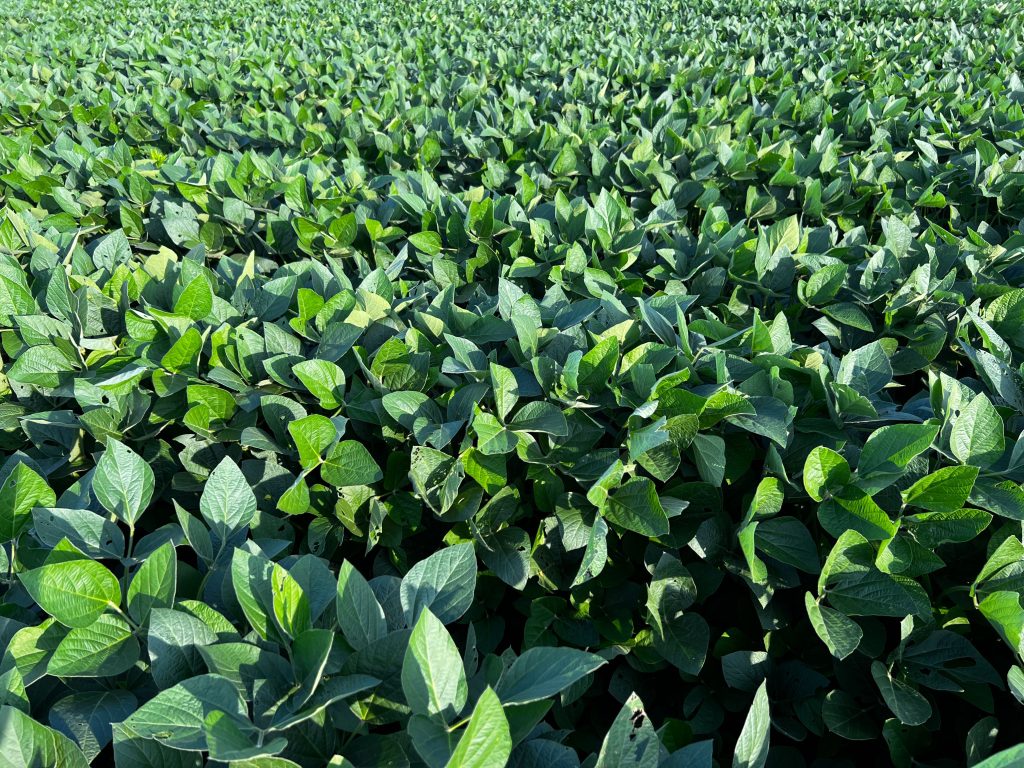
A soybean field in August can look much closer to harvest than it really is.
The rows are closed. The canopy is tall. Pods are visible from top to bottom, and the crop may already be beginning to change color in isolated areas.
Inside those pods, however, yield is still being built.
During the R5 stage, seeds are beginning to develop. By R6, green seeds fill much of the pod cavity. The plant is still using water, capturing sunlight, taking up nutrients, remobilizing nutrients from older tissue, and moving carbohydrates into developing seed.
That makes August an important period for protecting soybean yield.
Potassium is part of that process because soybeans require substantial K and depend on it for water regulation, enzyme function, carbohydrate transport, and normal reproductive development.
The important management question is whether the crop has access to enough potassium, not whether another fertilizer application can simply be added late in the season.
Current 2026 field observations show why that distinction matters. Minnesota Extension reported in August that hot and dry conditions were contributing to pod and seed abortion in some soybean fields and emphasized that the R4-to-R7 period remains critical for final yield.
At the same time, Iowa State reported many soybean fields progressing through R4 and R5 under highly variable rainfall conditions.
A field in active seed fill that is also short of soil moisture may show nutrient symptoms for reasons that go beyond fertilizer rate.
Soybean yield comes down largely to the number of harvested seeds and the weight of those seeds.
Earlier in the season, plants have considerable ability to compensate for stress. They can produce additional branches, flowers, and pods when conditions improve.
That flexibility decreases as reproductive development advances.
Once the crop reaches the heart of seed fill, lost seed number and seed size become harder to recover.
Drought during this period can reduce photosynthesis and cause pods or individual seeds to abort. Seeds that remain may finish smaller if the crop cannot maintain enough water and carbohydrate supply.
Minnesota’s August 2026 observations describe R5.5 as an especially important point for soybean yield because the plant is heavily committed to seed development.
Soybeans accumulate large amounts of potassium during the growing season.
The nutrient supports many processes rather than serving as a structural component of one particular molecule.
Potassium contributes to stomatal regulation, enzyme activation, transport of photosynthates, water balance, and other functions involved in converting sunlight and soil resources into seed.
When potassium is insufficient, leaf function can decline and the plant may lose productive canopy area while seed fill is still underway.
That is one reason low-K soybeans can show significant yield response to a properly planned potassium program.
The key word is properly planned.
A severe August deficiency is often evidence that the field should have entered reproductive development with better potassium availability.
Potassium is mobile in the soybean plant, so early deficiency often appears on older leaves.
The edges of the leaflets turn yellow. With increasing severity, those margins become brown and necrotic while the tissue closer to the center may remain greener for a time.
Late in the season, however, the pattern can become less straightforward.
Iowa State has documented potassium-deficiency symptoms in middle and upper soybean leaves during August, particularly in low-testing soils and droughty conditions.
That means growers should not dismiss upper-canopy yellowing simply because potassium deficiency is normally taught as an older-leaf symptom.
At the same time, disease can produce similar canopy discoloration, so diagnosis needs to go beyond color alone.
Sudden death syndrome and brown stem rot are two examples of soybean problems that can produce yellowing between leaf veins and eventually cause necrosis.
Other diseases and root problems may also contribute to premature canopy decline.
If an affected plant shows leaf symptoms that do not clearly match marginal K deficiency, split the stem and examine internal tissue. Inspect roots. Check whether the problem follows field drainage, soil type, or variety.
A diagnostic laboratory can be valuable when symptoms are unclear.
Applying potassium to a field whose primary limitation is disease will not solve the problem.
Likewise, diagnosing a true K deficiency as disease can allow a correctable fertility problem to continue for another rotation.
Soybean roots obtain potassium from the soil solution and exchange sites around the root zone.
As soil dries, K movement toward roots becomes slower.
Root activity also becomes concentrated where moisture remains.
This is why potassium-deficiency symptoms frequently appear during drought.
Iowa State reports that K symptoms can develop even in fields where soil-test potassium is adequate if dry soil is restricting root access to the nutrient.
That difference matters enormously.
If the field is truly low in K, the fertility program needs correction.
If the field already contains adequate K but lacks moisture, another fertilizer application may do very little until water returns.
It is accurate to say that potassium is involved in plant water regulation.
It is inaccurate to turn that relationship into the claim that potassium fertilizer can protect any soybean field from drought.
A crop with adequate K is better positioned to carry out its normal physiological functions than a crop suffering from a true potassium deficiency.
However, potassium cannot make stomata function normally when the soil is so dry that the plant must close them to prevent severe water loss.
Minnesota Extension’s August 2026 observations describe how soybean stomata close during drought, reducing carbon dioxide uptake and photosynthesis. The crop can then begin losing top-end yield potential through reduced seed growth and reproductive loss.
If water is the main limitation, fertilizer cannot substitute for moisture.
The top inch of soil can be dry while deeper layers still contain usable water.
The reverse can also happen after a small rain that wets only the surface.
Use a probe, auger, or shovel to evaluate moisture through the active rooting depth.
Soil texture matters.
A deeper silt loam may store considerably more plant-available water than a coarse sandy soil.
Compaction also matters because it can prevent roots from reaching the deeper moisture even when that water is present.
The question is not simply whether the field received rain.
The question is whether the roots can access enough water to continue supporting seed fill.
Where irrigation is available, soybean water demand should be matched to crop stage and actual soil water supply.
Minnesota Extension’s August 2026 irrigation guidance notes that late reproductive crops can still have meaningful water use remaining before maturity.
Stopping irrigation too early can allow stress during seed fill.
Continuing too long can waste water and energy while creating unnecessary wetness late in the season.
The right decision is based on root-zone moisture, growth stage, soil water-holding capacity, crop water use, and expected rainfall.
When potassium symptoms appear, review recent soil tests.
A field already testing low in K has an obvious reason to investigate fertility further.
A field testing well into a sufficient range requires more scrutiny before assuming fertilizer is the answer.
Look at how many crops have been harvested since the sample was taken.
Consider yield levels.
Review potassium application history.
Check whether manure has been used.
Look for previous years when deficiency appeared in the same areas.
A single whole-field average may also hide important variability, especially on rolling ground or fields with different soil textures.
If an August field has distinct yellow areas, do not blend those areas into one postharvest composite sample.
Collect samples from the affected zone and from a nearby healthy zone with similar landscape position where possible.
Keep depth and sampling procedure consistent.
The comparison can answer an important question.
If the yellow area tests substantially lower in potassium, there is stronger evidence for a soil-fertility problem.
If both areas test similarly and adequately, drought, roots, disease, or another factor deserves more attention.
This zone-based comparison often provides more useful information than one field-average sample.
When testing confirms a potassium shortage, Supply Solutions Sulfate of Potash 0-0-50 provides potassium without adding nitrogen or phosphorus.
The reason to use it is to correct an identified K deficiency so the crop has adequate potassium available during future periods of rapid growth and reproductive demand.
The timing should follow soil-test recommendations, crop rotation, soil conditions, and regional agronomic guidance.
For soybeans already well into R5 or R6, a late rescue application should not automatically be expected to replace yield lost earlier in the season. In many cases, the stronger response is to document the problem and correct potassium fertility ahead of the next crop.
The problem Sulfate of Potash solves is inadequate K availability in the fertility program.
It does not correct disease or drought-induced uptake restriction by itself.
Soybeans are legumes and normally rely heavily on biological nitrogen fixation.
Stress can reduce fixation, especially during drought or prolonged saturation.
That can contribute to pale plants, but it does not mean commercial nitrogen should automatically be added.
Inspect nodules and roots.
Consider soil pH because acidity can influence nodulation.
Look at moisture stress.
Check for root disease.
Evaluate crop stage.
Routine late-season nitrogen application should not replace understanding why the soybean crop is yellow.
Soybean leaves remain important during R5 and R6 because they are producing the carbohydrates used to fill seed.
Insects and diseases that remove or disable substantial leaf area can therefore reduce final yield.
Minnesota Extension’s August 2026 field reports continued to highlight the importance of scouting soybean insects under dry conditions, including pests associated with stressed fields.
Treatment decisions should follow economic thresholds, current crop stage, and pesticide labels.
The same principle applies to fertility.
An application should be driven by a diagnosed and economically meaningful limitation rather than simply by the desire to keep the canopy green.
Soybeans naturally yellow and drop leaves as they approach maturity.
A field beginning normal senescence should not be treated as though it is suffering a correctable nutrient deficiency.
Crop staging is therefore essential.
Look inside pods.
Determine whether seeds have filled the pod cavity.
Check whether a mature-colored pod is present at one of the upper nodes used for staging.
If the crop is approaching R7, yellowing is increasingly part of normal maturation.
If the crop is still at R5 with widespread premature leaf loss, the diagnosis deserves much more attention.
A potassium problem discovered during seed fill should not be forgotten once harvest begins.
Map the affected zones.
Photograph them.
Compare yield later.
Review soil tests.
Sample strategically.
Then determine whether the fertility plan needs to change before the next soybean or corn crop.
The strongest potassium program is preventative rather than reactive.
The goal is to enter August with enough plant-available K that a genuine nutrient shortage does not add another layer of stress during pod and seed fill.
Supply Solutions Sulfate of Potash 0-0-50 can provide a targeted potassium source where testing shows that K needs to be built or maintained. The recommendation should come from soil-test status, yield history, crop removal, and field symptoms working together. Farmers who see recurring potassium stress in August can contact Supply Solutions for help selecting an appropriate source and timing, but correcting the fertility program before the next crop reaches seed fill will usually provide more value than waiting for yellow leaf margins to appear again.
Walk into a fertilizer warehouse, farm supply store, greenhouse, or garden center and the first thing most people notice on a fertilizer bag is a
When fertilizer prices are high, farmers naturally want every pound of nutrient they purchase to contribute as much as possible to crop production. That makes
Give us a call or visit our store, and we’ll help you find the right solution for your business.