

Uncategorized
Should You Fertilize a Heat-Stressed Lawn in August? Often, the Answer Is Not Yet
A brown lawn in August creates pressure to make it green. The grass may appear thin, dull, or lifeless. A fertilizer bag promises color and
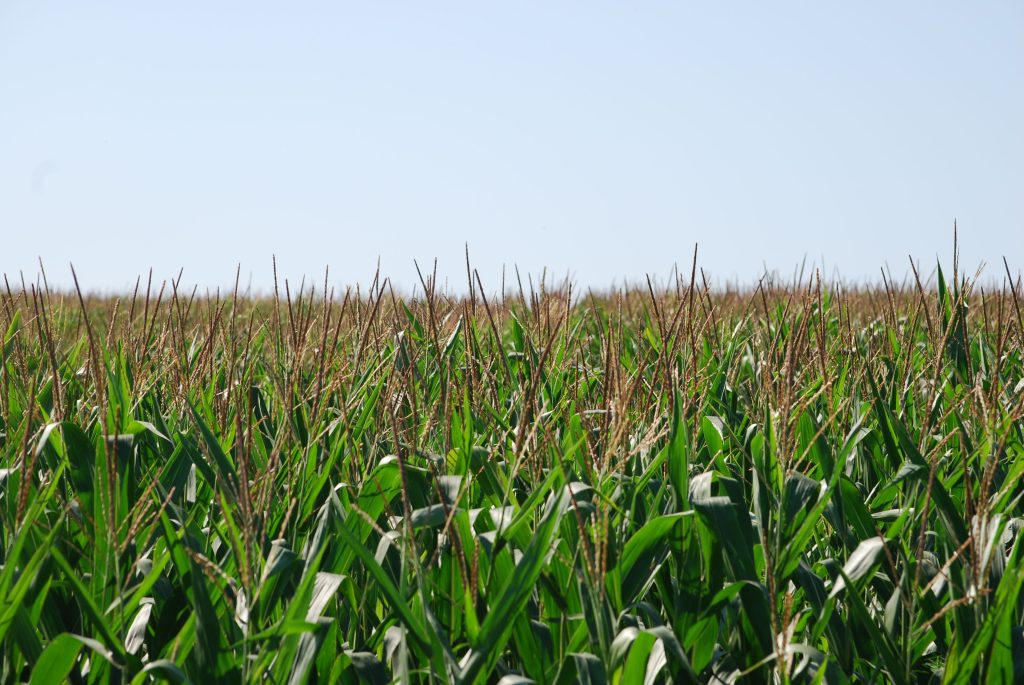
A cornfield can look nearly finished long before the crop is finished using water.
Once pollination is complete and ears are filling, attention often shifts toward harvest preparation. Irrigation equipment may be needed elsewhere. Water costs continue to accumulate. Growers begin watching milk lines and grain moisture. In a dryland field, there may be little control over rainfall, but there is still a need to understand how much yield remains exposed to stress.
The important point is that corn does not stop needing water when silks turn brown.
At blister stage, the ear has only begun converting the results of pollination into grain. At milk and dough, kernels are adding dry matter rapidly. Even after dent begins, the crop continues moving water, sugars, and nutrients into the ear until physiological maturity.
University of Minnesota Extension estimates that corn near R2, or blister, may still use roughly 6 to 7 inches of water before maturity under normal central Minnesota conditions. Estimated remaining use falls to about 4.7 inches at milk, 2.5 inches at dough, 1.5 inches at full dent, and less than an inch near the half-milk-line stage. Actual use varies with temperature, wind, humidity, canopy condition, soil, and location, but the numbers show why stopping irrigation by calendar date can be costly.
Corn reproductive stages describe what is happening inside the kernel.
R2, the blister stage, generally begins 10 to 14 days after silking. The kernels are small, pale, and filled with clear fluid. At R3, around three weeks after pollination, that internal fluid becomes milky as starch begins accumulating. During R4, the kernel contents thicken to a dough-like consistency, and the kernel has accumulated roughly half of its mature dry weight. Dent typically begins about 35 to 42 days after silking, followed by the gradual movement of the milk line toward the kernel tip. Physiological maturity occurs when dry-matter accumulation is complete.
That sequence is not simply a visual countdown to harvest. It reflects a large transfer of energy into the grain.
The plant needs healthy leaves to capture sunlight. It needs functioning roots to absorb water and nutrients. It needs enough stalk strength and stored carbohydrates to support the ear. When drought, disease, hail, nutrient shortage, or root restriction reduces current photosynthesis, the plant may draw more heavily on reserves stored in the stalk.
This can protect some kernel fill in the short term while increasing the risk of weak stalks and lodging later.
Leaf rolling is one of the most familiar signs of corn water stress. Plants roll their leaves to reduce the exposed surface area and slow water loss. Mild rolling late in the afternoon does not automatically mean severe yield loss. A field that recovers overnight may still be functioning reasonably well.
The pattern becomes more concerning when leaves roll early in the day, remain rolled overnight, or begin losing their gray-green color.
Even then, the visible canopy is only part of the story.
Water stress during grain fill can reduce photosynthesis, speed leaf death, shorten the grain-filling period, reduce kernel weight, and increase remobilization from the stalk. Where stress is severe soon after pollination, weak kernels may abort. Later stress more often reduces kernel depth and test weight.
A field can therefore retain a full-looking ear and still lose yield through lighter kernels.
A dry top inch does not mean the crop is out of water. A damp surface after a shower does not mean the profile is full.
Corn roots can explore several feet of soil where structure, drainage, and chemistry allow. The useful question is how much plant-available water remains within the active root zone.
A probe, auger, or soil-moisture sensor should be used at multiple depths. Checking only 6 inches can lead to unnecessary irrigation if deeper soil is still supplying the crop. Checking only a deep sensor can miss rapid drying in the portion of the root zone where most roots are active.
Field variability also matters.
Sandy areas hold less water and often require smaller, more frequent irrigation. Fine-textured soil can store more water but may accept it slowly. Compacted zones may contain moisture below a dense layer while roots remain shallow above it. Gravel, hardpans, high water tables, or damaged subsoil can reduce the effective root-zone depth.
A nominally deep soil does not provide deep storage when roots cannot use it.
Early-season weather often determines late-season water access.
Corn planted into wet soil may develop sidewall compaction or shallow roots. Saturated areas can lose roots from oxygen deprivation. Compacted headlands may restrict root penetration. Rootworm feeding, nematodes, crown rot, and other injuries can reduce the root system even when surrounding soil contains water.
This is why stressed corn sometimes appears beside green corn in the same field.
Before increasing irrigation, dig plants from both areas. Healthy roots should extend through a reasonable volume of soil, with fine lateral roots actively exploring the profile. Restricted roots may turn along a compacted layer, remain concentrated near the seed furrow, show pruning, or contain dark, decayed tissue.
More water applied to a restricted root zone can help temporarily, but heavy applications may also saturate the shallow zone and push nutrients below the roots.
A fixed schedule is simple but rarely efficient during grain fill.
Daily crop water use changes with growth stage and weather. Hot, dry, windy days can remove much more water than cloudy, humid days. The crop’s demand generally declines as leaves age and maturity approaches, but a late heat spell can still produce substantial use.
Irrigation decisions should combine:
University of Minnesota Extension recommends checking soil moisture regularly and avoiding the assumption that a crop needs water simply because the season is advanced. The same guidance warns against filling the profile immediately before forecast rain, because excess water can leach nitrate below the root zone and delay crop dry-down.
That is especially important on sandy soil.
A grower who applies a full irrigation ahead of a strong storm may turn useful rainfall into drainage. Water leaving the root zone can carry nitrate with it. The crop then enters late grain fill with less nitrogen available and no practical way to recover the lost nutrient.
The goal is to replace enough water to prevent damaging stress without applying more than the profile can hold.
A small irrigation may be appropriate when the upper portion of the root zone is drying but deeper moisture remains available. A larger application may be justified when a deeper profile deficit has developed and the soil can accept the water without runoff.
Application rate matters as much as total depth.
Heavy water delivered faster than the soil can absorb it may pond or run off. This is common on crusted surfaces, sloping fields, compacted soils, and fine-textured ground. In center-pivot systems, outer spans apply water at a higher instantaneous rate because they cover more area.
Residue helps by protecting the soil surface, reducing evaporation, and slowing runoff. Good aggregation and pore continuity allow water to move downward. Tillage pans and traffic compaction interrupt that movement.
When runoff occurs, increasing the irrigation amount usually increases the waste. The soil or application problem must be addressed.
The milk line is useful, but it should not be treated as an automatic shutoff switch.
As dented kernels mature, the milk line moves from the crown toward the tip. The amount of water still needed declines significantly, and the soil profile may contain enough stored moisture to finish the crop without another irrigation.
The correct decision depends on how much water remains, how many days are expected to maturity, and how much crop use is likely during those days.
A field at half milk line on a deep loam with a moist profile may be able to finish without irrigation. The same stage on shallow sand during a hot, windy forecast may justify another application.
Corn still requires some water until physiological maturity, but the final irrigation is usually applied before maturity because stored soil moisture carries the crop through the last portion of grain fill. Extension guidance notes that the last irrigation may often occur two to three weeks before physiological maturity, depending on soil water storage and weather.
Average field conditions can hide the areas that determine the irrigation decision.
A probe location near the pivot point may show adequate moisture while the outer spans are dry. A low area may be wet while sandy ridges are stressed. Compacted wheel tracks may remain saturated after the surrounding soil becomes workable. Field edges may receive less water because of system overlap or wind distortion.
Check multiple representative zones.
The purpose is not to keep every square foot at identical moisture. That is rarely possible. The purpose is to understand whether a meaningful share of the field is approaching damaging stress while enough yield potential remains to justify irrigation.
Variable-rate irrigation can help where equipment and field information support it, but careful manual scouting remains valuable even with sensors.
Water applied today protects future grain fill. It does not reverse kernel abortion or restore leaf area that has already died.
This distinction is important when deciding how much money to invest in a severely damaged field.
Open ears and examine kernel set. Assess leaf area above and below the ear. Check stalk quality, disease, insect injury, stand uniformity, and root health. Estimate how much functional canopy remains.
A field with strong kernel set, healthy upper leaves, and temporary moisture stress may have considerable yield left to protect. A field with poor pollination, extensive disease, dead leaf area, and weak roots may not repay aggressive irrigation.
The decision should be based on remaining yield potential rather than the original yield goal.
Late-season drought often brings visible nitrogen or potassium symptoms. That does not necessarily mean the soil lacks those nutrients.
Dry soil restricts nutrient movement to roots. It also reduces root growth and biological nutrient cycling. Applying more fertilizer to a dry surface may leave the nutrient unavailable until rain arrives. Concentrated fertilizer salts can increase stress near roots.
Foliar products are sometimes promoted as a way around dry soil, but a leaf can absorb only limited quantities of macronutrients. A foliar application cannot supply the pounds of nitrogen or potassium required to replace a major soil shortage during grain fill.
Correct the water limitation where irrigation is practical. Diagnose the nutrient problem separately.
Where irrigation is not available, preserve information for the next season. Map early-firing areas, compacted zones, poor infiltration, and shallow rooting. Soil and tissue samples from affected and healthy areas can help determine whether fertility contributed to the stress.
Efficient irrigation is not simply using less water. It is delivering water at the time, rate, and depth that protects yield while minimizing runoff, evaporation, and leaching.
That requires attention before August.
Residue management affects evaporation. Compaction affects rooting and infiltration. Drainage affects root survival. Nitrogen timing affects leaching risk. Hybrid maturity affects the length of the grain-filling period. Plant population affects total canopy demand. Weed control determines whether water supports the crop or competing plants.
August reveals the result of those earlier choices.
A well-rooted crop on structured soil can use water stored from earlier rainfall. A shallow-rooted crop may depend on repeated surface wetting. The difference can determine whether a field tolerates a week of heat or begins losing kernel weight after only a few days.
The best late-season irrigation decision starts with a shovel and a crop-stage check. Determine how much water the crop still needs, how much the soil can supply, and whether the roots can reach it. Then apply only what the profile can hold.
Supply Solutions can help growers evaluate soil conditions and nutrient programs alongside irrigation management. Fertilizer performs best when water is available, roots are active, and the application addresses a verified need. Contact the company for guidance before adding nutrients to a field where moisture, compaction, or root damage may be the real limitation.
A brown lawn in August creates pressure to make it green. The grass may appear thin, dull, or lifeless. A fertilizer bag promises color and

An orchard can look finished after the bins leave the row. The crop is harvested, irrigation demand begins to decline, and the urgency of the
Give us a call or visit our store, and we’ll help you find the right solution for your business.