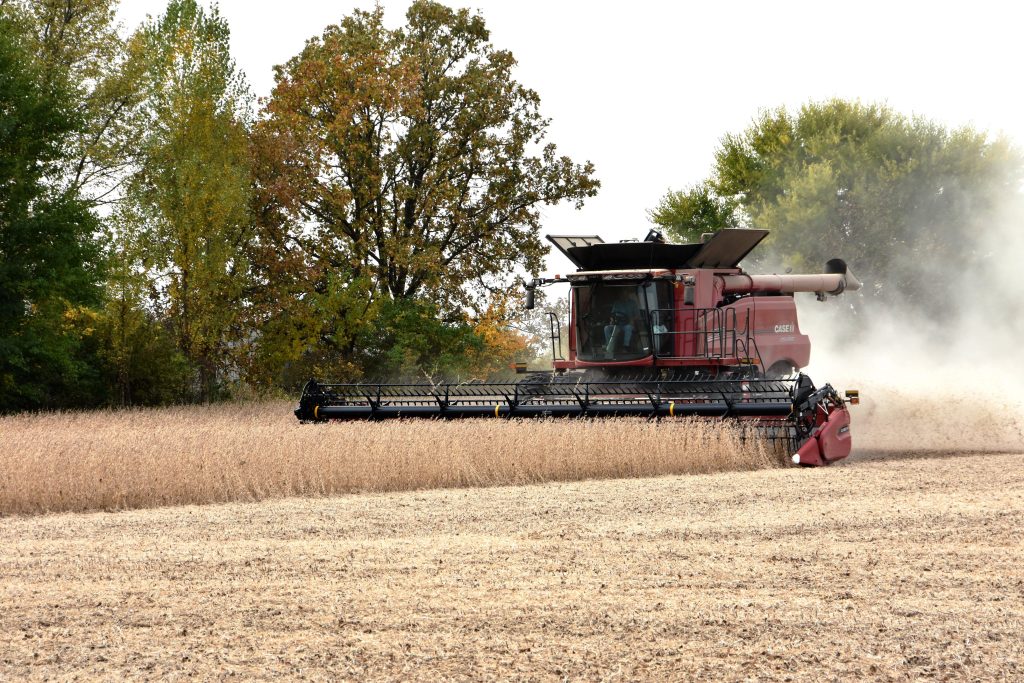
A soybean field can turn yellow for several completely different reasons.
One cause may justify a future potassium application. Another may require variety resistance and seed treatment next season. A third may point toward drainage, compaction, nematodes, or herbicide injury.
Treating all yellow soybeans as a fertilizer shortage is one of the easiest ways to spend money without changing the outcome.
August is when many of these problems become visible. The canopy is carrying pods, roots are under high demand, and diseases established earlier in the season begin expressing symptoms aboveground.
The diagnosis should start with the field pattern, then move to leaves, stems, and roots.
Look at the field before touching the plant
Stand where you can see the pattern.
Does the yellowing follow an eroded ridge, compacted headland, low area, old field entrance, soil type, drainage path, or previous crop row? Does it begin along field edges? Is it scattered in circular patches or spread uniformly?
Patterns provide clues.
Nutrient deficiencies often follow soil variation or crop-removal history. Sudden death syndrome may be more severe in productive, compacted, or poorly drained areas and where soybean cyst nematode pressure is high. Phytophthora follows wet soil and drainage patterns. Spider mites often begin at dry field edges. Herbicide injury may follow spray overlap, drift direction, or application width.
A field-level photograph is often as useful as a close leaf photograph.
Potassium deficiency affects leaflet margins
Potassium deficiency generally begins as light green or yellow tissue along the margins of older soybean leaves. The edges may turn brown and die as the shortage becomes more severe.
During reproductive growth, symptoms can move into the middle and upper canopy. Dry weather can produce potassium-deficiency symptoms even where soil-test potassium is considered adequate because moisture is required for potassium movement toward roots.
A true soil shortage is more likely where:
- Soil-test potassium is low
- High yields have removed substantial potassium
- Straw, silage, or forage has been removed
- Symptoms follow sandy or eroded areas
- Similar symptoms have appeared in previous years
- Healthy and affected zones have different soil-test results
Dry-soil-induced symptoms may improve after rain, although damaged leaf edges remain brown.
Sudden death syndrome begins at the roots
Sudden death syndrome, or SDS, produces striking leaf symptoms, but infection begins much earlier at the roots.
The disease is favored by cool, wet soil around planting. Symptoms often appear during reproductive growth, especially after rain or irrigation around flowering.
Leaves develop yellow spots between the veins. The yellow areas expand and may become brown, while the major veins remain green. Severely affected leaves drop, but their petioles often remain attached to the stem.
Roots may be rotted and plants can pull easily. Blue fungal growth may appear on roots under favorable conditions.
Nebraska Extension identifies petiole retention, root deterioration, and blue fungal growth as useful clues. Symptoms commonly appear from approximately R3 onward.
No August fertilizer application cures SDS.
Management focuses on resistant varieties, seed treatments where appropriate, soybean cyst nematode management, rotation, improved drainage, reduced compaction, and planting decisions.
Split the stem to separate SDS from brown stem rot
Brown stem rot can produce leaf symptoms nearly identical to SDS.
Both may cause interveinal yellowing and browning. Looking only at the leaves can lead to a wrong diagnosis.
Split the lower stem lengthwise.
With brown stem rot, the internal pith is commonly brown or discolored. With SDS, the center pith generally remains white while discoloration occurs in the outer vascular tissue and root cortex.
Nebraska Extension recommends splitting stems because brown stem rot discolors the center, while SDS primarily affects the outer stem layers and roots.
Sample several plants. Stem discoloration can vary with disease severity and plant age.
Phytophthora creates a dark external lesion
Phytophthora root and stem rot is associated with saturated soil and poor drainage.
Plants may die at several growth stages. Older plants often develop a dark brown lesion on the outside of the stem that begins near the soil line and extends upward. Leaves yellow, wilt, and may remain attached.
The external stem lesion helps distinguish Phytophthora from SDS and brown stem rot.
Dig roots carefully. They may be dark, decayed, and poorly developed.
Management depends heavily on variety resistance, seed treatment, drainage, field history, and pathogen population. Fertility cannot compensate for roots destroyed by the disease.
Root restriction can mimic a nutrient shortage
Not every yellow plant is diseased.
Compacted soil limits rooting depth and soil exploration. Early waterlogging may kill lateral roots. Sidewall compaction can confine roots to the seed furrow. Nematodes reduce root efficiency without always producing obvious aboveground signs.
A soybean plant with half the effective root volume has access to less water and fewer nutrients. It may show potassium, nitrogen, or general stress symptoms even when the surrounding soil tests adequately.
Dig healthy and affected plants.
Compare root length, lateral branching, nodules, rot, cysts, and soil structure. Examine whether roots turn horizontally at a dense layer. Check for standing water or gray, poorly aerated soil.
A root-zone problem often requires a soil-management response rather than another fertilizer.
Check nodulation
Soybeans rely on biological nitrogen fixation.
Healthy nodules should be present on the main and lateral roots. When cut open, actively fixing nodules are pink or reddish inside.
Poor nodulation can result from soil acidity, waterlogging, drought, compaction, ineffective inoculation, high residual nitrogen, or other stress.
A field with weak nodulation may appear pale, but applying nitrogen late in the season is not automatically economical. Determine how widespread the problem is and how much yield remains.
Record poor nodulation for future inoculation, pH, drainage, and soil-management decisions.
Spider mites create fine stippling
Hot, dry weather favors spider mites.
Feeding causes small pale dots, or stippling, on leaves. As populations increase, leaves turn bronze, yellow, and brown. Fine webbing may be visible on the underside.
Mite damage often begins at field edges but can move inward rapidly. Dusty conditions may worsen pressure.
Use a hand lens and shake leaves over white paper. Tiny moving mites are easier to see against the light background.
Do not mistake mite bronzing for potassium deficiency. Fertilizer will not stop an expanding mite population.
Treatment decisions should follow current local thresholds, product labels, resistance-management guidance, and beneficial-insect considerations.
Herbicide symptoms follow application history
Several herbicides can cause chlorosis, necrosis, cupping, crinkling, or distorted growth.
Review application records, tank contamination, weather, neighboring fields, and overlap patterns. Symptoms appearing in straight widths or along one side of the field suggest an application issue.
Root-inhibiting carryover can produce stunted plants and poor roots. Contact herbicides may create speckling or burned tissue. Growth-regulator injury often affects new leaves.
Nutrient applications do not repair herbicide-damaged tissue. The useful response is documenting the pattern, confirming the source, and protecting future growth where possible.
Normal maturity begins unevenly
Soybeans do not always mature uniformly.
Sandy ridges, compacted areas, disease patches, and earlier-planted zones may yellow before the rest of the field. Some variety differences are also normal.
At beginning maturity, one normal pod on the main stem has reached mature color. Leaves begin yellowing and dropping as nutrients move into seeds.
The difference between maturity and premature death lies in crop stage, pod development, and plant health.
Open pods. A mature plant should contain developed seeds. A diseased or severely stressed plant may yellow while pods remain flat or seeds are undersized.
Use paired sampling
Where nutrient deficiency remains possible, collect soil and tissue samples from affected and healthy areas.
Keep the samples separate and choose comparable landscape positions where possible. Do not compare a sandy ridge with a wet depression unless soil type is the suspected cause.
Follow the laboratory’s crop-stage instructions for tissue sampling. Avoid dead leaves and plants with obvious stem disease.
Record:
- Variety
- Planting date
- Crop stage
- Recent rain or irrigation
- Herbicide history
- Soil type
- Previous crop
- Fertilizer and manure history
- Nematode history
- Symptom pattern
A laboratory number without field context can be misleading.
Do not expect an August fertilizer to reverse disease
Where testing confirms a potassium or magnesium shortage and the crop remains responsive, a nutrient plan may be justified. In many fields, however, the best correction is made after harvest.
A dry-soil-induced shortage may not respond until moisture returns. SDS, brown stem rot, Phytophthora, nematodes, herbicide injury, and root compaction will not be cured by a general foliar feed.
The product must match the cause.
That standard protects the farm from treatments designed around appearance rather than agronomy.
Preserve information for next season
Flag disease patches before leaves drop. Record GPS locations. Collect roots and stems for diagnostic confirmation. Send nematode samples where appropriate.
After harvest, soil sample the affected zones. Review drainage and traffic. Compare variety performance. Check whether symptoms follow fields with low potassium or high soybean cyst nematode counts.
This information can change variety selection, seed treatment, crop rotation, lime, potassium management, tillage, drainage, and planting sequence.
A yellow field in August is not only a current-season problem. It is a map of where the production system is under pressure.
Supply Solutions can help evaluate soil and tissue results where potassium, magnesium, sulfur, pH, or another nutrient may be involved. Contact the company after disease and root problems have been separated from fertility. A correct diagnosis prevents fertilizer from being blamed for—or sold as the solution to—a problem that begins in the roots or stem.