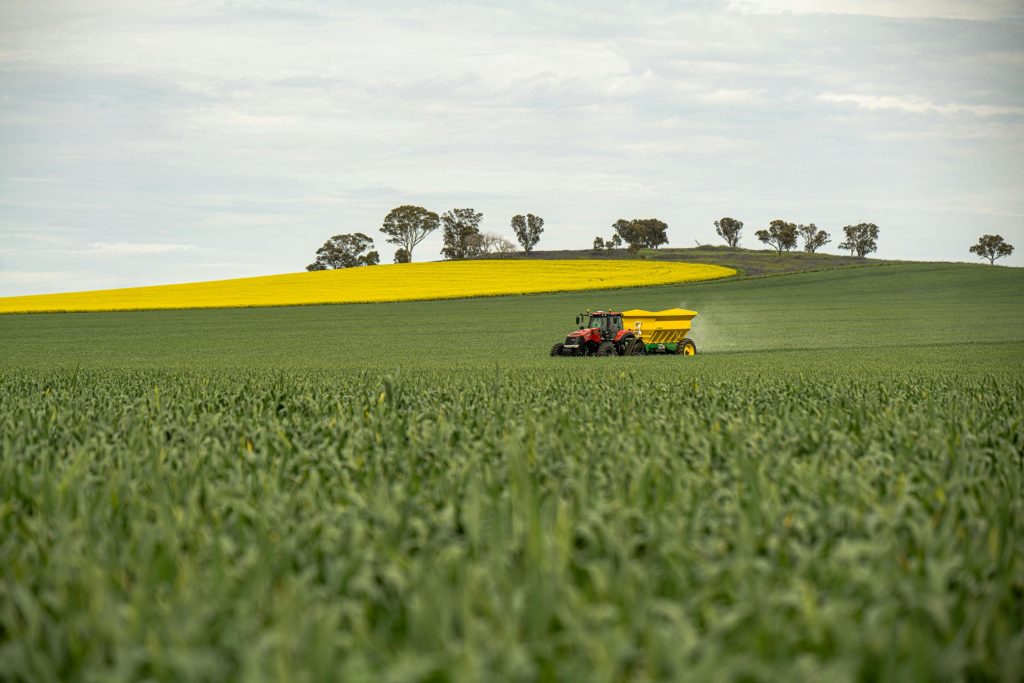
A fertilizer spreader can either be your best friend or your quiet saboteur.
If it is not calibrated, you can:
- Overapply in some areas and burn plants
- Underfeed in others and lose yield or color
- Waste product and money
- Create streaky lawns, fields, or sports turf that are hard to fix later
The good news is that calibration is not complicated. It just takes a little time, a scale, and a tape measure.
This guide will walk you through:
- Why calibration matters, even for small lawns and gardens
- A simple calibration procedure for walk-behind spreaders
- Adjustments for tow-behind and tractor-mounted spreaders
- How to record settings for products like 10-10-10, 16-16-16, 25-7-12, urea, ammonium sulfate, and sulfate of potash
Once you do this once or twice, it becomes part of your normal spring routine.
Why calibrate at all
Many people trust the chart on the spreader or guess at a setting. That is understandable, but risky.
Reasons to calibrate:
- Spreaders wear. Openings, gears, and plates change over time.
- Different fertilizers have different densities and granule sizes. 10-10-10 and 16-16-16 might not flow the same as urea or gypsum.
- Field conditions vary. Walking speed, tow speed, and overlap patterns affect total applied rate.
Calibration helps you answer a simple question with confidence:
“How many pounds of product per 1,000 square feet (or per acre) does this spreader apply at this setting and speed”
Once you know that, you can match spreader output to soil test recommendations.
Tools you need
For basic calibration, gather:
- A small accurate scale (kitchen or hanging scale)
- A measuring tape or wheel
- Buckets or pans to catch product (for stationary tests)
- A notepad and pen or your phone for notes
- A calculator
For larger tractor spreaders, you may also want:
- A tarp or sheet to catch product
- Flags or cones to mark distances
You will use the same principles whether you are calibrating for 16-16-16 on a lawn or urea on a pasture.
Part 1: Calibrating a walk-behind broadcast spreader
We will use a “weight over area” approach.
Step 1: Determine your target rate
From your soil test and product label, decide:
- How many pounds of product per 1,000 square feet you want to apply
For example:
- You decide on 4 lb of 16-16-16 per 1,000 square feet for an early spring lawn feeding.
Write that number down.
Step 2: Measure a test area
Choose a flat area where you can walk comfortably, and measure out:
- A rectangle that is 10 feet wide by 100 feet long = 1,000 square feet
or
- A rectangle that is 5 feet wide by 200 feet long = 1,000 square feet
Mark the boundaries with stakes, flags, or visible objects.
Step 3: Weigh fertilizer into the spreader
- Put a known amount of fertilizer into the spreader, for example 10 lb.
- Record the starting weight.
You want more than you think you will use so you do not run out mid-pass.
Step 4: Pick an initial setting and walking speed
- Set the spreader to a mid-range setting suggested on the chart for your product, or a starting point you have used before.
- Choose a comfortable walking speed you can maintain consistently.
Consistency is more important than perfection.
Step 5: Make a test pass
- Start walking a few feet before your test area so you are up to speed.
- Open the spreader at the starting line and walk the full length of the area in straight, even rows, overlapping slightly according to the spreader pattern.
- Close the spreader at the end and walk a few feet beyond before turning around.
Try to mimic how you would actually apply in the lawn.
Step 6: Weigh the remaining product
- Carefully pour the remaining fertilizer from the spreader back into the bucket and weigh it.
- Subtract from the original weight to determine how much was applied on your 1,000 square foot test area.
For example:
- Start: 10.0 lb
- End: 5.5 lb
- Applied: 4.5 lb on 1,000 square feet
Step 7: Compare to your target and adjust
If your target is 4 lb per 1,000 square feet and you applied 4.5 lb:
- You are slightly high. You can either:
- Close the gate slightly and repeat the test, or
- Walk a bit faster, which will reduce application per area
If you had applied only 3 lb and needed 4 lb:
- Open the gate slightly or walk a bit slower, then repeat the test.
Do one or two more test passes until you consistently hit close to your desired rate.
Step 8: Record your settings
Write down:
- Product name and analysis (for example, 16-16-16)
- Spreader brand and model
- Gate setting number or description
- Walking speed (for example, “normal brisk walk”)
- Achieved rate in lb per 1,000 square feet
This becomes your personal calibration chart.
Part 2: Calibrating tow-behind and tractor spreaders
The concept is the same, but the mechanics change slightly.
Step 1: Target rate and area
Decide your target rate per acre or per 1,000 square feet.
For field or pasture work, rates are often per acre. For example:
- 60 lb N per acre from urea 46-0-0 on pasture
- 50 lb K₂O per acre from sulfate of potash 0-0-50 on a hay field
Convert target NPK to product pounds per acre using the nutrient percentages on the bag. Supply Solutions can help with this math if needed.
Step 2: Stationary calibration (for large spreaders)
For some tractor-mounted spreaders, a stationary calibration is easiest:
- Block or disconnect the drive so you can spin the disc by hand, if the design allows, or elevate driven wheels and mark revolutions.
- Place a tarp or series of pans beneath the outlets to catch product.
- Run the spreader for a known number of disc revolutions or wheel rotations at a chosen gate setting.
- Weigh the collected product and convert to a per-acre rate using the spread width and ground speed you plan to use.
This method can be more technical, but many owner manuals provide step-by-step procedures. If you would like help interpreting them for urea, ammonium sulfate, gypsum, or blended fertilizers, Supply Solutions can assist.
Step 3: In-field calibration by distance
Another option:
- Put a known weight of product into the hopper, for example 200 lb.
- Measure a known area in the field, such as a strip that represents 1 acre based on your spread width and travel distance.
- Drive at the speed you will use for fertilizing with the gate at a trial setting.
- After passing over the measured area, weigh the remaining product.
- The difference is what you applied on that acre.
Adjust gate opening and travel speed until the applied amount matches your desired rate.
Always:
- Use safe procedures when working around moving equipment.
- Keep bystanders and animals away from calibration runs.
Matching calibration to different products
Different products flow differently:
- 10-10-10 with micronutrients is medium density with a certain granule size.
- 16-16-16 may have a similar or slightly different spread pattern.
- Urea 46-0-0 is very dense, with small prills that spread differently.
- Ammonium sulfate 21-0-0-24S and sulfate of potash 0-0-50 have their own characteristics.
- Purest Gypsum Soil Acidifier is a very fine, powdery product that requires specific application equipment and approaches.
You cannot assume one calibration works for all products. At a minimum:
- Calibrate at the start of the season with one representative product.
- Spot check when you switch to a noticeably different material.
Over time, you will build a small notebook of settings for each fertilizer you commonly use.
Safety and good habits
While calibrating and spreading:
- Wear appropriate PPE: gloves, eye protection, and a dust mask or respirator when working around dusty products.
- Keep children, pets, and visitors away from calibration and spreading areas.
- Clean spreaders after use to prevent corrosion and caking.
Store records of calibrations with your soil tests and fertilizer plans so that you can see how everything fits together.
A simple calibration checklist
- Decide target rate per 1,000 square feet or per acre from soil tests
- Measure test area and mark boundaries
- Weigh fertilizer into spreader
- Make a test pass at a chosen setting and speed
- Weigh remaining product and calculate applied rate
- Adjust gate opening or speed and repeat as needed
- Record final settings and rate for each product
If you would like help converting your soil test recommendations into practical calibration targets for 10-10-10, 16-16-16, 25-7-12, urea, ammonium sulfate, sulfate of potash, or gypsum, Supply Solutions can walk through the numbers with you.
Supply Solutions, LLC – Fertilizer, Agricultural & Safety Solutions
Phone: 503-451-1622
Email: sales@mysolutionssupply.com
Hours: Monday to Friday, 7:00 a.m. to 5:00 p.m.
Web: www.mysolutionssupply.com
We provide 10-10-10 and 16-16-16 lawn and garden fertilizers, 25-7-12 turf blends, urea 46-0-0, ammonium sulfate 21-0-0-24S, sulfate of potash 0-0-50, Purest Gypsum Soil Acidifier, Pacific Bounty organic fish fertilizers, and practical guidance to help Pacific Northwest growers calibrate spreaders and apply nutrients accurately.