An empty field in August is not inactive.
Crop residue is decomposing. Soil organisms are mineralizing nutrients. Rain is moving nitrate through the profile. Bare soil is exposed to erosion, crusting, weed establishment, and temperature swings.
After wheat, oats, peas, sweet corn, green beans, early potatoes, cucumbers, or another early-harvested crop, there may be enough growing season left to establish a useful cover crop.
That opportunity is more than a way to make the field look green.
A well-selected cover crop can capture residual nitrogen, protect the surface, support soil structure, suppress some weeds, provide roots for soil organisms, and create grazing or forage value.
A poorly selected or late-planted cover may produce little growth, complicate spring planting, or create costs without meeting the farm’s objective.
The correct species begins with a simple question:
What job does this field need the cover crop to do?
Start With the Planting Date
August planting provides more choices than late fall.
Winter-killed species such as oats and forage radish need enough warm weather to produce biomass before frost.
Overwintering species such as cereal rye can be planted later because they resume growth in spring.
Oats, peas, and tillage radish generally fit earlier fall planting, while cereal rye, winter wheat, hairy vetch, and red clover can often be planted later because they survive winter.
Regional frost dates matter.
An August 10 planting in Minnesota has a different amount of growing time from the same date in Kentucky.
Elevation, soil moisture, and forecast temperatures also affect establishment.
Use local cover-crop planting charts rather than a single national date.
Every week of delay reduces fall growth for most species.
Define the Primary Objective
Cover crops can provide several benefits, but no single species is best at everything.
A field may need:
- Nitrogen scavenging
- Erosion protection
- Compaction relief
- Weed suppression
- Living roots
- Winter cover
- Spring biomass
- Nitrogen fixation
- Grazing
- Pollinator habitat
- Improved trafficability
- Rapid spring termination
Rank the objectives.
Where nitrate loss is the greatest concern, a fast-growing grass may be more reliable than a legume.
Where spring planting must begin early, a winter-killed species may create fewer delays.
Where a grower needs spring weed suppression, cereal rye may be worth the additional termination management.
A mixture is useful only when each component contributes to the goal.
Oats Provide Quick, Manageable Fall Growth
Oats are a practical option after many August-harvested crops.
They emerge quickly, produce fibrous roots, scavenge available nutrients, and generally winterkill in colder regions.
The dead residue can protect the soil while avoiding a spring herbicide termination.
Oats fit fields intended for early spring planting, provided fall biomass is adequate and winter conditions reliably kill the stand.
Their weakness is limited winter persistence.
In southern regions or mild winters, oats may survive longer than expected.
Where planted too late, they may produce little biomass before frost.
Oats can also provide fall forage, but grazing plans should consider soil conditions, livestock class, nitrate risk, and crop-input restrictions.
Cereal Rye Offers the Widest Planting Window
Cereal rye is one of the most dependable late-planted cover crops.
It germinates under cool conditions, survives winter across much of the United States, scavenges nitrogen, and produces substantial spring growth.
That persistence is both its advantage and its management cost.
Rye must be terminated at the correct time.
Delayed termination can dry the seedbed, produce heavy residue, tie up nitrogen temporarily, and interfere with planting equipment.
Rye before corn requires especially careful nitrogen and termination management.
Before soybeans, rye is often easier to integrate because soybeans are less sensitive to temporary nitrogen immobilization.
Cereal rye should not be confused with annual ryegrass.
They are different species with different root systems, herbicide responses, and termination challenges.
Radish Can Build Rapid Taproot Growth
Forage or tillage radish can produce a large taproot when planted early enough.
That root captures nutrients, penetrates certain compacted surface layers, and leaves channels after it decomposes.
Radish is not a substitute for mechanical correction of severe subsoil compaction.
Roots follow existing cracks and weaker zones.
They improve biological porosity over time but will not instantly remove a dense traffic pan.
Radish also decomposes rapidly after winterkill, which means captured nitrogen may be released before the following crop can use it.
Combining radish with a grass can retain nutrients longer.
Large radish stands may develop a strong odor while decomposing near homes or public areas.
Legumes Need Time and Inoculation
Legume cover crops can fix atmospheric nitrogen through their relationship with Rhizobium bacteria.
Hairy vetch, crimson clover, red clover, field pea, and other legumes each have different planting windows and winter survival.
They generally establish more slowly than cereal rye and require enough fall growth to provide meaningful spring nitrogen.
Seed should be inoculated with the correct bacterial strain where needed.
Legumes are not ideal as the only species where the immediate objective is capturing high residual soil nitrate.
When abundant soil nitrogen is available, they may rely more on soil supply and fix less atmospheric nitrogen.
A grass-legume mixture can combine nitrogen scavenging with future nitrogen contribution, but seeding rates and spring termination must be managed carefully.
Use Mixtures With a Purpose
A mixture is not automatically better because it contains more species.
Each species competes for light, water, and nutrients.
A highly competitive cereal may suppress a slower legume.
A late planting may allow only the fastest species to contribute meaningful growth.
Useful combinations include:
- Oats and radish for winter-killed fall growth
- Cereal rye and hairy vetch for overwintering biomass
- Rye and radish for nitrogen capture and varied rooting
- Oats and peas for fall forage where conditions permit
- Multi-species blends for grazing systems with adequate management
Calculate the rate of each component rather than adding full monoculture rates together.
Seed cost should be compared with the value of the specific functions expected.
Residual Nitrogen Can Be Lost After Early Crops
Peas, sweet corn, vegetables, and small grains may leave mineral nitrogen in the soil.
Crop residues also release nitrogen as they decompose.
Warm August and September soils support microbial activity, especially where moisture is adequate.
Without a growing crop, nitrate can move below the root zone during fall and spring rainfall.
A grass cover crop absorbs nitrate into plant tissue.
The nutrient remains in the system until residue decomposes.
That does not mean all captured nitrogen becomes available to the next crop.
Release depends on species, carbon-to-nitrogen ratio, maturity, weather, tillage, and soil biology.
Do Not Fertilize a Scavenging Cover Crop Without a Reason
Applying nitrogen to make a nitrogen-scavenging cover grow faster can defeat part of its purpose.
If soil nitrate is already available, a well-established grass can use it.
Additional fertilizer may increase biomass but also raises cost and loss exposure.
There are situations where fertility is justified.
A cover intended for forage may need nutrients to meet a production target.
A severely deficient soil may limit establishment.
A crop grown for seed or harvested biomass has different requirements from a soil-protection cover.
Base the decision on:
- Soil test
- Previous crop
- Manure history
- Residual nitrogen
- Cover-crop objective
- Intended removal
- Local recommendations
Do not routinely apply phosphorus or potassium without a soil-test need.
Seed-to-Soil Contact Controls Establishment
Cover crops planted into dry residue or scattered on a hard surface often emerge unevenly.
Drilling provides consistent depth and seed contact.
Broadcast seed can work when rainfall is timely and light incorporation is possible, but success becomes more weather-dependent.
Species differ in ideal depth.
Small seeds such as clover and radish generally require shallow placement.
Cereal rye can be planted somewhat deeper, while larger oat seed can tolerate greater depth.
Check actual field depth.
A drill setting is only a starting point.
Residue hairpinning, worn openers, loose soil, speed, and down pressure can change placement.
Small seeds planted too deep may exhaust their energy before emergence.
Large seeds left on the surface may dry out or be eaten.
Moisture After Planting Matters More Than Moisture at Planting
Seed can be placed into moist soil and still fail if the surface dries during germination.
Warm August temperatures speed emergence but also increase evaporation.
A small rain may germinate seed without providing enough water for root establishment.
Plant ahead of dependable rain when possible, but avoid creating a seedbed vulnerable to crusting under a violent storm.
No-till residue helps conserve moisture and protect the surface.
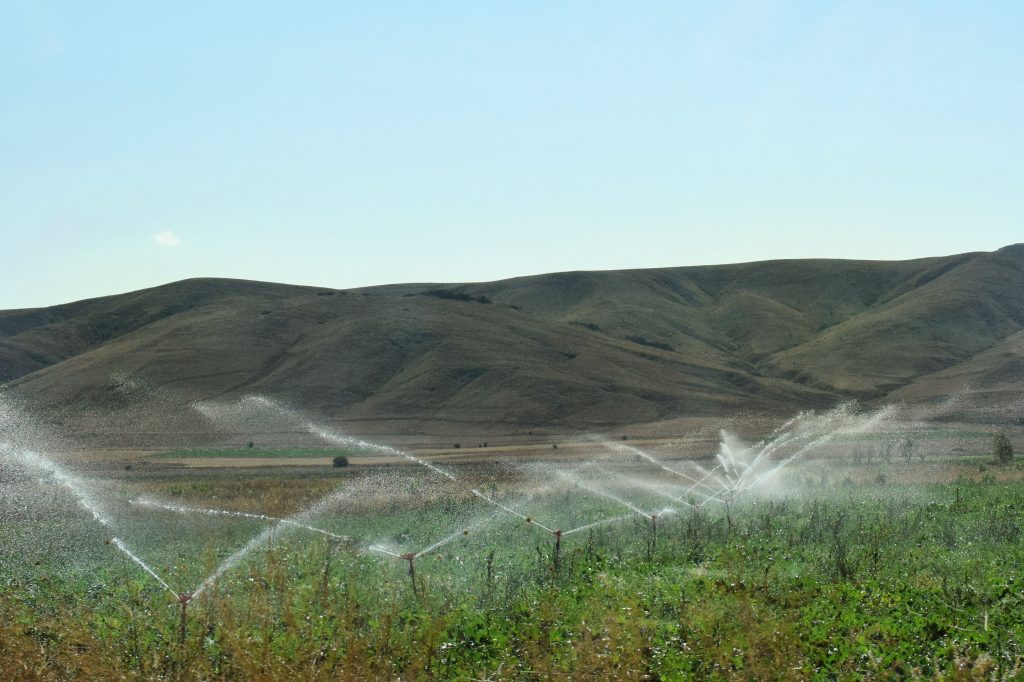
In irrigated vegetable systems, a light establishment irrigation may be used, followed by deeper applications that encourage root development.
Avoid keeping the surface saturated.
Control Weeds Before Seeding
Cover crops are not reliable rescue treatments for established perennial weeds.
Control johnsongrass, Canada thistle, quackgrass, bindweed, and other persistent weeds before planting where possible.
Review herbicide labels and rotational restrictions from the previous crop.
Some residual herbicides can injure cover crops or restrict their use as forage.
This is especially important when livestock may graze the cover.
A crop can germinate and appear healthy while still containing residues that prevent legal grazing or harvest.
Keep application records and consult the herbicide label.
Plan Termination Before Planting
Every cover crop decision includes a spring-management decision.
Ask:
- Will the crop winterkill?
- How will surviving plants be terminated?
- When will termination occur?
- What herbicide options remain?
- Can equipment handle the residue?
- Will the next crop be corn, soybeans, or vegetables?
- How will soil moisture be managed?
- Could the cover host insects or disease?
- Will the cover produce viable seed?
Do not wait until spring to learn that a species is difficult to terminate.
Winter rye is dependable because it survives.
That same survival means the grower must have a reliable termination plan.
Grazing Adds Value and Complexity
Cover crops can produce valuable fall or winter forage.
Grazing may help repay seed and establishment costs.
It also returns most consumed nutrients to the field.
Nutrient distribution will be uneven, especially around water, shade, and supplemental feed.
Hoof traffic can compact wet soil, and overgrazing can remove the protective residue the cover was planted to provide.
Livestock safety must also be considered.
Brassicas, cereal grains, sorghum species, and heavily fertilized covers can create nitrate, prussic acid, sulfur, bloat, or dietary-balance concerns under certain conditions.
Consult a livestock nutritionist and local extension specialist.
The soil-health objective should remain part of the grazing plan.
Evaluate the Cover Crop by Function
A green field is not enough evidence of success.
Measure what the cover was intended to accomplish.
For nitrogen capture, collect biomass and tissue samples where practical.
For erosion control, evaluate ground cover.
For compaction, examine roots and infiltration over several seasons.
For grazing, record livestock days and supplemental feed.
Photograph fixed points.
Compare drilled and broadcast areas, mixtures, planting dates, and termination timings.
Cover crops often deliver cumulative benefits that are difficult to measure in one season.
Good records separate real progress from assumptions.
August Is a Valuable Establishment Window
Short-season crops provide one of the clearest opportunities to integrate cover crops into U.S. rotations.
Peas, sweet corn, small grains, and corn silage can all create useful establishment windows when harvest timing allows.
The value comes from acting promptly.
A field left bare for three weeks after harvest loses three weeks of cover-crop growth.
Have seed, equipment, inoculant, and the species plan ready before the cash crop comes off.
Supply Solutions can help growers review soil-test results before deciding whether a cover crop needs any added fertility.
Contact the company where phosphorus, potassium, sulfur, pH, or another limitation may affect establishment.
The best cover-crop program uses fertilizer only when it supports a defined purpose and lets living roots do the work that a bare August field cannot.