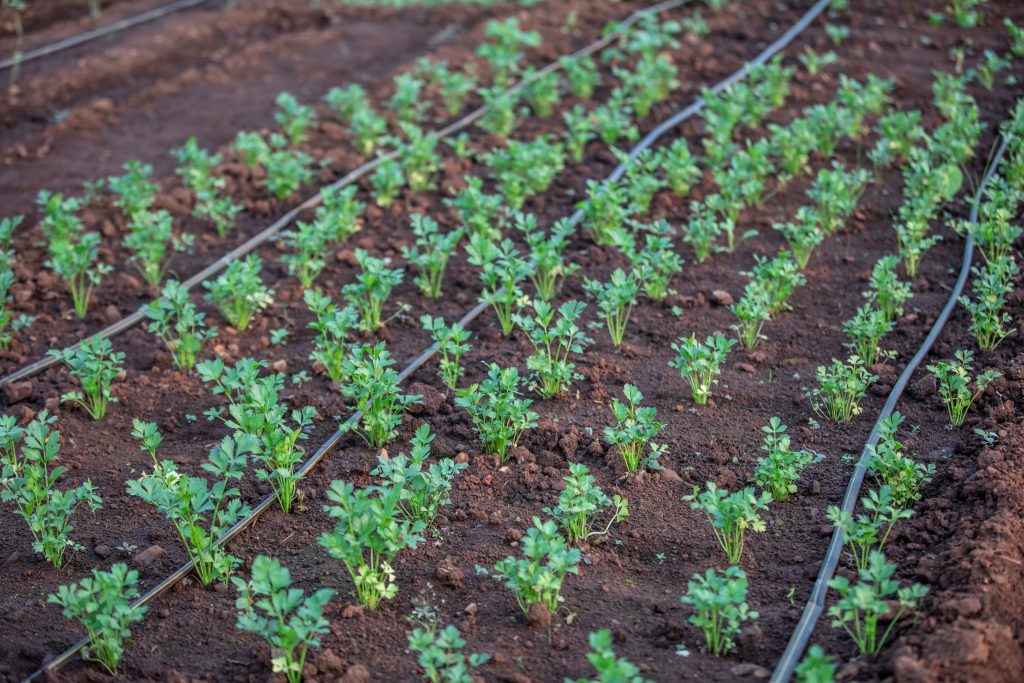
Irrigation water can keep a crop alive while gradually making the root zone harder to manage.
Every irrigation carries dissolved minerals.
The water is used by plants or evaporates from the soil surface, but most of those minerals remain behind.
After repeated summer applications, salts can become concentrated enough to restrict water uptake, burn foliage, damage roots, clog emitters, or reduce soil infiltration.
The field may appear dry even when it is wet.
That is one of the most confusing features of salinity.
Water is present, but the crop must use more energy to extract it from a concentrated soil solution.
Late summer is when the problem often becomes visible because irrigation volume, heat, and evaporation have accumulated over the season.
Water Quality Is More Than Whether Water Looks Clean
Clear irrigation water can contain substantial dissolved salts.
Visual appearance does not reveal electrical conductivity, sodium, chloride, boron, bicarbonate, or pH.
Those properties require laboratory testing.
A useful irrigation-water analysis may include:
- Electrical conductivity
- Total dissolved solids
- Sodium
- Calcium
- Magnesium
- Sodium adsorption ratio
- Chloride
- Bicarbonate
- Carbonate
- Boron
- pH
- Nitrate
- Iron and manganese where plugging is a concern
The exact panel should reflect the water source, crop, soil, and irrigation method.
Salinity is one of the most common irrigation-water concerns because excessive salts can accumulate in soil, restrict plant water uptake, and cause direct toxicity.
Electrical Conductivity Measures Total Salt Concentration
Electrical conductivity, commonly abbreviated EC, measures how well water conducts electricity.
Dissolved ions increase conductivity, so EC provides an estimate of total salinity.
It does not identify which salts are present.
Two water sources can have the same EC but different risks because one may contain more sodium or chloride.
Crop sensitivity also differs.
Beans, strawberries, and some ornamentals can respond to relatively low salinity.
Barley, sugar beets, and several forage grasses tolerate more.
Seedlings are generally more sensitive than established plants.
An EC value should therefore be interpreted with:
- Crop tolerance
- Soil texture
- Drainage
- Climate
- Irrigation method
- Leaching
- Rooting depth
- Growth stage
There is no single water-quality number that is safe for every situation.
Salinity Makes Water Physiologically Harder to Absorb
Plant roots take up water through differences in water potential.
When salt concentration outside the root becomes high, the plant must expend more energy to absorb water.
Growth slows, and the crop may wilt despite moist soil.
Common field symptoms include:
- Reduced emergence
- Stunted plants
- Leaf-tip burn
- Marginal scorch
- Premature leaf drop
- Poor nodulation
- Patchy stands
- White surface crusts
- Wilting in wet soil
- Low yield
Symptoms are usually worse in low areas, poorly drained zones, field edges influenced by saline seeps, and locations where evaporation concentrates salts.
Sodium Creates a Separate Soil-Structure Problem
Salinity and sodicity are related but not identical.
Salinity refers to the total concentration of soluble salts.
Sodicity refers to excessive sodium relative to calcium and magnesium.
Sodium can cause clay particles to disperse.
Aggregates break down, pores clog, the surface seals, and infiltration declines.
A sodic soil may become dense, crusted, and difficult to wet.
Water stands on the surface even though plants below are moisture stressed.
Sodium adsorption ratio, or SAR, is commonly used to evaluate sodium hazard in water or soil.
The risk depends on the interaction between sodium and total salinity.
Water with very low total salt but a high relative sodium concentration can create infiltration problems because there is not enough calcium and magnesium to maintain aggregation.
This is why SAR should not be interpreted without EC.
Bicarbonate Can Change the Effective Sodium Hazard
High bicarbonate water can precipitate calcium and magnesium as carbonates.
When calcium and magnesium are removed from solution, sodium becomes more dominant.
This can increase the effective sodium hazard at the soil surface.
Bicarbonate may also raise media pH over time, especially in greenhouse and container systems.
High-pH water is not always the same as high alkalinity.
pH measures the current hydrogen-ion condition, while alkalinity reflects the water’s capacity to neutralize acid, largely through bicarbonate and carbonate.
A water sample should therefore include bicarbonate where pH management, emitter deposits, or sodium hazard is a concern.
Chloride and Boron Can Injure Plants Directly
Some water-quality problems are caused by specific ions rather than total salinity.
Chloride can accumulate in leaf tissue and produce tip or marginal burn.
Overhead irrigation increases risk for sensitive crops because chloride-containing droplets dry directly on leaves.
Boron is an essential micronutrient in small amounts but becomes toxic over a narrow concentration range for sensitive plants.
Woody perennials may accumulate damage over several seasons.
Water that is acceptable for a tolerant field crop may be unsuitable for sensitive nursery plants, berries, or certain fruit trees.
Interpret test results for the crop actually being irrigated.
Sampling Must Represent the Water Plants Receive
Collecting a useful water sample requires more than dipping a bottle into a pond edge.
For a well, operate the system long enough to flush standing water and collect a representative sample.
For surface water, consider seasonal variation, algae, sediment, and changing inflow.
For drip irrigation, a sample from the end of a line may reveal plugging or treatment effects not visible at the pump.
Use the laboratory’s container and preservation instructions.
Record:
- Source
- Sampling date
- Pumping duration
- Recent rainfall
- Irrigation system
- Crop
- Field
- Treatment or injection
- Known plugging
- Seasonal changes
Sample repeatedly where quality varies during the season.
A water source influenced by declining reservoir level, groundwater pumping, drought, or recycled water may become more saline by August.
Soil Testing Shows What Repeated Irrigation Has Done
A water test estimates the salts being added.
A soil test shows the result in the root zone.
Routine soil fertility testing may not be enough.
Where salinity is suspected, request electrical conductivity using an appropriate method.
A saturated-paste extract is commonly used for detailed salinity evaluation.
Sodium, chloride, calcium, magnesium, SAR, and other measurements may also be needed.
Sample by depth.
Salt may concentrate near the surface under drip irrigation or accumulate at the wetting-front edge.
In furrow irrigation, distribution differs across the bed.
In poorly drained soil, deeper layers may contain salts that rise as the surface dries.
Separate healthy and damaged zones.
Do not mix saline patches with normal soil and expect the average to explain either one.
Leaching Requires Drainage
Salt is managed by moving it below the active root zone with water.
That process is called leaching.
It only works when drainage allows the salt-containing water to leave.
Applying extra water to a poorly drained field can raise the water table, increase saturation, and bring salts back toward the surface through capillary movement.
The required leaching amount depends on water salinity, crop tolerance, irrigation efficiency, and soil conditions.
Do not begin a large leaching program without understanding where the drainage water will go.
Irrigation Method Affects Salt Placement
Drip irrigation concentrates salts toward the edge of the wetted bulb.
The soil near the emitter may remain relatively low in salt while salts accumulate just beyond the main wetting zone.
Rain can later move that concentrated salt back toward roots.
Furrow irrigation often moves salts toward bed shoulders and upper ridges.
Sprinklers distribute salts more uniformly but may place chloride or sodium on foliage.
Flood irrigation can provide leaching where infiltration and drainage are adequate, but poor leveling creates uneven water and salt distribution.
Sampling locations should reflect the irrigation method.
Fertilizer Contributes to Total Salinity
Irrigation water is not the only salt source.
Fertilizers dissolve into ions, increasing the concentration of the soil solution.
Manure, compost, reclaimed water, and certain amendments also add salts.
Fertigation can be efficient because nutrients are delivered with water, but excessive concentration can injure roots and seedlings.
Monitor injector calibration and solution EC.
Avoid combining incompatible products that precipitate and clog the system.
During high heat, a crop already struggling with saline water may respond poorly to a heavy fertilizer dose.
More nutrients do not overcome osmotic stress.
Gypsum Is for Sodium Problems, Not Every Salt Problem
Gypsum supplies soluble calcium and sulfate sulfur.
The calcium can displace sodium from soil exchange sites in sodic soil.
Once displaced, sodium must be leached away through adequate drainage.
Gypsum does not remove ordinary salinity by itself.
In fact, adding any amendment increases dissolved ions temporarily.
Supply Solutions Premium 97 Solution Grade Gypsum is a calcium sulfate dihydrate product that supplies calcium and sulfur.
Its correct fit is narrow and measurable.
Why it is used: Gypsum supplies calcium that can replace exchangeable sodium and provides sulfate sulfur where sulfur is needed.
When it should be applied: Use it when soil and water analysis identify a sodium-related infiltration problem or a confirmed calcium or sulfur requirement. Calculate the rate from the soil’s sodium status, texture, CEC, and reclamation objective.
What problem it solves: It helps remediate sodic soil when calcium replacement and subsequent leaching are required. It does not correct all saline soil, ordinary traffic compaction, a high water table, or poor drainage.
Despite the wording sometimes used in product names, gypsum is not a dependable general soil acidifier.
It usually has little effect on the pH of ordinary non-sodic soil.
Avoid Applying Gypsum by Guesswork
A small garden rate and a field-reclamation rate are not interchangeable.
Sodic-soil correction may require substantial amounts calculated from laboratory results.
Too little may have no practical effect.
Too much adds cost and salts without improving the outcome.
The soil also needs infiltration and drainage after application.
Where dispersed clay prevents water movement, incorporation may be needed to place calcium in contact with affected soil.
That decision depends on depth and field conditions.
Manage Sodium at the Water Source When Possible
If irrigation water repeatedly adds sodium, soil amendment alone may become an ongoing expense.
Possible strategies include:
- Blending water sources
- Capturing higher-quality seasonal water
- Improving drainage
- Increasing calcium concentration under professional guidance
- Adjusting irrigation frequency
- Selecting more tolerant crops
- Using rootstocks with appropriate tolerance
- Reducing evaporation
- Maintaining residue or mulch
- Relocating sensitive crops
Treatment feasibility varies widely.
Acid injection, calcium products, filtration, and water blending require accurate chemistry and safe equipment.
Work with an irrigation-water specialist.
Watch Emitter Plugging
Iron, manganese, carbonate precipitates, algae, bacteria, and sediment can reduce emitter flow.
Uneven flow creates a misleading pattern that resembles salt or soil problems.
Measure discharge from emitters at the beginning, middle, and end of representative lines.
Flush lines and inspect filters.
Water treatment should match the plugging agent.
Acid will not solve biological slime, and chlorine will not remove every mineral deposit.
Follow equipment and chemical labels carefully.
Use Plants as Indicators, but Confirm With Tests
Salt-tolerant weeds, white crusts, poor emergence, and leaf scorch provide clues.
They are not substitutes for water and soil analysis.
Drought, fertilizer burn, root disease, and herbicide injury can produce similar symptoms.
Salinity may also be present before obvious crusts appear.
Compare soil moisture, EC, roots, and plant tissue between healthy and affected areas.
Keep records across years.
A gradual rise in root-zone EC is easier to manage before a large portion of the field becomes unproductive.
Late Summer Is the Time to Measure Accumulation
August reveals the combined effect of months of irrigation, evaporation, fertilizer, and drainage.
Take water samples while the source is being used.
Take soil samples from the actual wetting pattern.
Record crop symptoms and irrigation volume.
The goal is not to label water simply as “good” or “bad.”
The goal is to understand how that water behaves with a particular crop, soil, and system.
Supply Solutions can help growers choose soil analyses for salinity, sodium, and container media and determine whether Premium 97 Gypsum fits a verified calcium, sulfur, or sodicity need.
Contact the company before applying an amendment.
Effective salt management begins with water testing and drainage, not with spreading gypsum on every field where irrigation has become difficult.