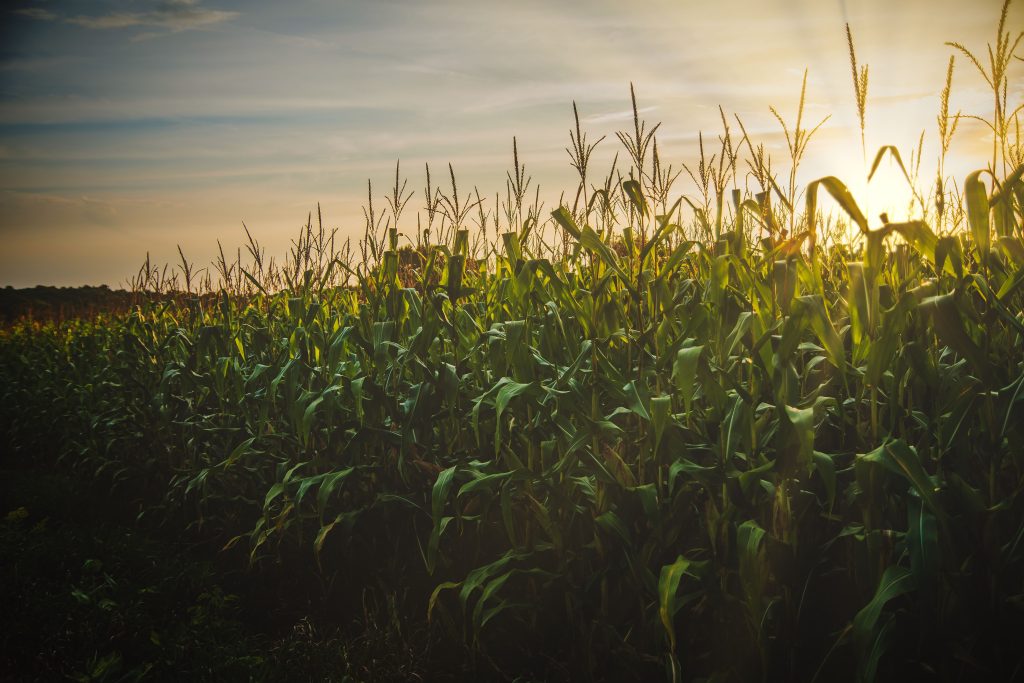
By August, a corn or soybean field can give the impression that most of the important decisions have already been made. Corn ears are established, soybean rows are closed, pods are hanging throughout the canopy, and harvest equipment is beginning to receive more attention around the farm.
A large portion of yield potential has certainly been determined by this point, but the crop is not simply waiting to dry down. Corn still has to turn photosynthates into kernel weight, and soybeans still have to fill developing seeds. Water, functioning roots, healthy leaves, nutrient availability, disease pressure, and the timing of crop maturity can still influence how much of the yield potential already established actually reaches the combine.
That distinction is important in August because it changes how farmers should think about late-season inputs. The goal should not be to keep adding fertilizer or other products simply because the crop is still alive. The goal should be to identify the factors that can still influence harvestable yield and concentrate management on those factors.
Current field conditions in 2026 illustrate the point particularly well. Iowa State Extension reported in early August that corn across much of Iowa was moving from late milk and dough into dent, while soybeans were generally in the R4-to-R5 range. Extension agronomists emphasized that corn kernel filling and soybean pod and seed development were still dependent on adequate moisture even though the crops were clearly moving toward maturity.
Farther north, University of Minnesota Extension reported on August 24 that parts of Minnesota remained dry or very dry and reminded growers that late-reproductive corn and soybeans could still have meaningful water demand before reaching maturity.
For farmers walking fields in August, the practical question is therefore not whether the crop can still use anything. It is whether the crop can still convert a particular management decision into enough additional grain to justify the cost.
Corn kernels are still gaining weight after pollination is over
Corn yield is built in stages.
Plant population was established much earlier. Ear size and kernel number were influenced heavily around pollination and early reproductive development. Once those kernels are successfully established, however, they still need to accumulate dry matter.
During the milk, dough, and dent stages, the plant continues moving carbohydrates into the kernels. Much of that material comes from current photosynthesis in green leaves, although the plant can also remobilize stored carbohydrates and nutrients from stalks and other tissues.
This means the number of kernels visible on an ear in August is not the final measure of yield.
Two plants can carry similar-looking ears in early August and produce different final grain weights if one maintains adequate water, healthy leaf area, and functioning roots while the other experiences severe stress before physiological maturity.
Iowa State’s August 2026 field observations highlighted exactly this issue. Agronomists reported that corn was progressing rapidly through dough and dent and noted that adequate soil moisture remained important for maintaining grain fill and kernel weight. They also observed tip-back in some fields that had experienced hot conditions and lower soil moisture earlier during grain fill.
Once kernel number has been reduced, late fertilizer cannot recreate those missing kernels. What farmers can still protect is the crop’s ability to fill the kernels that remain.
Green leaf area continues to support the ear
The corn canopy should not be judged only by whether it looks dark green from the road. What matters is how much functioning leaf area remains and whether that leaf area can continue supporting grain fill.
Healthy leaves intercept sunlight and manufacture carbohydrates. Those carbohydrates become part of the dry matter accumulating in kernels.
When leaf area is lost prematurely through drought, severe nutrient stress, disease, hail, insects, or other injury, photosynthetic capacity declines. The plant may then rely more heavily on carbohydrates stored in the stalk.
Some natural senescence is expected as corn approaches maturity. Lower leaves do not need to remain perfectly green until harvest. The concern is a crop that begins dying prematurely while significant grain fill remains.
A field moving into dent with a healthy upper canopy is in a very different position from a field at the same stage where leaves above and below the ear are already deteriorating rapidly.
That difference should prompt closer inspection of moisture, roots, disease, stalk condition, and nutrient history rather than an automatic recommendation for another fertilizer application.
Soybeans are still actively building yield during seed fill
Soybeans have their own version of the same August story.
A field carrying a large number of pods may look like its yield is already determined, but those pods still need to produce filled seeds.
During R5, seeds begin developing inside the pods. By R6, a green seed fills the pod cavity at the upper nodes used for staging. Between those stages, the crop is actively moving carbohydrates and nutrients toward developing seed.
The amount of yield ultimately harvested depends not only on how many pods were produced, but also on how many seeds survive and how much weight those seeds accumulate.
That gives soybeans some remaining vulnerability during August.
Drought can lead to seed abortion or smaller seeds. Severe defoliation can reduce the photosynthetic capacity needed for seed filling. Root problems can restrict both water and nutrient uptake. Disease can shorten the life of productive leaf tissue.
Iowa State agronomists reported in August 2026 that many soybean fields were in R4 or R5 and specifically identified pod and seed development as an important part of the remaining season.
Farmers should therefore avoid assuming that a tall, closed soybean canopy guarantees a strong crop. Opening pods and checking actual seed development provides much better information.
August moisture can still influence the final yield
Water is often the most important remaining variable during late reproductive growth.
By August, crop water use is declining compared with peak midsummer demand, but it has not stopped.
University of Minnesota Extension’s August 24, 2026 irrigation guidance estimates that corn at beginning dent may still use roughly 2 inches of water before maturity under central Minnesota conditions. Corn at full dent may have approximately 1.5 inches remaining. Soybeans at R5 may still use approximately 2.9 inches before maturity, while soybeans at R6 may have approximately 1.2 inches remaining.
Those figures should not be treated as universal prescriptions because soil type, climate, rooting depth, rainfall, temperature, humidity, and local conditions all affect actual crop water use.
They do illustrate an important point: a crop that looks close to harvest may still need considerable water to finish normally.
For corn, inadequate moisture during grain fill can reduce final kernel weight. For soybeans, water stress during pod and seed development can reduce seed development and final yield.
This is why an August rainfall can still be economically important, especially in fields with meaningful reproductive development remaining.
The root zone should be checked instead of relying on rainfall totals
A rainfall report does not tell farmers how much water the crop can actually use.
One field may have received an inch of rain but still have a dry root zone because the soil was already depleted and much of the rainfall ran off.
Another field may have received less recent precipitation but still contain useful moisture deeper in the profile.
Soil texture also changes how much available water can be stored. A deep, well-structured soil can generally store more plant-available water than a shallow or coarse-textured soil.
Rooting depth matters just as much.
Corn and soybean plants with deep, healthy roots can explore a larger volume of soil. Plants confined to shallow rooting because of compaction, early-season saturation, root disease, insect feeding, or poor soil structure can experience drought stress much sooner.
Use a probe or shovel to examine the profile rather than judging conditions by the surface.
A dry upper inch does not necessarily mean the crop has run out of usable water. Likewise, a brief shower that darkens the soil surface does not necessarily provide enough moisture to carry the crop through the rest of seed or grain fill.
August often reveals root problems that began much earlier
Many late-season crop problems originate months before symptoms become obvious.
A corn crop planted into excessively wet soil may develop restricted roots. Soybeans growing through a compacted zone may never fully explore deeper soil. Corn rootworm feeding can reduce effective root mass. Root diseases can limit uptake even when fertilizer and water are present.
During periods of regular rainfall, those limitations may remain difficult to see because the upper soil profile continues supplying enough water.
Once August becomes hot or dry, weaker root systems are exposed quickly.
A healthy plant continues drawing water and nutrients from deeper soil, while a shallow-rooted plant begins losing leaf function.
This is one reason growers should dig roots when parts of a field begin shutting down earlier than surrounding areas.
If the problem is a restricted root system, adding more fertilizer to the soil surface may do little to help the crop finish.
The more valuable information may be that soil compaction, drainage, root insects, or another physical limitation needs attention before next season.
Fertilizer cannot substitute for missing water
A stressed August crop frequently looks nutritionally deficient.
Corn may begin firing lower leaves. Marginal potassium symptoms may develop. Soybeans can become pale or show yellow leaf margins.
Those symptoms are real, but the cause is not always an insufficient amount of fertilizer in the soil.
Dry conditions reduce nutrient movement and root uptake. Potassium is particularly affected because much of the K reaching roots moves through diffusion in soil water.
Iowa State has documented potassium-deficiency symptoms in corn and soybeans during dry weather even when soil tests indicated that adequate potassium was present. In those cases, the plant was experiencing a shortage because dry soil was limiting K movement and root access.
Adding fertilizer to dry soil does not automatically restore that movement.
The crop still needs water.
This distinction is particularly important when fertilizer is marketed as a general stress treatment. Adequate potassium nutrition helps plants carry out normal processes involved in water regulation, but potassium fertilizer cannot create soil moisture where none exists.
A crop should enter August with adequate fertility. Once severe drought develops, the immediate limitation may be water rather than the total nutrient supply in the soil.
Late nitrogen needs to be treated with particular caution
Corn continues accumulating and remobilizing nitrogen during reproductive development, which sometimes leads to the assumption that late-season nitrogen applications can increase yield simply because the crop is still using N.
That conclusion does not necessarily follow.
University of Minnesota Extension reports that research in Minnesota has not shown a yield advantage from routine post-tassel nitrogen applications. In their research, late applications around V12 generally did not outperform properly timed preplant or earlier sidedress nitrogen except under specific situations such as irrigated sandy soils.
This becomes even more important once corn is several reproductive stages beyond tasseling.
A crop at R4 or R5 has already taken up a large portion of the nitrogen it will use. If severe deficiency appears at that point, some yield potential may already have been lost.
University of Minnesota Extension has also documented situations where late-season nitrogen deficiency around R3 and R4 was associated with compaction, shallow rooting, early-season excessive moisture, and possible denitrification. In those fields, applying additional nitrogen late in the season was unlikely to recover much of the yield already lost.
That is why lower-leaf yellowing in August should start a diagnostic process rather than an immediate fertilizer application.
Urea 46-0-0 fits where nitrogen is genuinely limiting and timing still makes sense
When a crop or forage system has a confirmed nitrogen requirement and enough growing season remains for an application to produce an agronomic response, Supply Solutions Urea 46-0-0 Nitrogen Fertilizer provides a concentrated source containing 46% nitrogen.
The reason to use Urea 46-0-0 is straightforward: it supplies nitrogen when plant-available N is genuinely insufficient.
The timing is just as important as the product. Urea should be applied when the crop can still respond, roots are functioning, and moisture conditions allow nitrogen to move into the root zone. Surface-applied urea also requires attention to volatilization risk and rainfall or irrigation timing.
For an August corn field already well into dent, a late application should not be justified simply because lower leaves are yellowing.
If the yellowing is caused by normal senescence, drought-limited uptake, compaction, or damaged roots, adding nitrogen may provide little return.
If substantial nitrogen loss has genuinely occurred and a later-planted crop still has enough reproductive development remaining, the calculation may be different.
The field conditions, crop stage, and expected yield response should make that decision.
Potassium matters during grain and seed fill, but the response needs to be planned
Potassium deserves particular attention in corn and soybean fields because both crops use substantial amounts of K and the nutrient supports many processes involved in crop function.
Potassium contributes to water regulation, enzyme activation, movement of carbohydrates, and normal plant metabolism.
A truly K-deficient crop enters August with an additional stress that can reduce performance during grain or seed fill.
The problem is that August is often when growers first notice symptoms that began with an inadequate soil fertility program much earlier.
Corn typically shows potassium deficiency as yellowing and browning along older leaf margins.
Soybeans can develop similar marginal symptoms, and Iowa State has documented late-season soybean K symptoms during reproductive development, particularly under drought or where soil-test K is low.
Once those symptoms become severe in a mature crop, another fertilizer application should not automatically be expected to rebuild lost yield.
The more useful response may be to identify the affected zones, compare them with healthy areas, and prepare for targeted soil sampling after harvest.
Sulfate of Potash can correct a confirmed potassium shortage before the next period of peak demand
When soil testing shows that potassium is genuinely below the desired range and nitrogen or phosphorus are not needed in the same application, Supply Solutions Sulfate of Potash 0-0-50 provides a concentrated potassium source.
The reason to use it is to correct inadequate potassium fertility so the crop is not entering important reproductive stages with a preventable K limitation.
The appropriate timing depends on soil testing, crop rotation, regional recommendations, application method, and soil conditions. In mature August corn and soybean fields, a postharvest or preplant application may often make more agronomic sense than attempting to rescue a crop that is already far through grain or seed fill.
The specific problem the product addresses is inadequate potassium supply.
It should not be used as a general drought treatment. A field testing adequately for K but unable to absorb potassium because the root zone is dry needs moisture more urgently than another K application.
This is one of the most important distinctions in late-season fertilizer management.
Disease can still affect the amount of functioning canopy
By August, disease management decisions also become more dependent on crop stage.
Corn leaf diseases can reduce productive leaf area when they become severe early enough. Soybean diseases can contribute to premature leaf loss or interfere with vascular and root function.
However, finding disease does not automatically mean another fungicide treatment will return its cost.
Iowa State’s August 2026 agronomists reported relatively low disease pressure across many fields and noted that some crops were already advanced enough that additional fungicide applications were unlikely to produce a return.
Scouting remains worthwhile even when the treatment window has passed.
Knowing which diseases are present can explain premature senescence, influence hybrid or variety selection, change future fungicide timing, and help prioritize fields that may be at greater risk of lodging.
The important point is that August scouting should continue even when spraying does not.
Late-season insects should be evaluated according to crop stage and threshold
The same reasoning applies to insects.
An insect population that would justify treatment earlier may not produce enough additional damage near maturity to pay for an application.
Soybeans still in active seed fill should be evaluated differently from soybeans approaching R7.
Corn insects affecting roots or stalks may also provide valuable information for next year’s management even when there is little direct treatment opportunity left this season.
Current Extension reports in 2026 have continued to note rootworm beetles, aphids, and other insect observations during August.
The farmer’s job is to determine whether those insects are currently threatening enough remaining yield to exceed an economic threshold rather than applying a treatment because the pest is present.
Stalk integrity becomes increasingly important as corn approaches maturity
A corn plant under severe grain-fill stress may begin drawing more heavily on carbohydrates stored in the stalk.
This process is sometimes referred to as stalk cannibalization because the plant remobilizes reserves from vegetative tissue to support the ear.
Drought, foliar disease, root injury, hail, nutrient stress, and other factors can increase the likelihood that photosynthesis cannot keep pace with kernel demand.
As stalk reserves decline, stalk tissue may weaken and become more vulnerable to lodging and stalk-rotting organisms.
That means farmers should begin evaluating stalk strength before harvest.
Use the pinch test on lower internodes. Push plants away from vertical and observe whether they return upright. Split suspicious stalks and look for deteriorated internal tissue.
A field developing significant stalk weakness may need to move earlier in the harvest schedule.
In that situation, harvest timing can preserve more yield than another late fertilizer or fungicide application because no product can rebuild structurally degraded stalk tissue before the next windstorm.
Soybean lodging deserves attention for a different reason
Soybeans can also lodge during August, particularly where plants are tall and dense and storms bring heavy rain or wind.
Iowa State reported soybean lodging in several regions following August 2026 rainfall and strong winds.
Lodged soybeans are not automatically ruined, but lodging can change canopy conditions, complicate disease development, reduce light distribution, and eventually make harvest more difficult.
The severity, timing, and ability of the canopy to recover all matter.
Additional nitrogen should not be used in an attempt to make lodged soybeans “grow out of it.” Soybeans already have a strong biological nitrogen supply through nodulation when roots are functioning normally, and excessive vegetative growth is not the objective during seed fill.
The better approach is to continue monitoring seed development, disease, and eventual harvestability.
Irrigated farms should avoid both stopping too early and watering too long
Late-season irrigation decisions illustrate the importance of crop staging particularly well.
Stopping irrigation too early can expose corn or soybeans to avoidable moisture stress while kernels or seeds are still gaining weight.
Continuing irrigation after the crop has very little remaining water demand can waste energy and potentially move nitrate below the active root zone.
University of Minnesota’s August 2026 guidance recommends considering three factors together: the amount of water remaining in the root zone, current crop stage, and estimated water demand through maturity.
For example, the same soil-moisture reading may justify another irrigation in R5 soybeans but not in a field approaching physiological maturity.
Weather forecasts should also be included. Applying a large late irrigation immediately before significant rainfall can result in excessive water moving through the profile.
The objective is not to maintain a completely full soil profile until harvest. The objective is to supply enough water for the crop to complete economically important grain and seed development.
August field differences can help explain next year’s fertility decisions
One of the most useful things a farmer can do during grain fill is compare good and poor areas of the same field.
Look at whether the better area has deeper roots.
Compare soil moisture.
Examine ear development.
Open soybean pods.
Check disease severity.
Look for potassium symptoms.
Evaluate lower-leaf nitrogen symptoms.
Record whether the affected zones correspond with drainage patterns, soil texture, compaction, elevation, or previous yield maps.
If one portion of a field repeatedly shuts down earlier than another, there is usually a reason.
It may be a fertility issue.
It may be a root-zone issue.
It may be lower water-holding capacity.
It may be drainage.
It may be an interaction among several factors.
The August crop is providing a stress test of the entire production system.
Postharvest soil sampling should follow the patterns seen during grain fill
Problem areas should be marked while they are visible.
If potassium deficiency appears in specific zones, sample those zones separately from healthy portions of the field.
If corn repeatedly shows severe nitrogen stress in wet depressions, map those areas and review drainage and nitrogen timing.
If drought symptoms are consistently worse in compacted headlands, dig those areas and consider whether the soil physical condition is restricting both roots and nutrient uptake.
A whole-field composite sample can hide some of this variability.
Where the management system supports more targeted sampling, August observations can help define the zones that deserve separate attention.
This creates a stronger connection between what the plant experienced and what the soil test later reports.
Yield-monitor data should complete the diagnosis
Visual symptoms become much more useful after they are compared with harvest data.
Did the potassium-deficient area actually produce fewer bushels?
Did the drought-prone ridge show lower kernel weight?
Did saturated soil reduce corn yield substantially?
Did early soybean senescence correspond with smaller seeds?
Did lodged corn lose yield before the combine arrived?
The yield monitor helps place an economic value on the problem.
A visible symptom that repeatedly corresponds with a major yield loss deserves more attention than a cosmetic difference that has little measurable effect on production.
Over several seasons, this approach can improve fertilizer placement, drainage investments, hybrid selection, irrigation strategy, and field-zone management.
The best August management protects what the crop can still produce
Corn and soybeans do not stop responding to their environment simply because harvest is approaching. Kernel weight is still developing. Soybean seeds are still filling. Roots are still supplying water and nutrients. Leaves are still capturing sunlight. Disease, drought, saturation, and lodging can still reduce the amount of yield that reaches the combine.
At the same time, late-season management has to recognize that some opportunities have already passed.
A kernel lost during pollination cannot be recreated with August fertilizer. Yield lost after weeks of severe nitrogen deficiency cannot necessarily be recovered with a late N application. A potassium-deficient field that is already well into maturity may benefit more from correcting soil K for the next crop than from trying to force an immediate response.
That is why August management should be based on crop stage and diagnosis rather than the desire to make one more pass.
Supply Solutions Urea 46-0-0 can provide concentrated nitrogen where nitrogen is genuinely limiting and there is still an agronomically sound application window. Supply Solutions Sulfate of Potash 0-0-50 can correct a confirmed potassium shortage where soil testing shows that K fertility needs attention. Neither product should be expected to replace rainfall, repair damaged roots, reverse disease, or restore yield that the crop has already lost.
The most productive August decisions come from understanding what the crop still needs to finish and what the soil and weather can realistically provide. Farmers who use this period to monitor moisture, inspect roots, protect functioning leaf area, evaluate stalk strength, and document nutrient patterns will enter harvest with a better understanding of both this year’s yield and next year’s fertility needs. When soil testing confirms that nitrogen, potassium, or another nutrient needs to be addressed, Supply Solutions can help match the fertilizer source to that specific field need and the application window where it has the best chance to provide value.