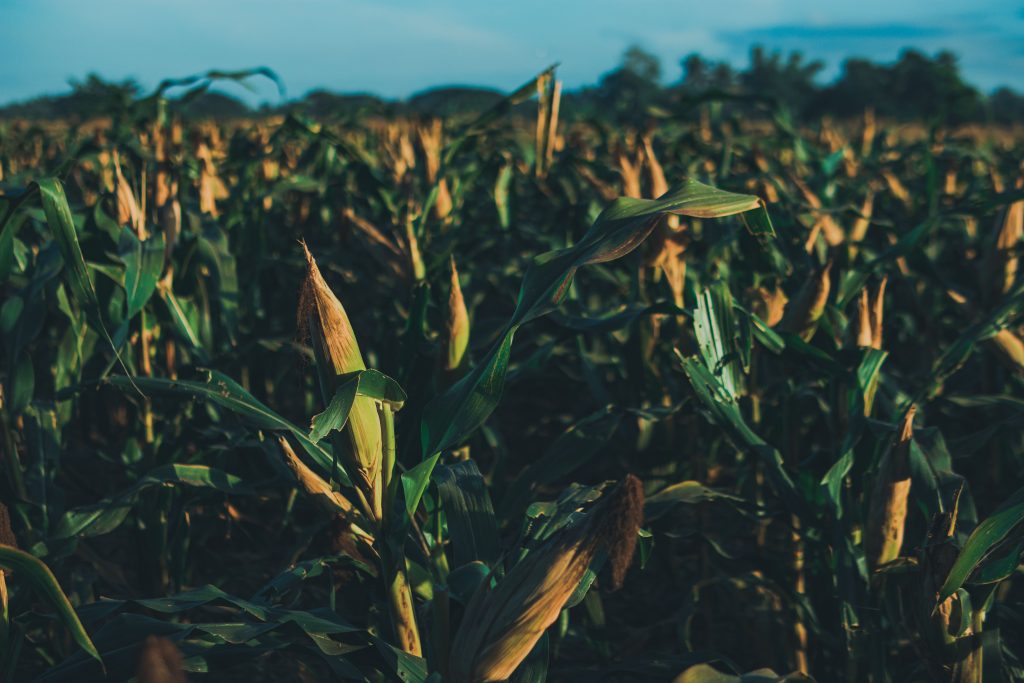
By August, corn and soybean fields have already been through most of the weather that will shape the season. Roots have developed through wet periods, dry stretches, compacted layers, and changing soil temperatures. Corn is generally somewhere in reproductive development, while soybeans are setting pods and filling seeds. At this stage, the crop often begins showing the cumulative effects of everything that happened earlier.
That is why August can be one of the most confusing times to diagnose a field.
A patch of yellow corn may look nitrogen deficient. Brown leaf margins may suggest potassium trouble. Soybeans may develop yellow areas in the canopy that look like a nutrient shortage from the road. But drought, saturated soil, damaged roots, compaction, disease, insects, and normal plant aging can produce symptoms that overlap with nutrient deficiencies.
The 2026 season is providing a good example. Iowa State Extension reported highly variable rainfall in early August, with some areas receiving several inches while others remained dry. Corn was moving through dough and dent stages, while soybeans were in pod development and seed fill. At the same time, NOAA has documented rapid-onset drought and persistent extreme heat across portions of the Central and Southern Plains and the Mississippi Valley. A field in one county can therefore be dealing with excess moisture while another only a few miles away may be struggling to keep enough water around the roots.
Those conditions make visual diagnosis especially important.
Start With the Pattern, Not the Fertilizer
When a farmer sees yellow leaves, the natural question is often, “What nutrient am I short?”
A better first question is, “Where is the problem occurring, and what does the pattern tell me?”
Walk beyond the headland. Look at whether symptoms appear across the entire field or only in certain areas. Pay attention to slopes, compacted end rows, low spots, sandy ridges, old manure application patterns, wheel tracks, field entrances, drainageways, and differences in soil type.
If the problem follows soil texture or topography, moisture may be involved.
If it follows traffic patterns, compaction deserves attention.
If the symptoms are concentrated in poorly drained depressions, root injury or nitrogen loss from saturated soil may be contributing.
If symptoms are worse on dry ridges, the soil may contain adequate nutrients but not enough water to move those nutrients to active roots.
This is particularly important with potassium. Iowa State research and Extension observations have repeatedly shown that corn and soybeans can exhibit potassium-deficiency symptoms during dry weather even where soil-test potassium is adequate. Dry surface soil, poor rooting, compaction, root injury, and restricted water uptake can all reduce the plant’s ability to obtain K.
In other words, the leaf may really be short of potassium even though the soil is not.
That distinction determines whether fertilizer can solve the problem.
What True Nitrogen Deficiency Usually Looks Like in Corn
Nitrogen is mobile within the corn plant. When the plant cannot obtain enough N from the soil, it can move nitrogen out of older leaves and toward younger tissue and developing grain.
That is why nitrogen deficiency normally begins on lower leaves.
The classic symptom is yellowing that starts near the leaf tip and progresses down the midrib toward the stalk, creating a V-shaped pattern. As deficiency becomes more severe, the yellow tissue turns brown and additional leaves become involved. University of Minnesota Extension identifies this lower-leaf V-shaped yellowing as one of the most useful visual indicators of corn nitrogen deficiency.
But August requires some restraint in interpreting it.
Corn naturally remobilizes nitrogen from older tissue during grain fill. Lower leaves can senesce as the crop approaches maturity. A corn plant does not have to remain dark green from the soil surface to the tassel to produce a good crop.
Iowa State researchers examining corn leaf senescence note that modern corn plants naturally lose lower leaves over the growing season, with additional senescence occurring as plants move through reproductive development.
The important distinction is severity and timing.
A few lower leaves yellowing late in grain fill can be normal.
Yellowing advancing rapidly toward the ear while kernels still have substantial filling left to do deserves more attention.
Whole plants that are pale compared with healthy areas deserve investigation.
Patterns associated with low spots, compacted zones, or poor roots need to be diagnosed before assuming the original nitrogen rate was inadequate.
Drought Can Make a Crop Look Nutrient Deficient
Nutrients do not simply sit in the soil waiting to jump into a root.
Most nutrient uptake depends in some way on soil moisture, root activity, and movement of nutrients through the soil solution.
When soil dries, several things happen at once. Root growth can slow in the dry portion of the profile. Nutrient movement toward the root becomes more limited. Biological activity and mineralization can decline. The crop reduces transpiration as stomata close. Root contact with nutrients may become restricted.
That is why a field can contain nutrients and still produce nutrient-deficiency symptoms.
Potassium is particularly sensitive to this situation. Iowa State has documented drought-induced K deficiency in both corn and soybeans and specifically cautions that applying soil or foliar K during severe drought may not correct the problem when lack of moisture is preventing uptake.
This changes the agronomic question.
The goal is not merely to ask whether the leaf contains too little potassium.
The goal is to determine why.
If soil-test K is low, potassium fertility is part of the problem.
If soil-test K is adequate but roots are trapped in a dry, compacted zone, fertilizer may not be the immediate answer.
If normal rainfall returns and new growth looks healthy, an induced deficiency becomes more likely.
Potassium Symptoms Have Their Own Pattern
Potassium is also mobile inside the plant, so true K deficiency typically begins in older tissue.
In corn, look for yellowing and eventually browning along the leaf margins. The center portion of the leaf can remain greener than the edges. This differs from the more characteristic midrib-centered V associated with nitrogen deficiency.
In soybeans, potassium deficiency typically causes yellowing around leaflet margins. As it progresses, those margins may become brown and necrotic.
Late-season soybean diagnosis can be more difficult because K deficiency may appear higher in the canopy during reproductive stages. Iowa State has documented upper-canopy K symptoms during August, especially where soil-test K is low or drought has reduced uptake. Disease symptoms can sometimes resemble nutrient problems closely enough that laboratory confirmation is worthwhile.
This is one reason diagnosing soybeans from a pickup window is risky.
Get into the canopy.
Look at which leaves are affected.
Examine stems and roots.
Compare affected plants with normal plants from the same field.
Root Problems Often Explain the Mystery
A crop can only use the soil volume its roots can explore.
August symptoms often trace back to root restrictions established months earlier.
Sidewall compaction at planting can restrict roots. Saturated spring soil can produce shallow rooting. Rootworm feeding can reduce the corn root system. Disease can damage roots. Compacted traffic areas can reduce rooting depth. A dry surface layer can effectively remove part of the nutrient-rich topsoil from the plant’s usable rooting zone.
Iowa State notes that compaction can contribute to nutrient-deficiency symptoms by limiting root development and potassium uptake.
Digging plants is therefore one of the most useful diagnostic tools available.
Do not pull the plant out and inspect only the stalk. Use a shovel and remove a block of soil around the roots. Compare healthy and affected areas.
Ask whether the root mass is similar.
Look for flattened or restricted roots.
Check whether roots are concentrated in a shallow layer.
Look for insect feeding.
Smell saturated roots and examine tissue for decay.
Then examine the soil itself.
Sometimes the reason a crop looks hungry is not that the soil lacks nutrients. The root system simply cannot reach them.
Saturated Soil Creates the Opposite Problem
Too much moisture creates a different set of symptoms.
Water fills soil pore spaces that normally contain air. Roots need oxygen for respiration, and prolonged saturation reduces root function. Soybean nodulation and nitrogen fixation can also be disrupted.
Corn faces another concern: nitrate loss.
Under warm, saturated conditions, denitrification can convert nitrate into gaseous forms that leave the soil. On coarse-textured or heavily drained soils, nitrate may also move below the root zone through leaching. University of Minnesota Extension notes that denitrification increases after soils become oxygen depleted and that prolonged saturation can create substantial nitrogen losses.
A yellow corn field after flooding therefore may involve actual N loss.
But it can also involve roots that temporarily cannot absorb the N that remains.
That distinction matters greatly in August because crop stage determines whether a rescue treatment still has enough time to provide an economic response.
August Is Often Too Late for a Reflex Rescue Application
One of the hardest agronomic lessons is that correctly identifying a deficiency does not automatically mean that applying fertilizer today will recover lost yield.
Late-season corn is a good example.
University of Minnesota Extension has reported that when substantial nitrogen deficiency does not appear until reproductive development, applying additional N may be too late to recover yield. In some cases the field contains adequate nitrogen, but a weak root system cannot access it.
Likewise, Iowa State has found no consistently economical corrective treatment for K deficiency once symptoms appear late in the season.
The symptom still has value.
It tells you where to investigate.
It tells you which areas to soil sample after harvest.
It may identify a compaction problem, low-K zone, drainage problem, rootworm issue, or nitrogen-management weakness that should change next year’s plan.
That information can be worth more than a poorly timed rescue application.
Where a Potassium Product Fits
If soil testing confirms that the field is actually deficient in potassium, then a concentrated K source can have a clear role in the fertility program.
Supply Solutions Sulfate of Potash 0-0-50 supplies potassium without adding nitrogen or phosphorus. That makes it useful where testing shows K is the nutrient that needs attention while N and P are already adequate.
The why is straightforward: potassium is needed for normal water regulation, enzyme function, carbohydrate movement, and many other processes involved in crop growth.
The when is just as important. An August deficiency in a mature corn or soybean crop does not necessarily mean that broadcasting K immediately will rescue yield. In many row-crop situations, the better use is as part of a soil-test-driven postharvest or preplant program for the next crop.
The problem it solves is an actual soil potassium shortage—not drought itself.
That distinction should stay clear. Potassium fertilizer cannot make a crop drought-proof. It can correct inadequate K fertility so that a future crop is not trying to manage drought while also dealing with a preventable nutrient limitation.
Where testing shows potassium, magnesium, and sulfur are all needed, Supply Solutions 0-0-22 Pro-Mag Trio provides those three nutrients without adding nitrogen or phosphorus. It makes sense only where that combined nutrient profile fits the soil or crop need; it should not be chosen simply because several nutrients are listed on the label.
Compare Good and Bad Areas Before Making a Decision
One of the best August diagnostic practices is paired sampling.
Find a clearly affected area and a nearby normal area with similar soil type and management.
Compare plants.
Compare roots.
Take soil samples separately.
If tissue testing is appropriate for the crop stage, collect healthy and affected samples using the same plant part and sampling method.
Document rainfall patterns and field history.
Look back at fertilizer records.
Check whether the affected pattern matches a previous yield map.
Review drainage and compaction.
This comparison is much more useful than collecting one sample from the middle of a yellow patch and trying to interpret it in isolation.
Tissue testing deserves particular caution during drought because nutrient concentrations can be affected by reduced growth and altered uptake. Iowa State specifically warns that drought can either concentrate or dilute nutrients in plant tissue, complicating interpretation.
The test should support diagnosis, not replace field observation.
Read New Growth and Crop Stage
Another clue is what happens after conditions improve.
Suppose corn showed marginal K symptoms during a prolonged dry spell. Then rainfall returns.
If soil K is adequate and the issue was primarily drought-induced, newer tissue may develop without additional symptoms. That does not erase any yield impact caused by the earlier stress, but it tells you that dumping more fertilizer onto the field during the drought probably would not have solved the immediate problem.
Crop stage matters as much as symptom severity.
A nutrient shortage at V8 corn is different from one at R5.
A soybean field at R2 has much more season remaining than a field moving from R6 toward maturity.
By late August, some soybeans are already beginning to drop leaves, while corn is moving rapidly through dough and dent stages in many states. Current USDA reporting confirms that reproductive development is well advanced nationally.
There is less time for a corrective fertilizer treatment to be absorbed, incorporated into plant processes, and converted into harvestable yield.
That is why the right August recommendation is sometimes: document the problem now and fix the fertility program after harvest.
Use August Symptoms as a Map for Better Decisions
The most useful field in August is not always the one that stays perfectly green. A field that shows stress can reveal weaknesses that are invisible in easier years.
Dry weather exposes shallow roots.
Heavy rain exposes drainage limitations.
High crop demand exposes low-testing potassium areas.
Grain fill can expose nitrogen shortages.
Disease can reveal areas where crop stress has reduced stalk integrity.
Those observations are valuable if they are recorded.
Mark problem zones in a field map. Save photographs. Note whether symptoms occur on slopes, ridges, low spots, end rows, or particular soil types. Compare those observations with the yield monitor this fall. Then soil sample accordingly.
The farmer who does that has more information going into next year’s fertilizer decision than the farmer who simply sees yellow leaves and applies another product.
Good nutrient management starts with knowing what is limiting the crop. Sometimes that is nitrogen. Sometimes it is potassium. Sometimes the soil contains the nutrient but drought has shut down uptake. Sometimes saturated roots cannot function. Sometimes disease or compaction is the real problem.
Supply Solutions has targeted fertilizer options for situations where testing confirms a nutrient need, but no fertilizer should be asked to fix a problem it cannot solve. Use August to read the field carefully, separate true deficiencies from weather-induced symptoms, and carry those observations into soil testing and postharvest planning. When the diagnosis shows that potassium, nitrogen, magnesium, sulfur, or another nutrient really is limiting production, Supply Solutions can help match the fertilizer source to the field instead of treating every yellow leaf the same way.