

Uncategorized
How to Read a Fertilizer Grade: What N-P-K Numbers Actually Tell You
Walk into a fertilizer warehouse, farm supply store, greenhouse, or garden center and the first thing most people notice on a fertilizer bag is a
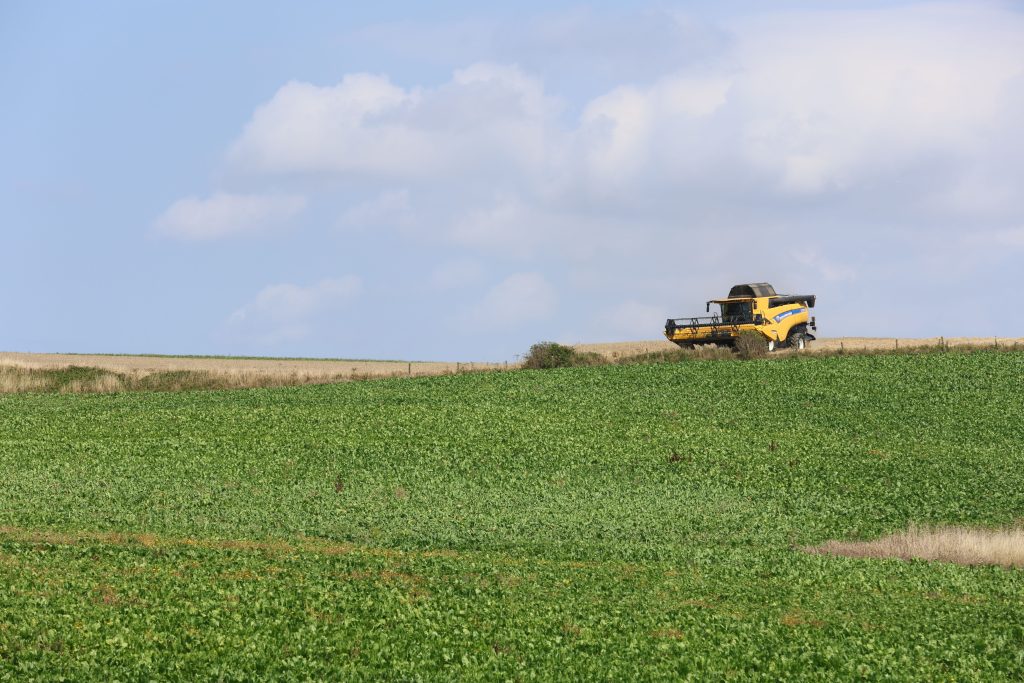
August may feel early to think about fall soil testing when corn is still filling kernels and soybeans are still developing seed, but this is exactly when a useful fall fertility plan should begin taking shape. The soil probe may not enter the field until after harvest, yet the information needed to decide where and how to sample is already visible in the standing crop.
Fields rarely finish the growing season uniformly. One area may have shown potassium-like symptoms during a dry stretch, while another remained green. A poorly drained depression may have yellowed after heavy rainfall. Corn on an eroded ridge may have fired earlier than plants in deeper soil. Compacted headlands may be showing premature stress even though the center of the field continues filling grain normally. Once the combine passes, many of those differences become much harder to identify.
This makes August an important bridge between managing the current crop and planning fertility for the next one. The objective is not to decide now which fertilizer will be spread after harvest. It is to identify the questions that soil testing needs to answer so that fertilizer can be directed toward actual deficiencies instead of applied by habit.
That approach is especially relevant in 2026. Iowa State University Extension has been emphasizing soil-test interpretation, phosphorus and potassium planning, lime management, fertilizer budgeting, and return on fertilizer investment in its August Fertilizer and Finance workshops. Extension specialists specifically point to high fertilizer costs and current crop economics as reasons growers need to be more deliberate about where nutrient dollars are likely to provide the greatest return.
A good fall fertility plan therefore starts with something more useful than asking, “What should I spread?” It starts by asking what the field actually needs.
One of the advantages of planning soil sampling in August is that the crop is still showing the effects of this season’s soil, weather, roots, and fertility program. A farmer can walk into the field and compare areas that performed differently rather than trying to remember those patterns several weeks after harvest.
Suppose one portion of a soybean field developed marginal leaf yellowing during seed fill while the rest of the field remained healthy. That pattern might indicate low potassium, but it could also result from drought-limited potassium uptake, root restriction, disease, or differences in soil texture. The appropriate fall response is not to assume that the entire field needs potassium. A better approach is to identify the affected area now and plan to sample it separately from a nearby healthy area after harvest.
Corn can provide similar clues. Early firing in low spots may point toward nitrogen loss after saturation, while premature stress on ridges may reflect shallow soil and limited water-holding capacity. Plants in compacted headlands may show nutrient symptoms because their roots never explored as much soil as plants in the rest of the field. Those observations can help separate true soil fertility shortages from physical limitations that another fertilizer application will not correct.
This is where soil sampling becomes part of crop diagnosis instead of a routine fall task. The laboratory can measure the soil that reaches the sample bag, but it cannot determine whether the sample came from a representative part of the field. The usefulness of the result therefore depends heavily on how well the sampling area was chosen.
Farmers who already use yield maps, soil maps, elevation information, electrical conductivity data, or management zones can combine those records with what the crop is showing in August. Even growers without precision-agriculture systems can mark problem areas on a field map or record their locations while the differences are still obvious.
Soil varies over surprisingly short distances. Fertilizer history, manure application, erosion, soil texture, crop removal, drainage, landscape position, and past management can all create differences within the same field.
That is why a soil sample should normally represent more than one probe location. Iowa State Extension recommends making a composite sample from multiple soil cores and notes that sampling areas should be kept reasonably small unless field history suggests that a larger area is genuinely uniform. Its guidance recommends approximately 10 to 15 cores for a composite sample and explains that multiple sampling areas are useful for deciding whether fertilizer or lime should be applied uniformly or site-specifically.
The practical reason is simple. One soil core might happen to come from an old fertilizer band, while another could come from a spot where manure accumulated years ago. Neither location alone represents the surrounding acres very well. Combining several consistently collected cores reduces the influence of those small-scale differences.
However, collecting more cores does not automatically solve a poor sampling design. If a farmer combines soil from a high-producing bottom with soil from an eroded ridge, the resulting laboratory value may simply average two very different fertility situations. The number may be mathematically correct while being agronomically unhelpful.
This is why the sampling approach should reflect the field rather than convenience. Uniform fields may be managed successfully with relatively simple sampling. Fields with substantial variation in soil, topography, yield, or fertility history may benefit from grid sampling or management-zone sampling. Iowa State describes management zones as areas defined by information such as soil maps, yield history, topography, previous management, and farmer experience, while grid sampling provides a more systematic picture of nutrient variability across the field.
Neither system needs to be used simply because it sounds more advanced. The correct level of sampling detail is the one that provides enough information to make the fertilizer decisions the farm is actually capable of implementing.
Fall after harvest is a practical sampling period for many farms because the crop is out of the field, soils are usually accessible, and results can be reviewed before many fertilizer and lime applications are made. Spring sampling before fieldwork can also work, but consistency from one sampling cycle to another improves the value of long-term comparisons.
Iowa State Extension recommends sampling at a consistent time of year and generally sampling before fertilizer application. Its soil-sampling guidance notes that fields are commonly tested every two to four years or once within a crop rotation, although more frequent sampling may be justified when fertilizer costs are high or when growers are intentionally trying to change soil-test levels.
Consistency matters because soil-test values are not completely independent of season and field conditions. Soil moisture, temperature, crop uptake, nutrient cycling, residue decomposition, and recent applications can all influence what is measured.
A farm that samples the same field in fall each cycle, at the same depth and using the same general method, has a much stronger basis for evaluating whether phosphorus or potassium levels are truly rising, declining, or remaining stable. If sampling time and depth change repeatedly, it becomes harder to know whether a different number represents a real fertility trend or simply a different sampling situation.
For growers trying to manage fertilizer more precisely, the trend can be more informative than one isolated laboratory result. A field that has gradually moved from a high potassium category toward a more responsive category over several rotations is telling a different story from a field that produces one unusually low number after an exceptionally dry year.
If the purpose of soil testing is to decide how much phosphorus or potassium should be applied, collect the sample before making that application.
This sounds obvious, but fall schedules can become compressed. Harvest is followed quickly by manure hauling, tillage, fertilizer spreading, and winter weather. When operations overlap, it is tempting to apply fertilizer first and sample whenever time becomes available.
That sequence weakens the value of the test.
Fresh fertilizer can create locally elevated concentrations near the soil surface, particularly where material remains concentrated rather than thoroughly mixed through the sampled depth. Manure can create the same problem because it adds nutrients unevenly depending on application method, rate, and incorporation.
Sampling first allows the laboratory result to describe the fertility condition that existed before the planned application. The recommendation can then be used to determine whether phosphorus, potassium, lime, or another amendment is justified.
This is one reason August planning helps. Fields that need to be sampled can be identified before harvest so the sampling crew is ready to move as soon as crop removal and soil conditions permit, rather than discovering afterward that fertilizer has already been applied.
A soil test only represents the depth of soil that was collected. If that depth changes, the result can change even when the field has not.
This becomes particularly important with phosphorus, potassium, and soil pH because these properties can be stratified vertically. In no-till and reduced-tillage systems, fertilizer, residue, and lime may remain concentrated near the surface. A sample that unintentionally loses the upper portion of the soil core can therefore produce a very different result from one that includes the entire recommended depth.
Iowa State’s sampling guidance emphasizes collecting complete soil cores at a consistent depth, with approximately six inches commonly used for routine phosphorus, potassium, and pH sampling under its recommendation system.
Growers should follow the sampling depth used by the university or laboratory interpretation system appropriate for their state because soil-test calibration is tied to specific sampling methods. A six-inch Iowa recommendation should not automatically be assumed to be the correct protocol for every crop, soil, or state.
What matters across the country is consistency. If a farm wants to compare this fall’s potassium result with a sample collected three years earlier, both tests are much more meaningful when the same sampling depth and general procedure were used.
August planning also gives farmers time to avoid another common soil-testing problem: collecting samples immediately after a prolonged drought simply because the crop has been harvested.
Potassium testing can be particularly sensitive to dry conditions. Soil drying influences potassium relationships among clay minerals and the soil solution, while drought also affects how quickly potassium contained in crop tissue and residue is returned to the soil.
Iowa State has cautioned growers that sampling extremely dry soil can produce phosphorus and especially potassium values that appear lower than expected. Its fall sampling guidance recommends waiting after prolonged drought until meaningful rainfall has wetted the sampling depth and allowing roughly a week after that rainfall before collecting samples when practical.
The physical sampling process also becomes less reliable when soil is extremely dry. Hard ground can make it difficult to push a probe to a uniform depth, while powdery surface soil may fall from the core before it reaches the sample bucket. In no-till systems, losing that nutrient-rich surface portion can further distort the result.
The lesson is not that growers should avoid sampling after a dry year. The lesson is that unusually dry sampling conditions need to be recognized when results are interpreted. If a potassium result falls dramatically below previous trends after a severe drought, the farmer should compare it with crop symptoms, yield history, previous soil tests, and sampling conditions before making a large change in fertilizer rate.
Waiting for better sampling conditions can sometimes produce a more useful fertility decision than rushing into the field immediately behind the combine.
Phosphorus and potassium usually attract the most attention on fall soil-test reports, but pH deserves to be evaluated before fertilizer rates are finalized.
Soil acidity influences root growth, microbial activity, nutrient availability, and crop performance. When pH moves outside the appropriate range for the crop and soil, fertilizer efficiency can suffer because roots and soil chemistry are no longer operating under favorable conditions.
This does not mean that every field needs lime. Liming decisions should be based on soil testing and regional recommendations rather than the number of years since the previous application.
When pH is below the recommended range, the soil-test system may use an additional buffer measurement or another regional method to estimate the amount of lime needed. The target itself also varies according to crop and soil. Alfalfa, for example, generally benefits from a higher pH target than many grass crops.
The important management point is that fertilizer and lime solve different problems. Applying more phosphorus or potassium does not correct severe soil acidity, just as applying lime does not replace nutrients that are genuinely deficient.
A fall soil test allows those issues to be evaluated together so the most limiting condition can be addressed first.
The value of soil testing becomes clearest when fertilizer costs are high.
A crop requires phosphorus and potassium regardless of fertilizer price, but the need for an application depends on how much plant-available fertility the soil can already supply.
Iowa State’s March 2026 phosphorus and potassium guidance stresses that cutting fertilizer rates indiscriminately because prices are high is not sound management. Instead, growers should use calibrated soil tests to identify the situations where yield response is most likely. Lower-testing soils generally carry greater response risk if fertilizer is withheld, while high-testing soils provide more opportunity to reduce or postpone applications without sacrificing yield.
This is a more useful way to think about fertilizer economics than simply asking whether potash or phosphate is expensive.
If a field is very low in potassium, withholding K because fertilizer prices are uncomfortable may expose the crop to a much larger yield loss than the fertilizer savings. If another field already tests well above the range where yield response is expected, applying the usual rate simply because it has always been applied can tie up money with little probability of additional yield.
The soil test helps separate those situations.
That is exactly why current 2026 Extension programming is placing so much emphasis on connecting soil-test interpretation with financial planning. Fertility management should protect productive capacity while placing each dollar where the probability of response is strongest.
Soil tests should also be interpreted alongside actual crop production.
A high-yield crop removes more phosphorus and potassium in harvested grain than a low-yield crop. Over several rotations, those differences can influence whether soil-test levels remain stable or gradually decline.
This becomes particularly important when yields differ sharply across the same field. One management zone may consistently remove substantially more nutrients than another because its yield potential is higher.
The appropriate fertilizer strategy depends partly on the soil-test category. In lower-testing soils, the priority is generally correcting the deficiency and protecting yield response. In soils already maintained within an adequate range, expected crop removal may play a larger role in long-term maintenance decisions depending on local university recommendations.
Yield-monitor information can help put those removal estimates into context. A field that averaged 180 bushels of corn may contain areas that yielded far above and far below that number. Where sampling and application systems support zone management, those differences can be considered rather than assuming that every acre removed the same amount of nutrient.
This is another reason August scouting and harvest data work well together. The visible crop shows where stress occurred, the yield monitor shows how much that stress mattered economically, and the soil test helps determine whether fertility contributed to the difference.
If fall soil testing confirms that potassium is below the desired range while phosphorus is already adequate, the fertilizer program can target potassium instead of automatically applying a broad N-P-K blend.
For that kind of confirmed potassium need, Supply Solutions Sulfate of Potash 0-0-50 provides a concentrated potassium source without adding nitrogen or phosphorus. Supply Solutions lists the product as a 0-0-50 potassium fertilizer intended to provide K where potassium nutrition needs attention.
The agronomic reason to use it is not simply that potassium is important to crops. The reason is that soil testing, crop history, and the fertility plan indicate that potassium itself needs to be corrected or maintained. Applying a K-focused source in that situation allows the grower to address the identified nutrient without automatically adding phosphorus or nitrogen that may not be needed.
Timing should fit the cropping system, soil conditions, and regional recommendations. In many situations, fall provides a useful opportunity because harvest has removed the crop and fertilizer can be incorporated into the fertility program ahead of the next period of strong crop demand. However, application should still be based on actual soil need rather than the convenience of having the spreader available.
The problem this product solves is insufficient potassium fertility. It should not be applied simply because corn or soybeans showed drought stress in August. Dry soil can restrict potassium uptake even where soil K is adequate, which is precisely why the soil test and field history need to be considered together.
Some fields will not have a potassium-only problem. Soil and crop information may show that potassium needs attention while magnesium and sulfur are also relevant to the cropping system.
Where that combined nutrient profile is justified, Supply Solutions 0-0-22 Pro-Mag Trio provides potassium, magnesium, and sulfur without adding nitrogen or phosphorus. Supply Solutions identifies those three nutrients as the core components of the product.
The reason to choose a product like Pro-Mag Trio is that the field needs that combination, not because a fertilizer containing more nutrients is automatically better. Magnesium is important in chlorophyll and plant metabolism, while sulfur contributes to amino acid and protein formation. Both nutrients are essential, but supplying them to a field that already has adequate availability does not make the fertility plan more efficient.
This is where soil-test interpretation, crop history, soil texture, organic matter, tissue information where appropriate, and regional recommendations need to work together. If potassium is the primary deficiency and magnesium does not need correction, a more focused potassium source may make better agronomic sense. If the field truly needs K, Mg, and S, then the multi-nutrient product has a clear purpose.
The fertilizer analysis should match the diagnosis rather than determine it.
Nitrogen needs to be handled differently from phosphorus and potassium because nitrogen is much more dynamic in the soil.
Nitrate can move with water or be lost through denitrification. Organic matter releases nitrogen through mineralization, and the rate of that process changes with soil temperature and moisture. The previous crop, manure history, weather, soil texture, and timing of nitrogen application all influence how much N may be available to the next crop.
For that reason, the routine fall soil tests used for pH, phosphorus, and potassium should not automatically be interpreted as a complete nitrogen recommendation for next year’s corn.
There are specialized soil nitrate and inorganic nitrogen tests that can be useful in certain production systems and regions, but they require specific sampling depths, timing, and interpretation procedures. Farmers interested in those tools should follow their state’s university guidance rather than assuming that a standard surface soil sample can answer every nitrogen question.
The broader lesson is useful for all nutrients: a laboratory test should only be used for decisions for which that test has been properly calibrated.
The real strength of soil testing appears when results can be compared across several years.
A single test shows the fertility condition measured at one point in time. A series of consistently collected samples shows direction.
If potassium gradually declines over several rotations despite regular applications, crop removal may be exceeding the amount being replaced. If phosphorus continues increasing in a field that already tests high, applications may be exceeding what is needed to maintain soil fertility. If pH steadily declines, lime can be planned before acidity becomes severe enough to interfere with crop performance.
For those trends to mean anything, the sampling history needs enough detail that future samples can be collected under comparable conditions. Rather than reducing recordkeeping to a series of isolated reminders, growers should think of the sample as having its own management history. The sampling date, depth, method, previous crop, general soil condition, and laboratory used all provide context for the number on the report. Grid locations or management-zone boundaries should also be preserved when those systems are being used so future samples represent the same areas.
Fertilizer, manure, and lime applications made after sampling belong in the same fertility record because they help explain what the next round of testing should show. When those records are maintained together, a soil-test change can be evaluated against actual management rather than interpreted in isolation.
This becomes particularly useful after an unusual season. If a potassium result appears unexpectedly low following severe drought, the farmer can compare the new test with earlier values, sampling conditions, crop symptoms, yield, and fertilizer history before deciding whether the fertility program needs a major correction.
One of the most valuable results of good soil testing may be discovering where fertilizer does not need to be applied.
That is not the same as reducing fertility indiscriminately.
Fields or zones testing low should receive serious attention because the probability of crop response is higher. Areas already testing high may offer an opportunity to postpone an application and use those dollars somewhere else on the farm.
That difference matters during a period of expensive inputs. A dollar that does not need to be spent maintaining an already high soil-test value can remain available for a low-testing field, lime application, drainage improvement, weed-control program, seed investment, or another input with a stronger probability of protecting yield.
At the same time, growers should avoid using high fertilizer prices as a reason to mine genuinely low-testing soils. Current Iowa State guidance on 2026 phosphorus and potassium economics specifically cautions against reducing rates across all soil-test situations simply because prices are high.
Efficiency comes from distinguishing responsive acres from nonresponsive ones, not from cutting every acre equally.
The strongest soil-testing programs begin before harvest because the farmer knows what needs to be investigated.
If a soybean area showed potassium-like symptoms, the fall sampling plan should help determine whether that zone is genuinely low in K. If corn repeatedly struggled in wet depressions, the farmer should examine drainage and nitrogen history rather than expecting a routine P and K test to explain the entire problem. If an eroded ridge consistently finishes early, the soil test should be considered alongside soil depth, organic matter, water-holding capacity, and rooting.
That approach prevents the laboratory report from becoming nothing more than a collection of numbers.
The numbers are there to answer questions about soil fertility.
Once those answers are available, product selection becomes much more straightforward. A field confirmed low in potassium may justify a focused source such as Supply Solutions Sulfate of Potash 0-0-50. A situation where potassium, magnesium, and sulfur all need attention may fit Pro-Mag Trio. A field that already tests adequately for those nutrients may not require either product, and forcing fertilizer into that situation would work against the purpose of soil testing.
Fall fertility does not begin when the spreader reaches the field. It begins while the current crop is still showing where roots, soil, water, and nutrition worked together successfully and where the production system struggled. Farmers who use August to map those differences can collect more meaningful soil samples after harvest, interpret the results in the context of actual field performance, and direct fertilizer toward the acres where it has the strongest agronomic purpose. Supply Solutions can help growers choose an appropriate fertilizer once those needs are identified, but the most productive fall fertility program starts with a representative soil sample and a clear understanding of what the field is asking you to correct.
Walk into a fertilizer warehouse, farm supply store, greenhouse, or garden center and the first thing most people notice on a fertilizer bag is a

When fertilizer prices are high, farmers naturally want every pound of nutrient they purchase to contribute as much as possible to crop production. That makes
Give us a call or visit our store, and we’ll help you find the right solution for your business.