
Uncategorized
How to Read a Fertilizer Grade: What N-P-K Numbers Actually Tell You
Walk into a fertilizer warehouse, farm supply store, greenhouse, or garden center and the first thing most people notice on a fertilizer bag is a
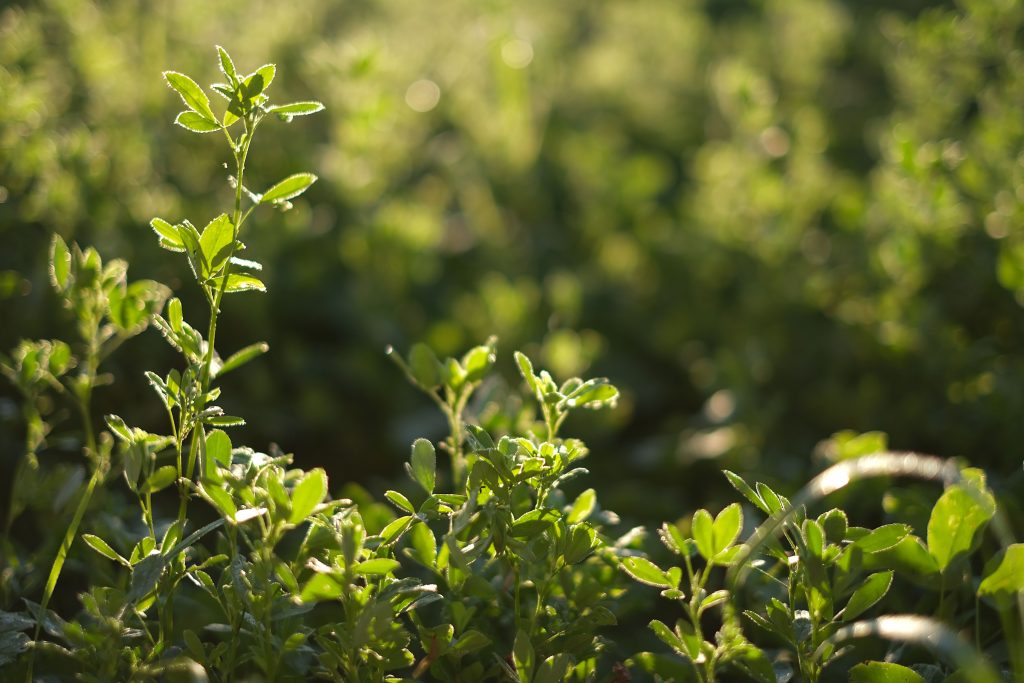
Late-summer alfalfa seeding can be one of the best opportunities to establish a productive perennial forage stand, but it leaves less room for correcting mistakes after planting. When the field is prepared properly, moisture is available, and seeding occurs early enough for seedlings to develop before a killing frost, late-summer alfalfa can enter the following spring with a strong root system and much more production potential than a newly seeded spring stand.
The challenge is that alfalfa is not very forgiving of poor field selection or weak preplant fertility.
A corn or soybean crop may tolerate a less-than-ideal soil pH for one season and allow the farmer to adjust the program later. Alfalfa is expected to remain in the field for several years. Once the stand is established, deep incorporation of lime, phosphorus, or potassium becomes much more difficult. A fertility problem that should have been corrected before planting can therefore affect stand establishment, yield, root development, nitrogen fixation, and persistence for much of the life of the stand.
That is why August alfalfa establishment should begin with the soil test rather than the seed bag.
University of Wisconsin Extension describes late summer as an excellent alfalfa establishment period in many areas, but it also stresses that successful planting depends on suitable soil moisture, correct timing, and adequate fertility. Wisconsin guidance recommends having soil tested and correcting lime, phosphorus, potassium, boron, and sulfur needs before establishment. It identifies an optimum soil pH near 6.8 and notes that lime is ideally applied well ahead of planting because changing soil acidity takes time.
University of Minnesota Extension gives similar advice. Its establishment guidance recommends maintaining soil pH between about 6.5 and 7.0, correcting deficiencies before planting, and paying particular attention to phosphorus, potassium, and sulfur because those nutrients influence establishment as well as the productivity and persistence of the stand over the years that follow.
The practical lesson is simple: late-summer alfalfa seeding should be treated as the beginning of a multi-year fertility program, not as a one-time planting operation.
Even an excellent fertility program cannot overcome a field that is fundamentally poorly suited to alfalfa.
Alfalfa develops a deep taproot when soil conditions allow it. University of Minnesota notes that alfalfa roots can explore very deep soil profiles under favorable conditions, which helps explain the crop’s ability to remain productive during moderate dry periods once the stand is established. The same crop performs poorly where water regularly ponds, where roots encounter severely restricted soil layers, or where drainage keeps the root zone saturated for long periods.
This makes field drainage one of the first establishment decisions.
A low area that remains saturated after spring storms may not be a good alfalfa site even if the soil test is excellent. Saturated soils limit oxygen around the roots and favor several root diseases. Winter conditions can compound the problem because low-lying wet areas are more vulnerable to ice sheeting and freeze-thaw injury.
Shallow, severely eroded soils create a different problem. They may not hold enough water to support young seedlings through late-summer heat, and the root system may have little depth to explore once the surface dries.
Before spending money on seed and fertilizer, walk the field with those physical limitations in mind. If one portion consistently ponds or another has only a shallow layer of productive soil, the farmer may need to exclude those acres, improve drainage, or choose another forage better suited to the site.
Fertility can improve the soil’s nutrient environment. It cannot create drainage or soil depth.
The phrase “late-summer seeding” can be misleading if it causes growers to believe alfalfa can be planted whenever a field becomes available near the end of summer.
The crop needs enough growing time to establish several healthy leaves, build a crown and root system, and accumulate carbohydrate reserves before severe cold arrives.
Wisconsin Extension recommends providing at least about 45 frost-free days of good growing conditions after seeding. In Wisconsin, a general late-summer window often falls around August 1 through August 15, with earlier timing favored farther north. University of Minnesota recommends approximately August 1 through September 1 in southern Minnesota and earlier planting in northern parts of the state.
Pennsylvania also recognizes late summer as an excellent forage-establishment period when soil conditions are favorable, but actual dates vary by region.
Those dates should not be copied across the entire United States.
A producer in northern Minnesota has a much shorter establishment window than one in Kentucky or the Mid-Atlantic. Elevation, expected first frost, rainfall pattern, and current soil moisture all influence the decision.
The better rule is to follow local Extension planting dates and make sure seedlings have enough good growing weather remaining to establish before winter. Saving a week on field preparation is not valuable if the result is a stand planted too late to survive reliably.
The correct calendar date does not compensate for inadequate moisture.
Late-summer seeding often follows wheat, another small grain, vegetable harvest, or a failed earlier crop. Those fields may be open and convenient for planting in August, but the seedbed can be dangerously dry after summer heat.
Wisconsin Extension specifically cautions against planting alfalfa into dry soil. A small rain may provide enough moisture to germinate the seed, only for seedlings to die several days later if the soil underneath remains dry and no additional rain arrives.
This is one of the worst establishment outcomes because the producer can lose both the seed investment and the planting window.
Check moisture through the seed-placement zone before planting. A darkened soil surface after a brief shower is not enough evidence that the field contains adequate moisture for germination and early root growth.
The weather forecast also matters. If the soil is marginally dry and the next ten days are expected to remain hot with no meaningful rain, waiting may be safer than planting simply because the target date has arrived.
On the other hand, growers should not delay repeatedly while waiting for perfect conditions until the frost-free establishment window disappears. Late-summer alfalfa establishment always involves balancing soil moisture against the amount of growing season remaining.
That is why field preparation should begin before the planting date rather than after it.
Alfalfa is more sensitive to soil acidity than many common forage grasses.
University of Minnesota recommends maintaining soil pH around 6.5 to 7.0 for alfalfa, while Wisconsin guidance identifies an optimum near 6.8. Penn State likewise places legumes such as alfalfa in a higher target pH range than grasses.
That pH range matters for several reasons.
Nutrient availability changes as soil becomes increasingly acidic. More importantly for a legume, the Rhizobium bacteria responsible for biological nitrogen fixation perform best under a favorable soil pH.
Alfalfa obtains most of its nitrogen through this symbiotic relationship rather than through repeated nitrogen fertilizer applications. If acidity interferes with nodulation and bacterial activity, the plant can struggle even when other nutrients are adequate.
Penn State points out that applying nitrogen fertilizer to an alfalfa field with poor pH may temporarily mask a nitrogen-deficiency symptom without fixing the underlying soil problem. Correcting acidity before establishment is the better long-term approach.
The timing of lime matters as well.
Lime does not instantly change soil pH throughout the root zone. University of Minnesota recommends applying and incorporating lime roughly six to twelve months before seeding where possible, while Wisconsin suggests an even broader six-to-24-month planning period depending on conditions.
If a farmer is only beginning to think about lime a few days before an August seeding, some benefit may still come from correcting the soil, but the ideal preparation window has already been missed.
That is why fields intended for alfalfa should be identified well in advance.
Phosphorus deserves attention before alfalfa seeding because young plants need to establish a strong root system quickly.
Wisconsin Extension specifically identifies phosphorus as critical to proper root and seedling development.
A low-phosphorus field can therefore create problems at exactly the stage when late-summer alfalfa has little time to spare.
The seedlings need to emerge, expand leaves, develop roots, establish nodules, and begin building reserves before cold weather. A nutrient shortage that slows early growth shortens the effective establishment window even further.
The correct phosphorus rate should come from a calibrated soil test and local university recommendations. Soil-test methods and interpretation categories differ across the United States, so one universal ppm target or fertilizer rate should not be applied everywhere.
If phosphorus is deficient, correcting it before or at establishment generally provides more opportunity to place the nutrient where young roots can access it than waiting until the stand is several years old.
If soil-test phosphorus is already high, however, additional P should not be added simply because alfalfa is being established. The crop requires phosphorus, but a high-testing soil may already be capable of supplying enough.
The principle remains the same throughout the fertility program: essential does not automatically mean deficient.
Potassium becomes increasingly important once alfalfa begins producing multiple cuttings per year.
Hay harvest removes the entire aboveground portion of the crop, which means large amounts of potassium leave the field in stems and leaves. University of Minnesota estimates removal at approximately 58 pounds of K₂O per ton of alfalfa produced.
That is a substantial nutrient export.
A four-ton crop using that estimate could remove more than 200 pounds of K₂O per acre over the season. A high-yielding field producing even more forage can remove correspondingly more.
This is why a field that begins with marginal soil-test potassium can quickly become problematic once full production begins.
University of Minnesota describes potassium as especially important for alfalfa yield and persistence.
The important point for a new seeding is to correct low K before the stand begins several years of repeated hay removal.
Once a perennial alfalfa crop is established, surface applications can maintain fertility, but incorporating needed potassium throughout the prepared root zone becomes much more difficult. A preplant soil test provides the opportunity to correct a serious deficiency before the field becomes a permanent hay stand.
At the same time, growers should avoid the outdated idea that a heavy fall potassium application automatically improves winter survival regardless of soil-test need. University of Minnesota research has found that an additional fall K application did not improve winter hardiness where soil potassium was already adequate. The university recommends soil testing and applying the needed rate rather than using fall potash as routine winter insurance.
That is an important distinction. Adequate potassium supports alfalfa health and persistence. Excess potassium does not automatically create a stronger stand.
Where preplant testing confirms that potassium is below the desired range and additional nitrogen or phosphorus is not required in the same application, Supply Solutions Sulfate of Potash 0-0-50 can provide a concentrated potassium source.
Supply Solutions lists this product as a 0-0-50 potassium fertilizer, meaning it supplies potassium without adding nitrogen or phosphorus.
The reason to use a potassium source before alfalfa establishment is that the soil test has identified a K shortage that could limit future forage production and stand persistence. Applying it before seeding can allow the fertility program to correct that shortage before repeated hay harvest begins exporting large amounts of potassium.
The appropriate rate should still follow the local soil-test recommendation. A new alfalfa field should not receive a large potassium application merely because alfalfa removes substantial K once established.
The problem Sulfate of Potash solves is inadequate potassium fertility.
It does not correct low pH, replace phosphorus where phosphorus is deficient, improve drainage, or rescue seedlings planted into dry soil.
Keeping that role specific prevents the product from being forced into fields where it is not needed.
Sulfur has become a more common part of forage fertility discussions as atmospheric sulfur deposition has declined across the United States.
Most soil sulfur is associated with organic matter. Microbial mineralization releases plant-available sulfate during the growing season, so soils with more organic matter generally have a greater potential internal sulfur supply.
Sandy soils with low organic matter have less reserve and are more vulnerable to sulfate movement with water.
University of Minnesota notes that low-organic-matter sandy soils can require supplemental sulfur and cites rates as high as approximately 25 pounds of S per acre annually in some situations.
This does not mean every new alfalfa seeding should receive sulfur automatically.
Manure history, soil texture, organic matter, irrigation, crop removal, and regional response data all matter. A field with regular manure applications may receive meaningful S from that source, while a coarse-textured field with no manure history may have a stronger probability of response.
Sulfur should therefore be evaluated as part of the establishment plan rather than added as insurance simply because alfalfa is a high-value forage crop.
Magnesium is essential to alfalfa because it is part of chlorophyll and participates in numerous metabolic reactions.
When soil magnesium is genuinely deficient, it should be corrected.
The method depends partly on soil pH.
If the field is acidic and also needs magnesium, a magnesium-containing lime source can sometimes address both problems. If pH is already suitable, however, adding large amounts of lime simply to supply magnesium may raise soil pH unnecessarily.
This is another area where fertilizer selection should follow soil-test need.
Growers should also avoid trying to force soil calcium, magnesium, and potassium into an arbitrary “ideal” ratio. Research-based fertility programs focus much more heavily on maintaining adequate nutrient levels than on chasing a specific cation balance.
The goal is not to make the laboratory report look mathematically perfect.
The goal is to ensure that none of the essential nutrients is likely to limit alfalfa establishment and production.
Alfalfa is a legume.
When properly inoculated and grown under suitable soil conditions, Rhizobium bacteria within root nodules can supply much of the crop’s nitrogen requirement through biological fixation.
That means routine nitrogen fertilization is generally unnecessary for successful alfalfa production.
In fact, Wisconsin Extension cautions that high available soil nitrogen can delay or reduce nodule formation in newly establishing alfalfa.
This is another reason the preplant fertility discussion should not begin by asking which N-P-K blend to use.
A fertilizer blend containing substantial nitrogen may provide a nutrient that the alfalfa is designed to obtain biologically while failing to provide enough potassium or phosphorus to correct the actual soil shortage.
Alfalfa establishment is one of the clearest examples of why fertilizer grade needs to be matched to the crop rather than applied according to habit.
The nitrogen already present from manure or previous crop management should also be considered. Fields with unusually high residual N may produce vigorous early top growth while nodulation develops more slowly.
Good soil pH and effective inoculation matter more to long-term nitrogen nutrition than routine applications of commercial N.
Because alfalfa depends on biological nitrogen fixation, seed inoculation deserves attention during establishment.
Many commercial alfalfa seeds are sold pre-inoculated, but producers should confirm what they are buying and whether the inoculant remains viable under the seed’s storage conditions.
If the seed is not inoculated or the field has no recent alfalfa history, applying the correct strain of Rhizobium according to seed and inoculant directions becomes especially important.
The bacteria cannot perform well if soil pH is severely acidic, which brings the fertility discussion back to soil preparation.
A farmer can buy high-quality inoculated seed and still obtain poor nodulation if the root environment is unfavorable.
Good establishment is built from several pieces working together: suitable pH, correct inoculation, adequate phosphorus and potassium, moisture, drainage, and timely seeding.
No individual product can replace the rest of that system.
Boron is another nutrient commonly associated with alfalfa.
Wisconsin includes boron among nutrients that should be evaluated when preparing fertility for alfalfa establishment.
The challenge with boron is that the difference between deficiency and excessive application can be much smaller than it is for macronutrients such as potassium.
That means growers should follow regional soil- and tissue-testing guidance carefully rather than adding boron casually to every new stand.
Uniform application is also important because a concentrated amount placed in one small area can create toxicity even when the average field rate appears reasonable.
If the soil and regional recommendations indicate that boron is needed, it can be included carefully in the program. If no evidence supports a B shortage, applying it “just in case” is not good fertility management.
The same principle applies to micronutrients generally.
More nutrients do not automatically create a better alfalfa stand.
One of the most important field-selection issues in alfalfa is autotoxicity.
Established alfalfa plants release compounds that can reduce germination and, more importantly, restrict root development of new alfalfa seedlings planted into an old alfalfa stand.
University of Minnesota and Wisconsin both warn against immediately establishing new alfalfa into mature alfalfa ground because of this effect.
The exact waiting period varies with stand age, region, and management recommendations, but the main lesson is clear.
Fertilizer cannot overcome autotoxicity.
A producer may correct pH perfectly, apply the right phosphorus and potassium, prepare an excellent seedbed, and still establish a poor stand if new alfalfa is planted too soon after an older alfalfa crop.
Crop rotation needs to be part of the establishment plan.
Failed seedings from the same spring may be treated differently from old established stands because toxin accumulation and root systems differ, so local Extension recommendations should be followed before reseeding.
Late-summer alfalfa often follows another crop harvested earlier in the season.
That creates a possible herbicide carryover problem.
Wisconsin Extension specifically warns that residues from herbicides used in the previous crop can damage a new alfalfa stand.
Plant-back restrictions vary widely among herbicide products, rates, soil pH, rainfall, and crop species.
This is not something that should be guessed from memory.
Review the label and field records before preparing the seedbed.
A nutrient program cannot compensate for herbicide injury. If the rotational restriction has not expired, planting a few weeks later or choosing a different field may be less expensive than losing an entire perennial stand.
Alfalfa seed is small, which means planting depth needs to be shallow and uniform.
University of Minnesota recommends good seed-to-soil contact and emphasizes a firm seedbed, while Wisconsin cautions against excessive tillage that dries the soil immediately before late-summer planting.
This becomes especially important in August.
Every unnecessary tillage pass can release moisture from the seedbed at the exact time when young seedlings are most vulnerable to drying.
The goal is not a powdery seedbed.
A properly prepared field should be firm enough that seeding equipment can place seed shallowly and consistently while maintaining good contact between the seed and moist soil.
A field worked repeatedly until it looks perfectly smooth may actually be less favorable for establishment if those operations dry the upper profile.
Late-summer seeding rewards restraint.
There is also a practical management issue when soil-test results arrive late.
Farmers sometimes discover in August that pH, phosphorus, or potassium should have been corrected months earlier. They then face a difficult decision between delaying planting while completing fertility work and planting on time into an imperfect field.
There is no universal answer because the severity of the deficiency matters.
A minor maintenance need is different from a severely acidic field or a strongly deficient potassium level.
What this situation should reinforce is the value of testing fields well before the planned alfalfa establishment year.
Ideally, the soil test, lime requirement, crop rotation, herbicide history, and drainage issues should already be understood before the small grain or previous crop is harvested.
Then August becomes an execution window rather than a planning emergency.
Alfalfa should not be managed as though the goal is simply to achieve green seedlings this fall.
The field will eventually be expected to produce several cuttings each year. Every ton of harvested hay will remove nutrients. University of Minnesota estimates that each ton of alfalfa can remove about 14 pounds of P₂O₅, 58 pounds of K₂O, and roughly 6 pounds of sulfur.
Those removals accumulate rapidly in a productive stand.
That is why establishment fertility should put the field in a position where the soil can support repeated harvest rather than allowing the stand to begin its productive life already deficient.
Regular soil testing should continue after establishment. Alfalfa is not a crop that can be fertilized once before planting and ignored for four years.
The initial soil correction creates the foundation. Annual or regular monitoring keeps that foundation from being mined away by hay removal.
Late-summer alfalfa establishment succeeds when timing, moisture, soil conditions, and fertility all support the same goal. The seed needs enough growing season to establish before frost, but it also needs a root zone with suitable pH, adequate phosphorus and potassium, good drainage, and enough moisture to survive germination and early growth. Nitrogen should not be treated as the main establishment fertilizer simply because it drives grass production, because alfalfa depends primarily on biological nitrogen fixation when soil pH and nodulation are managed correctly.
Where soil testing confirms a genuine potassium shortage, Supply Solutions Sulfate of Potash 0-0-50 can provide K without forcing additional nitrogen or phosphorus into the program. Its role is to correct inadequate potassium before a high-removal perennial hay crop begins drawing heavily on the soil reserve. Other deficiencies, particularly phosphorus, sulfur, magnesium, boron, or low soil pH, should be corrected with products and rates appropriate to the soil test and local Extension recommendations rather than forcing one fertilizer to solve every problem.
A productive alfalfa stand is built before the first cutting ever occurs. Farmers who select a well-drained field, correct acidity early, establish adequate phosphorus and potassium, protect seedbed moisture, check herbicide and autotoxicity risks, and plant within the correct regional window give the crop a much stronger chance to remain productive for several years. Supply Solutions can help growers match fertilizer products to confirmed nutrient needs, but the best late-summer alfalfa program begins with a soil test early enough to make the corrections before the seed goes into the ground.
Walk into a fertilizer warehouse, farm supply store, greenhouse, or garden center and the first thing most people notice on a fertilizer bag is a
When fertilizer prices are high, farmers naturally want every pound of nutrient they purchase to contribute as much as possible to crop production. That makes
Give us a call or visit our store, and we’ll help you find the right solution for your business.