
Uncategorized
How to Read a Fertilizer Grade: What N-P-K Numbers Actually Tell You
Walk into a fertilizer warehouse, farm supply store, greenhouse, or garden center and the first thing most people notice on a fertilizer bag is a
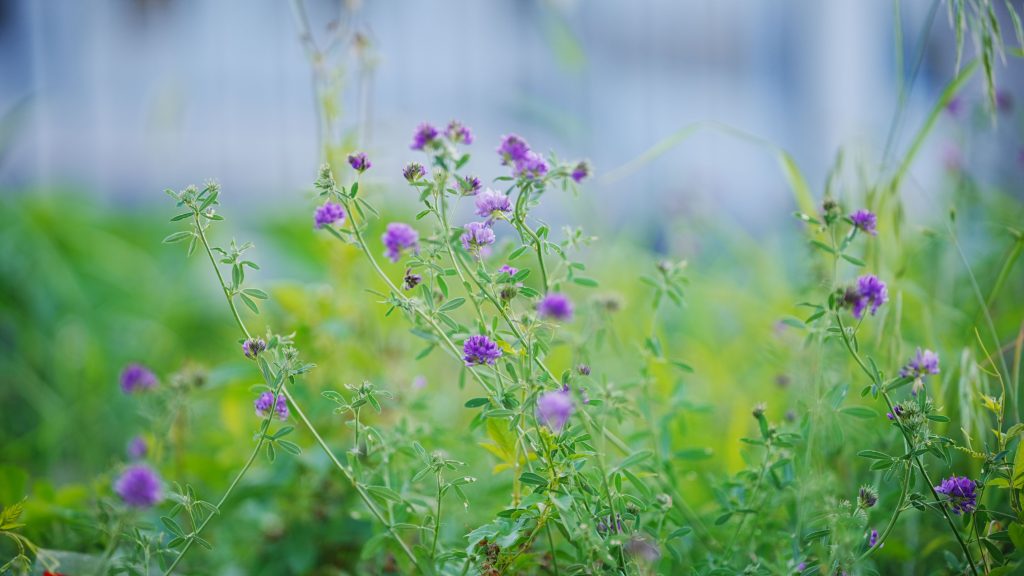
When an established alfalfa field begins losing color or slowing down after several cuttings, nitrogen is often the first fertilizer nutrient that comes to mind. That reaction makes sense in grass crops because nitrogen has a strong and visible effect on vegetative growth. Alfalfa, however, operates under a different fertility system.
A healthy, effectively nodulated alfalfa stand obtains most of the nitrogen it needs through biological nitrogen fixation. Rhizobia bacteria living in nodules on the roots capture atmospheric nitrogen and convert it into forms the plant can use. When soil pH is suitable, nodules are functioning properly, and the stand is otherwise healthy, applying commercial nitrogen generally does not increase yield enough to justify the expense. Penn State Extension states that established, effectively nodulated legumes can fix the nitrogen needed for growth and that fertilizer N can actually discourage nodulation and biological fixation.
Potassium tells a very different story.
Every alfalfa cutting removes a substantial amount of potassium from the field. Unlike nitrogen, which the crop can obtain biologically, potassium must come from the soil and fertilizer program. Once the forage is cut, baled, chopped, and hauled away, the K contained in those stems and leaves leaves with it. Over several cuttings and several years, that nutrient export can draw a productive field from adequate soil-test potassium into a range where yield, regrowth, stand persistence, and stress tolerance begin to suffer.
University of Minnesota Extension identifies potassium as especially important for alfalfa yield and persistence and recommends monitoring phosphorus, potassium, and sulfur throughout the life of the stand because large quantities of nutrients leave with harvested forage.
That is why the fertility conversation for established alfalfa should usually begin somewhere other than nitrogen. For many productive stands, potassium deserves much closer attention.
Alfalfa’s ability to fix nitrogen is one of the reasons it fits so well into forage rotations. The plant forms a symbiotic relationship with Rhizobia bacteria that live inside nodules on the roots. The plant supplies carbohydrates produced through photosynthesis, while the bacteria provide biologically fixed nitrogen.
This system can supply a remarkable amount of nitrogen over the life of a productive stand.
It also means that a farmer should not manage established alfalfa like orchardgrass, bermudagrass, tall fescue, or another grass forage. Those grasses depend heavily on soil and fertilizer nitrogen. Pure alfalfa does not normally require routine N fertilizer when nodulation and soil conditions are suitable.
The distinction matters economically. Nitrogen is expensive, and putting it on a healthy alfalfa stand can add cost without addressing the nutrients actually being removed most aggressively by hay harvest.
It can also interfere with the biological process that is already supplying the crop. Penn State notes that commercial nitrogen discourages nodulation and inhibits fixation in established legumes.
When established alfalfa looks pale, therefore, the first question should not be how many pounds of nitrogen to apply. The better question is why the stand is pale.
Poor soil pH can reduce Rhizobia activity. Saturated roots can interfere with plant function. Disease or insect injury can weaken the canopy. Potassium, sulfur, phosphorus, or another nutrient may be limiting. A declining stand may simply be old enough that crown and root health are deteriorating.
Nitrogen may temporarily make a stressed legume appear greener in some circumstances, but that does not mean it corrected the underlying problem.
Established alfalfa’s ability to supply its own nitrogen depends heavily on the root environment.
University of Minnesota recommends maintaining alfalfa soil pH around 6.5 to 7.0 because nutrient availability and Rhizobia activity are both favored in that range. Penn State similarly notes that alfalfa is particularly sensitive to acidic soil and that low pH can reduce bacterial activity enough for the crop to show nitrogen-deficiency symptoms. Applying nitrogen without correcting the pH only masks the problem temporarily and is generally not economical.
This is an important diagnostic lesson for older stands.
Suppose a field was limed before establishment and performed well for several years. Repeated harvest and fertilizer use can gradually change soil chemistry, and portions of the field may become more acidic over time. If alfalfa begins declining, the grower should check the current soil test rather than assume the preplant lime application is still doing everything needed.
A pH problem affects much more than nitrogen fixation. Root growth, phosphorus availability, calcium and magnesium supply, and overall nutrient uptake can all be affected as acidity moves outside the preferred range.
Another nitrogen application cannot solve those problems.
Potassium deserves so much attention in established alfalfa because hay production is an intensive nutrient-removal system.
University of Minnesota estimates that a ton of harvested alfalfa can remove roughly 58 pounds of K₂O. At four tons per acre, that is more than 200 pounds of K₂O represented in the harvested forage. Higher-producing fields can remove considerably more.
The exact nutrient concentration varies with soil fertility, variety, maturity, weather, and management, so removal figures should not be treated as perfect replacement formulas. They are still useful for understanding why soil-test potassium can change quickly under intensive alfalfa production.
This is fundamentally different from a grain system in which much of the crop residue remains on the soil surface.
With alfalfa hay, most of the aboveground crop leaves.
A producer who cuts four or five times per season is repeatedly exporting potassium throughout the summer. If the soil started near the lower end of the adequate range and K applications do not keep pace with soil-test recommendations, the field can move toward deficiency relatively quickly.
That is why an alfalfa field that looked excellent during its first full production year may begin struggling two or three years later even though management appears largely unchanged.
The soil nutrient reserve has changed.
Potassium is sometimes discussed mainly in terms of how many tons of forage it can produce. Its role in alfalfa is broader than that.
The nutrient is involved in water regulation, enzyme activation, carbohydrate movement, protein synthesis, and other important physiological processes. Wisconsin Extension notes that potassium contributes to the movement and storage of carbohydrates in alfalfa, including the buildup and mobilization of energy reserves used by the crown and roots.
Those reserves matter because alfalfa repeatedly regrows after cutting.
When the crop is harvested, much of the photosynthetic canopy disappears. The plant initially relies on reserves stored in the crown and roots to produce new shoots. Once enough leaf area has developed, photosynthesis again supplies much of the energy needed for continued growth and rebuilding reserves for the next cutting.
A stand suffering from inadequate potassium is trying to manage that cycle with an important physiological limitation.
This helps explain why potassium fertility is connected not only with yield but also with stand persistence and tolerance to repeated harvesting.
University of Minnesota calls K especially critical for high yields and persistence in alfalfa.
By August, an established alfalfa stand may have already produced several cuttings.
That makes late summer a particularly useful time to evaluate whether the fertility program is keeping up.
A field that began spring with adequate moisture and cool temperatures may have produced strong early growth even while potassium reserves were becoming marginal. After multiple harvests, high nutrient export, summer heat, and periods of limited moisture, the weaker portions of the field can become much easier to identify.
Potassium deficiency in alfalfa commonly appears first on older leaves because K is mobile within the plant. Early symptoms can include small pale or whitish spots near leaf margins, followed by yellowing and tissue death as deficiency becomes more severe. UGA Extension identifies marginal spotting and subsequent yellowing on older leaves as characteristic symptoms of K deficiency in alfalfa.
However, late-summer discoloration should not be diagnosed from leaf appearance alone.
Leafhopper injury, disease, drought, root restriction, poor drainage, soil acidity, and natural stand decline can produce symptoms that resemble fertility trouble.
The best response is to compare affected and healthy areas, review soil tests, inspect crowns and roots, and consider how much forage has been harvested from the field.
August symptoms are useful because they tell the farmer where to investigate.
They are not a fertilizer rate by themselves.
Because alfalfa removes so much potassium, it is tempting to calculate the tons harvested and automatically replace the estimated K removed.
That can be useful as part of a fertility budget, but it should not replace soil testing.
A high-testing soil has a larger potassium reserve available to the crop than a low-testing soil. If the field still tests high, a large removal estimate does not necessarily mean the full amount needs to be replaced immediately.
A low-testing field is different. Simply replacing this year’s estimated removal may not be enough if the soil reserve is already below the desired range.
University of Minnesota recommends evaluating soil P, K, and S before establishment and annually during the alfalfa lifecycle because maintaining nonlimiting levels contributes to yield and persistence.
That regular testing is especially valuable in high-yield hay systems because nutrient removal can change rapidly from one year to another.
A drought year may produce only two or three cuttings and reduce K export. A favorable year may produce five cuttings and far greater removal.
The fertilizer program should reflect what the field actually produced and what the soil currently contains.
When an established alfalfa field needs a substantial potassium application, timing can influence how efficiently the crop uses it.
Penn State Extension notes that low maintenance rates on optimum-testing soils can generally be applied after a cutting or in the fall without much advantage from splitting. When high potassium rates are recommended, however, dividing the application can be useful. Part can be applied earlier in the season and the remainder later rather than placing a large amount on the field at once.
One reason is luxury consumption.
Alfalfa can absorb potassium beyond the amount needed to maximize yield when large amounts are readily available. That extra K ends up in the harvested forage.
If the entire annual potassium recommendation is applied at one time, the first cutting or two may absorb more than necessary, leaving less potassium available later in the growing season.
Splitting a large recommendation can spread nutrient availability more evenly across several harvest cycles.
This is especially logical in an alfalfa system because nutrient removal also occurs several times rather than once at the end of the year.
The exact timing should follow local Extension recommendations, soil texture, fertilizer source, and the size of the soil-test recommendation.
Luxury consumption has another consequence when alfalfa is being fed to dairy animals.
Wisconsin Extension notes that alfalfa will absorb K beyond its yield requirement when soil or applied potassium is abundant. High forage potassium can create nutritional challenges, particularly for close-up dry dairy cows where high-K diets can increase the risk of hypocalcemia around calving.
That does not mean potassium should be withheld from an alfalfa field that tests low.
Low K can reduce crop productivity and persistence.
The goal is adequate potassium rather than maximum potassium.
This is where soil testing, fertilizer timing, and forage testing should work together. A dairy producer may need to maintain productive alfalfa while also knowing which fields are likely to produce lower-potassium forage for animals with specific nutritional requirements.
Applying excessive K simply because alfalfa removes large quantities can work against that goal.
A balanced fertility program supplies what the crop needs without intentionally driving tissue concentrations higher than necessary.
Potassium is closely associated with alfalfa persistence and winter survival, but that relationship is sometimes oversimplified.
Older recommendations often encouraged an extra fall potash application specifically to help alfalfa survive winter. More recent research shows that the issue is more nuanced.
University of Minnesota research found that an additional fall potassium application did not improve winter hardiness where soil K was already adequate. Wisconsin Extension similarly emphasizes that maintaining optimal K fertility throughout the growing season supports winter hardiness, while topdressing potassium very late in fall is unlikely to change that year’s overwintering potential significantly.
This makes physiological sense.
Alfalfa needs adequate potassium while it is actively building and moving carbohydrates into root and crown reserves. Fertilizer applied after the crop has essentially gone dormant arrives too late to influence much of that preparation.
The practical recommendation is not to ignore fall potassium.
If soil testing shows that the field needs K, fall may be an appropriate application period in many regions and soils.
The important distinction is that potassium should maintain adequate soil fertility, not be marketed as a last-minute winter insurance treatment.
A deficient field should have been supplied with enough K while the plants were actively growing.
Stand persistence depends on more than fertilizer.
Every cutting temporarily reduces photosynthetic area and forces the plant to draw on stored reserves for regrowth. If cutting intervals are consistently too short, the alfalfa may be harvested before those reserves have been fully replenished.
Late-season cutting creates an additional concern in cold regions because the plant is preparing for winter at the same time.
Wisconsin Extension’s current guidance emphasizes that fall-cutting risk depends on stand age, disease resistance, winter-hardiness genetics, harvest schedule, soil fertility, and weather. Maintaining adequate potassium helps reduce some of the stress associated with fall harvest, but good K fertility cannot make an excessively aggressive cutting program risk free.
Penn State likewise notes that winter injury risk increases when late harvesting does not leave enough time for root carbohydrate reserves to recover.
This is another example of why fertilizer should not be asked to solve a management problem.
Adequate K helps the plant perform normally.
It does not create extra growing days between the final cutting and winter.
When an alfalfa field becomes thin, another potassium application is not automatically the answer either.
Stand age matters.
Older alfalfa crowns accumulate disease, mechanical injury, winter damage, and traffic stress over time. Even a well-fertilized stand eventually reaches a point where plant density and stem density become too low to support profitable production.
Penn State recommends evaluating both plant counts and stem density when deciding whether an older stand should remain in production. Its guidance suggests that stem densities above roughly 55 stems per square foot are generally not yield limiting, while stands below about 40 stems per square foot may warrant replacement.
These thresholds should be used with local guidance and field judgment, but the principle is valuable.
If a stand has lost a substantial share of its productive crowns, fertilizer cannot manufacture new mature alfalfa plants.
Applying potassium to a low-K field may improve the performance of the plants that remain, but it will not reverse advanced stand loss.
Before spending heavily on fertilizer for an older field, determine whether enough healthy alfalfa remains to justify another production year.
A soil test tells only part of the story in a perennial forage crop.
Dig several alfalfa plants from both productive and weak portions of the field. Cut crowns and upper taproots lengthwise and examine the internal tissue.
Healthy crowns and roots should have substantial firm, light-colored tissue. Severe internal browning, rotting, hollow areas, or extensive crown damage suggests that disease or accumulated injury may be contributing to stand decline.
Older stands are naturally more vulnerable to this damage. University of Minnesota notes that stand age, disease, pests, fertility, and winter conditions all interact to determine survival and persistence.
A field can therefore test low in potassium and also have severe crown disease.
Correcting K may still be justified, but the expected lifespan of the stand should influence how much money is invested.
There is little value in making a large multi-year fertility investment in a field that is likely to be terminated after one more cutting.
Potassium may deserve more attention than nitrogen, but it is not the only nutrient that matters in established alfalfa.
Sulfur deserves particular consideration because alfalfa has meaningful S demand and atmospheric sulfur deposition has declined substantially over time.
University of Minnesota notes that sulfur shortages are more likely on low-organic-matter soils and recommends evaluating S throughout the alfalfa lifecycle.
Sulfur behaves differently from potassium in soil. Plant-available sulfate is mobile and can move with water, especially in sandy soils. Organic matter supplies sulfur through mineralization, which means deep, high-organic-matter soils may provide more internal S than coarse, low-organic-matter ground.
This is why sulfur should be included when the field has a documented need rather than automatically applied to every established alfalfa stand.
A field may need both K and S.
Another may need potassium alone.
The fertilizer source should match that difference.
Alfalfa also removes phosphorus with every cutting.
The quantity is generally lower than potassium removal, but P remains essential to root function, energy transfer, and crop productivity.
A field that tests low in both phosphorus and potassium should not receive a potassium-only program and be expected to reach full yield potential.
Likewise, a high-phosphorus field does not need additional P simply because a standard forage blend has traditionally been applied after each cutting.
This is one of the advantages of using current soil testing rather than a fixed N-P-K blend.
If K is the primary deficiency, the farmer can select a potassium-focused source.
If both P and K are deficient, a different fertilizer strategy may be appropriate.
If both are adequate, neither should be applied merely because the field has just been harvested.
When soil testing confirms that an established alfalfa stand needs potassium but does not require additional nitrogen or phosphorus in the same application, Supply Solutions Sulfate of Potash 0-0-50 provides a concentrated 0-0-50 potassium fertilizer. Supply Solutions lists the product in its agricultural category as a potassium fertilizer.
The reason to use it in established alfalfa is specific: repeated hay harvest has drawn on the potassium supply, and soil testing indicates that K needs to be replenished or corrected to support continued forage production.
The most appropriate timing depends on the size of the K recommendation, soil texture, number of remaining cuttings, and local university guidance. Where only a modest maintenance application is required, timing may be flexible. Where the soil test calls for a large rate, splitting potassium through the production season can help reduce luxury consumption and keep K available across several cutting cycles.
The problem the product solves is inadequate potassium fertility.
It does not supply the biological nitrogen that healthy alfalfa already obtains through nodulation, and it should not be used as a treatment for crown disease, poor drainage, compaction, or an old stand that has already lost too many productive plants.
Keeping that role clear is what makes the fertilizer recommendation agronomically credible.
After cutting, alfalfa can look unimpressive for several days.
The canopy is gone, the field may appear pale, and new shoots have not yet rebuilt enough leaf area to give the field its normal appearance.
That period should not be mistaken automatically for nitrogen deficiency.
Regrowth begins using stored root and crown reserves. As new leaves expand, photosynthesis increases and the normal cycle continues.
A healthy nodulated stand will again obtain nitrogen biologically.
Putting Urea 46-0-0 or another nitrogen fertilizer on pure established alfalfa simply because the field looks slow after cutting is generally not the best use of fertilizer dollars.
The situation changes if the field is actually an alfalfa-grass mixture. Grasses in the stand can respond to nitrogen, and producers managing a mixed forage system may intentionally change fertility to influence species composition. That is a different production objective from fertilizing pure alfalfa.
In a predominantly alfalfa stand, the grower should first determine why biological N supply appears inadequate before purchasing commercial nitrogen.
Late summer brings together several pieces of information that make a fertility decision easier.
By August, the producer knows how many cuttings have been harvested and has a reasonable estimate of the season’s tonnage. Potassium removal is therefore no longer an abstract preseason estimate.
Stand vigor can also be evaluated after repeated harvest.
Weak zones are visible. Wheel-traffic damage may be apparent. Disease pressure has had time to develop. Thin areas can be assessed for plant and stem density. The producer can compare the current soil-test history with how the field is actually performing.
Current UGA guidance from July 2026 emphasizes that established alfalfa should continue to receive annual fertility monitoring along with regular disease and insect scouting because management after establishment determines whether a stand remains productive for five years or more.
That is exactly the perspective farmers should bring into August.
The question is not simply how to fertilize the next cutting.
The question is whether the fertility program is protecting the remaining productive life of the stand.
A young, vigorous stand with strong stem density and several productive years ahead may justify correcting a low soil-test K level aggressively according to university recommendations.
An aging stand scheduled for termination after one more season deserves a different economic calculation.
In the older field, applying enough potassium to support the next crop or two may make sense, but a large build program intended to support several more years of alfalfa may not.
The rotation matters as well.
Any phosphorus and potassium remaining in the soil after alfalfa termination can contribute to the fertility of the following crop, so the investment is not necessarily lost. Still, the farmer should understand whether the application is intended primarily to feed the existing forage, build long-term soil fertility, or both.
That clarity improves budgeting.
Established alfalfa is an excellent example of why crop fertility should be based on plant biology rather than fertilizer habit.
The crop has a biological system capable of supplying its nitrogen when nodules, roots, and soil pH are functioning properly. Applying commercial nitrogen to a healthy pure stand generally does little to improve yield and can interfere with fixation.
Potassium has no equivalent biological replacement.
Every cutting removes K, and the only way to keep an intensively harvested stand adequately supplied over time is through the combination of soil reserves, nutrient recycling, manure where appropriate, and fertilizer applications guided by testing.
That does not justify unlimited potash.
Alfalfa can take up more potassium than it needs, high forage K can create livestock-feeding concerns, and late-fall applications should not be treated as an automatic winter-hardiness treatment. The objective is to maintain enough potassium to support yield, regrowth, carbohydrate movement, and persistence without driving soil or forage concentrations unnecessarily high.
For established stands in August, that means reviewing how much forage has already left the field, checking current soil-test potassium, evaluating pH and sulfur as well, and looking carefully at the health and remaining life of the stand. When testing confirms that potassium needs attention, Supply Solutions Sulfate of Potash 0-0-50 provides a targeted K source that can be incorporated into a soil-test-based fertility program without automatically adding nitrogen or phosphorus.
Productive alfalfa does not need fertilizer simply because another cutting has been taken. It needs the nutrients that the soil, root system, and biological nitrogen-fixation process cannot supply in sufficient amounts. Farmers who maintain that distinction are more likely to protect both forage yield and stand longevity while avoiding fertilizer expense that does not solve the field’s actual limitation. Supply Solutions can help growers select an appropriate potassium source once soil testing and production history show that K is the nutrient the stand truly needs.
Walk into a fertilizer warehouse, farm supply store, greenhouse, or garden center and the first thing most people notice on a fertilizer bag is a
When fertilizer prices are high, farmers naturally want every pound of nutrient they purchase to contribute as much as possible to crop production. That makes
Give us a call or visit our store, and we’ll help you find the right solution for your business.