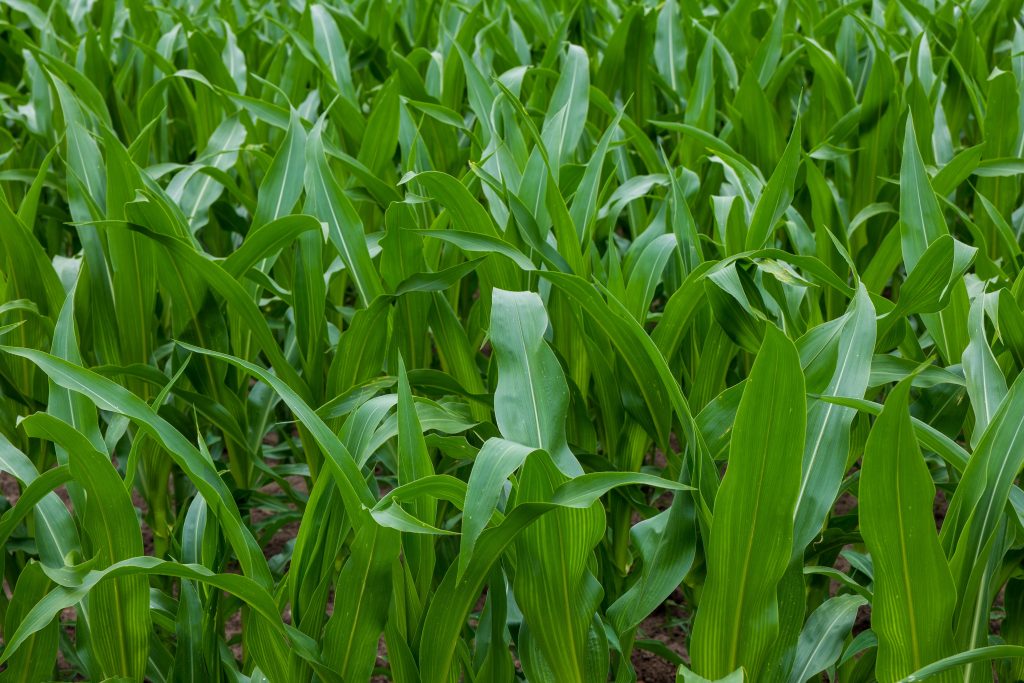
Corn can change quickly in June.
A field or garden row that looked slow in cool May weather may suddenly start moving once soil warms. Leaves lengthen. Color deepens. Roots expand. Sweet corn begins looking more upright and aggressive. Field corn moves from early establishment into the rapid-growth stretch that sets the crop up for the rest of the season.
That is why June is such an important nitrogen window.
Corn needs nitrogen, but it does not need all of it at the same moment. Early growth uses some nitrogen, but demand rises sharply once the plant has enough leaf area and root system to grow fast. If nitrogen is short at that point, the crop can lose momentum. Leaves become pale. Lower leaves may yellow. Growth slows. Stalks may stay thin. Sweet corn may lose yield potential before tasseling ever arrives. Field corn can fall behind during a stage that is hard to make up later.
At the same time, applying nitrogen without reading the crop and soil can create problems.
If soil is saturated, roots may not take up nitrogen well. If heavy rain has moved nitrogen below the root zone, the crop may need a correction. If the plant is pale because of sulfur deficiency, nitrogen alone may not fully solve the problem. If potassium is low, corn may still struggle with water stress and stalk strength even after nitrogen is supplied. If nitrogen is applied too close to the plant or without moisture to move it into the soil, response may be uneven.
A good early summer corn program is not just “add nitrogen.”
It is about timing the nitrogen push when corn can use it, placing it where roots can reach it, accounting for rainfall and soil type, and supporting the nutrients that help corn turn nitrogen into strong growth.
For June corn, three Supply Solutions products fit naturally into that decision: Urea 46-0-0 Nitrogen Fertilizer, Ammonium Sulfate 21-0-0 + 24% Sulfur, and KMS 0-0-21.5 Potassium Magnesium Sulfate. Each one solves a different part of the early summer fertility picture.
Corn demand changes after establishment
Young corn does not use nitrogen at the same rate all season.
At emergence, the seed and early root system support the plant. As roots expand and leaves develop, demand increases. Once corn reaches the stage where it begins adding leaf area quickly, nitrogen uptake rises. That is why side-dressing or early summer nitrogen correction can be so important.
The crop may look modest early, then suddenly need more.
For home gardeners growing sweet corn, this often happens when the corn is knee-high or beginning to stretch. The plants may have looked fine for weeks, then lower leaves begin to pale. For small farms and field corn, the window often lines up with early vegetative stages when the crop is preparing for rapid growth and eventual ear development.
This is the time to look closely at color and growth pattern.
Healthy corn should have steady new growth, good leaf width, and an even green color for the crop stage and variety. It should not be stalled, pale, or uneven across the row unless soil conditions explain it. A few plants may lag because of seed depth, compaction, cold stress, or insect damage. But if whole areas of the field or garden begin paling, nitrogen or sulfur may be part of the issue.
The key is to correct early enough that the plant can use the nutrient before the most demanding stages arrive.
Nitrogen shortage often begins on lower leaves
Corn is a grass, and it uses nitrogen heavily.
When nitrogen becomes limiting, older lower leaves often show the first signs. They may turn pale green, then yellow. In more noticeable cases, yellowing may form a V-shape starting at the leaf tip and moving down the midrib. The plant may look thinner, shorter, and less vigorous than nearby corn with enough nitrogen.
That pattern matters.
If the newest leaves are green but lower leaves are yellowing, nitrogen shortage may be likely, especially in actively growing corn. If the whole plant is pale, nitrogen may still be involved, but sulfur, cold soil, wet roots, or general root stress may also be part of the picture. If yellowing appears mainly in low spots after rain, oxygen stress may be involved. If plants are purple, phosphorus stress, cold soil, or root restriction may be part of the issue. If leaf edges scorch, potassium or water stress may deserve attention.
Corn color should always be read with soil conditions.
A pale plant in dry soil may not be taking up nutrients because water is limiting movement. A pale plant in saturated soil may have roots that cannot breathe. A pale plant after heavy rain on sandy soil may truly be short on nitrogen because nutrients moved out of the root zone.
Before applying fertilizer, dig around the roots. Check moisture. Look at the whole area. Then decide whether the crop is hungry or simply stressed.
Urea fits a clear nitrogen push
When corn clearly needs nitrogen and the soil conditions are right, Urea 46-0-0 Nitrogen Fertilizer is a strong early summer tool.
Urea supplies a high concentration of nitrogen. That makes it useful for corn because corn demand can rise quickly in June. For field corn, sweet corn, garden corn, and small farm corn plantings, urea can help correct nitrogen shortage and support rapid vegetative growth when the crop is ready to use it.
The problem urea helps solve is clear nitrogen hunger in actively growing corn. That may show up as pale color, lower leaf yellowing, slow growth, or uneven vigor in areas where nitrogen was not applied, was applied too lightly, or may have been lost after heavy rainfall.
The timing is early summer when corn is established and entering faster growth. Urea fits side-dressing or nitrogen correction when plants have enough root system to take up nitrogen and enough moisture is available to move it into the root zone.
The caution is placement and moisture. Urea should not be placed directly against corn stems or tender roots. It should be incorporated, watered in, or timed with appropriate rainfall according to the grower’s system and product directions. Surface-applied urea can be vulnerable to loss if it sits without moisture or incorporation, especially in warm conditions.
Urea is a strong nitrogen source. Use it when nitrogen is the limiting factor, not when corn is pale because roots are waterlogged or cold.
Wet June weather can change nitrogen availability
Spring and early summer rain can complicate corn nitrogen decisions.
Heavy rainfall can move nitrate nitrogen below the active root zone, especially in sandy soils or well-drained areas. Saturated soil can also reduce root function and create nitrogen loss conditions in some fields. In low areas, corn may yellow after prolonged wetness even if nitrogen was applied, because roots cannot take up nutrients well.
This is where field observation matters.
If corn is yellow across sandy areas after heavy rain, nitrogen loss may be a real concern. If corn is yellow in low, wet pockets, root oxygen may be the first issue. If corn is pale in streaks or bands, fertilizer placement may be part of the story. If only compacted wheel tracks are yellow, root restriction may be limiting uptake.
A nitrogen push with Urea 46-0-0 can help where nitrogen has been lost or underapplied and roots are active enough to respond. But if the soil is still saturated, wait until conditions improve. Fertilizer cannot make oxygen-poor roots function normally.
For gardeners growing sweet corn, the same principle applies. After repeated June storms, sweet corn may pale. Before feeding, check whether the soil is wet and sour or simply leached and ready for correction. Side-dressing into mud is rarely the best answer. Wait until the soil can receive fertilizer without compaction or runoff.
Sulfur shortage can look like nitrogen shortage
Corn does not only need nitrogen.
Sulfur has become a more important nutrient to watch in many production systems. It supports protein formation and plant growth. When sulfur is short, corn can look pale or yellow, sometimes more evenly across the plant or on newer growth than a classic nitrogen shortage. Sulfur issues are more likely on sandy soils, low-organic-matter soils, heavily leached soils, and fields where spring rainfall has been high.
This is why some pale corn does not respond fully to nitrogen alone.
If the crop needs both nitrogen and sulfur, Ammonium Sulfate 21-0-0 + 24% Sulfur can fit very well.
Ammonium sulfate supplies nitrogen and sulfur together. The nitrogen supports green growth and early summer vigor. The sulfur supports plant metabolism and nutrient function. For corn in June, that combination can be useful when the crop is pale and sulfur may be part of the shortage.
The problem ammonium sulfate helps solve is combined nitrogen and sulfur need. It fits corn where sulfur deficiency risk is higher, where spring leaching has been significant, or where soil history suggests sulfur may be limiting.
The timing is early summer while corn is actively growing and before the crop falls behind. It can fit field corn, sweet corn, garden rows, and small farm production where nitrogen and sulfur together make agronomic sense.
The caution is soil pH. Ammonium sulfate is acid-forming over time. That may be useful in some situations, but repeated use should be guided by soil testing and pH monitoring. It should also be applied at appropriate rates and watered in or placed properly.
When sulfur is part of the problem, ammonium sulfate can give a better correction than nitrogen alone.
Potassium still matters in a nitrogen conversation
Corn growers often focus heavily on nitrogen in June, and for good reason.
But potassium should not be ignored.
Potassium supports water regulation, stalk strength, root function, stress tolerance, and overall plant resilience. As corn grows taller and moves toward rapid development, potassium demand becomes important. A crop can receive enough nitrogen and still struggle if potassium is short, especially under heat, dry weather, or compaction stress.
Potassium deficiency often appears on older leaves, with yellowing or browning along leaf edges. In corn, lower leaves may show marginal scorching while the center remains greener. Plants may be less drought tolerant, weaker in stalk development, or more prone to stress.
KMS 0-0-21.5 Potassium Magnesium Sulfate fits when corn needs potassium, magnesium, and sulfur support without adding nitrogen.
The problem KMS helps solve is nutrient balance beyond nitrogen. It supplies potassium for water regulation and plant strength, magnesium for chlorophyll and leaf function, and sulfur for plant metabolism. This can be useful where corn has enough nitrogen or is receiving nitrogen from another source, but potassium and magnesium support are still needed.
The timing is early summer, especially before heat and rapid growth put more pressure on the crop. It fits fields, garden corn, sweet corn patches, and small farm rows where soil testing, symptoms, or field history suggest potassium and magnesium need attention.
The caution is that KMS is not a nitrogen fertilizer. It will not replace urea or ammonium sulfate when nitrogen is clearly short. It should be used where potassium, magnesium, and sulfur are actually needed.
A strong corn plant needs more than green leaves. It needs balance.
Sweet corn needs timely side-dressing
Sweet corn is often grown by home gardeners, market growers, and small farms, and it responds clearly to timely feeding.
A common issue is planting sweet corn into soil that had enough fertility for early emergence but not enough nitrogen to carry the crop into rapid growth. The plants look fine at first, then stall or pale as demand rises. By the time tassels appear, it is late to correct early nitrogen shortage.
June is usually when sweet corn needs a close look.
If plants are established, growing actively, and beginning to stretch, side-dressing may be needed. Urea 46-0-0 fits when nitrogen is the main need. It can support strong vegetative growth before tasseling and ear development.
If the sweet corn is pale and sulfur may be part of the issue, Ammonium Sulfate may be the better fit because it supplies nitrogen and sulfur together.
If the crop has enough nitrogen but shows weak stress tolerance, marginal leaf scorch, or soil tests point toward potassium and magnesium need, KMS can support that side of the program.
Placement matters. Side-dress beside the row, not directly on the stalk. Keep fertilizer away from tender roots and leaves. Water in after application. Do not side-dress onto dry soil and leave the fertilizer sitting on the surface.
Sweet corn rewards timely feeding, but timing matters more than last-minute rescue.
Field corn decisions should follow zones and patterns
In field corn, uneven color often tells a story.
A whole field that is pale may point toward nitrogen, sulfur, cold soil, or general fertility. Sandy ridges may show nitrogen or sulfur shortage after rain. Low areas may show wet-soil stress. Compacted headlands may be pale because roots are restricted. Lighter areas following application patterns may show placement issues. Spots near residue-heavy zones may show temporary nitrogen tie-up.
Do not read the field from the road only.
Walk into the field. Compare healthy and weak areas. Dig roots. Check soil moisture. Look at lower leaves and new leaves. Think about fertilizer timing, rainfall, soil texture, residue, and compaction. A field can have more than one problem at the same time.
For a clear nitrogen correction, Urea 46-0-0 fits. For nitrogen plus sulfur need, Ammonium Sulfate fits. For potassium, magnesium, and sulfur balance where nitrogen is not the only concern, KMS fits.
Field corn management should be based on zones, not assumptions. A low wet area does not need the same correction as a leached sandy rise.
Corn in sandy soils needs closer timing
Sandy soils can make early summer corn fertility more challenging.
They warm quickly and drain well, which can help early growth. But they also hold less water and fewer nutrients. Nitrogen and sulfur can move through sandy soils more easily, especially after heavy rainfall or frequent irrigation. Potassium may also require careful management depending on soil levels.
In sandy soils, timing matters.
A large early nitrogen application may not stay in the active root zone long enough if heavy rain follows. Splitting nitrogen or correcting in June can make sense where the crop is actively growing and showing need. Urea can supply a strong nitrogen correction when nitrogen is the main issue. Ammonium Sulfate can supply nitrogen and sulfur together where leaching risk and sulfur need are both concerns.
KMS can fit sandy soils where potassium, magnesium, and sulfur need support. Magnesium can be more limited in certain sandy soils, and potassium demand rises as corn grows.
The caution is not to overapply at once. Sandy soils reward timely, measured feeding. They also punish neglect because stress appears quickly when heat and dry weather arrive.
Corn in heavy soils may look hungry because roots are struggling
Clay and heavier soils hold nutrients better than sandy soils, but they bring different challenges.
If June is wet, heavy soils may stay saturated longer. Roots may lack oxygen. Corn may turn pale, especially in low spots. The grower may assume nitrogen is gone, but the immediate problem may be poor root function. If fertilizer is applied while the soil is too wet, response may be limited and compaction risk may increase.
Heavy soils can also crust, compact, or restrict root growth, especially where equipment or foot traffic occurred when soil was wet.
Before applying nitrogen, check the root zone.
If the soil is wet and roots are brown or shallow, wait for recovery before feeding. If the soil has drained and the crop remains pale, a nitrogen correction may be useful. If sulfur or potassium are part of the issue, select the product accordingly.
Urea fits nitrogen need. Ammonium Sulfate fits nitrogen plus sulfur need. KMS fits potassium, magnesium, and sulfur balance.
In heavy soils, do not confuse oxygen stress with nutrient shortage. Fertilizer helps only when roots can take it up.
Side-dress placement affects response
Corn roots expand outward from the row as the plant grows.
A side-dress application should be placed where roots can reach it but not so close that it burns the plant. Fertilizer placed directly against the stalk can injure tissue. Fertilizer placed too far away may be less available, especially in dry soil. Surface-applied material needs moisture or incorporation to move into the root zone.
For gardens and sweet corn, side-dressing beside the row is often practical. Keep fertilizer off the leaves. Avoid piling material near the base of plants. Water it in after application.
For field systems, placement depends on equipment, soil conditions, fertilizer form, and timing. The same principle applies: place nutrients where roots can use them and where loss risk is managed.
Urea 46-0-0 should be managed carefully because it is concentrated nitrogen. Ammonium Sulfate should also be placed and watered in appropriately. KMS should be applied where potassium and magnesium can reach active roots.
Good placement improves response and reduces waste.
Moisture after application matters
A nitrogen push needs moisture to work.
If fertilizer is applied to dry soil and no rain or irrigation follows, response may be delayed. Surface-applied fertilizer can also be vulnerable to loss depending on conditions. If heavy rain arrives immediately after application, nutrients may move too quickly or runoff may become a concern.
The best window is when soil has enough moisture for roots to be active and there is enough water to move fertilizer into the soil without causing loss.
In gardens, this often means side-dressing before a moderate watering or light rain. In field systems, it means watching the forecast and soil conditions. Avoid applying ahead of storms likely to cause runoff or ponding. Avoid applying to cracked, dry soil without a plan to water in.
For Urea and Ammonium Sulfate, moisture is important for movement into the root zone. For KMS, moisture also helps move potassium and magnesium into the active soil zone.
Fertilizer timing is never separate from water timing.
Do not overcorrect pale corn
Pale corn creates urgency.
That urgency can lead to overcorrection. A grower sees yellow leaves and applies too much nitrogen too close to the plant. A gardener side-dresses heavily after every rain. A field gets a rescue pass without checking whether sulfur, compaction, or wet roots are part of the issue.
Overcorrection can waste money and create imbalance.
Too much nitrogen can push growth beyond what roots and water can support. It can increase lodging risk later if other nutrients are not balanced. It can contribute to nutrient loss if applied at the wrong time. It can also mask other deficiencies without solving them.
A better approach is measured correction.
If nitrogen is the main shortage, use Urea 46-0-0 properly. If sulfur is also likely, use Ammonium Sulfate. If potassium and magnesium are part of the weakness, use KMS where appropriate.
Then watch response. Corn that receives the right nutrient at the right time should begin improving in new growth. Old damaged leaves may not fully green back up, but the plant should regain momentum.
Potassium and nitrogen work together in stalk strength
Corn with strong nitrogen supply can grow quickly.
That growth needs structural support. Potassium helps with stalk strength, water regulation, and stress tolerance. If nitrogen is supplied but potassium is short, the crop may become more vulnerable to drought stress, weak stalks, or uneven performance later.
This is why a June corn fertility program should review more than nitrogen.
If soil tests show potassium is low, correct it. If leaf edges show potassium stress, do not ignore it. If the crop is on sandy or leaching-prone soil, watch potassium and magnesium more closely. If irrigation is frequent, nutrient movement may change.
KMS can support potassium, magnesium, and sulfur where those nutrients are needed. It pairs conceptually with nitrogen feeding because it supports the plant’s ability to turn growth into stronger, more resilient tissue.
Nitrogen builds the crop. Potassium helps the crop hold up.
A practical early summer corn feeding approach
Start with crop stage.
If corn is newly emerged or very small, avoid heavy correction unless there is a clear problem and the product is appropriate. If corn is established and beginning rapid growth, this is the window to review nitrogen. If sweet corn is knee-high or field corn is moving through early vegetative stages, side-dressing may be timely.
Then read the color pattern.
Lower leaf yellowing and pale growth may point toward nitrogen. Pale new growth or whole-plant yellowing may involve sulfur, root stress, or wet conditions. Leaf edge burn may point toward potassium or water stress.
Then check the soil.
Is it dry? Saturated? Compacted? Sandy and leached? Clay and oxygen-limited? Was there heavy rain after nitrogen was applied? Has the crop had enough moisture to use fertilizer?
Then choose the product.
Use Urea 46-0-0 Nitrogen Fertilizer when corn needs a clear nitrogen push during active growth.
Use Ammonium Sulfate 21-0-0 + 24% Sulfur when nitrogen and sulfur are both needed, especially in leaching-prone or low-sulfur situations.
Use KMS 0-0-21.5 Potassium Magnesium Sulfate when potassium, magnesium, and sulfur support are needed alongside or separate from nitrogen management.
Apply with proper placement, keep fertilizer off leaves and stems, and water in when needed.
Corn should enter summer with momentum
Early summer corn is building the plant that will carry the ear later.
Once the crop reaches rapid growth, a nitrogen shortage can limit momentum. But nitrogen alone is not the whole answer. Sulfur can limit growth. Potassium can limit stress tolerance and stalk strength. Magnesium can affect leaf function. Wet or dry soil can limit uptake no matter what was applied.
The strongest June corn programs are not built on panic. They are built on timing, observation, placement, and balance.
Supply Solutions offers practical options for this early summer window. Urea 46-0-0 Nitrogen Fertilizer fits corn that needs a clear nitrogen push during active vegetative growth. Ammonium Sulfate 21-0-0 + 24% Sulfur fits situations where nitrogen and sulfur are both needed after wet weather, in sandy soils, or where sulfur deficiency risk is higher. KMS 0-0-21.5 Potassium Magnesium Sulfate supports potassium, magnesium, and sulfur balance for stronger water regulation, leaf function, and stress tolerance. Used at the right stage and matched to soil conditions, these products help corn move through June with stronger growth instead of falling behind before summer demand peaks. Contact Supply Solutions for help choosing the right early summer corn fertility approach for sweet corn, field corn, garden rows, or small farm production.