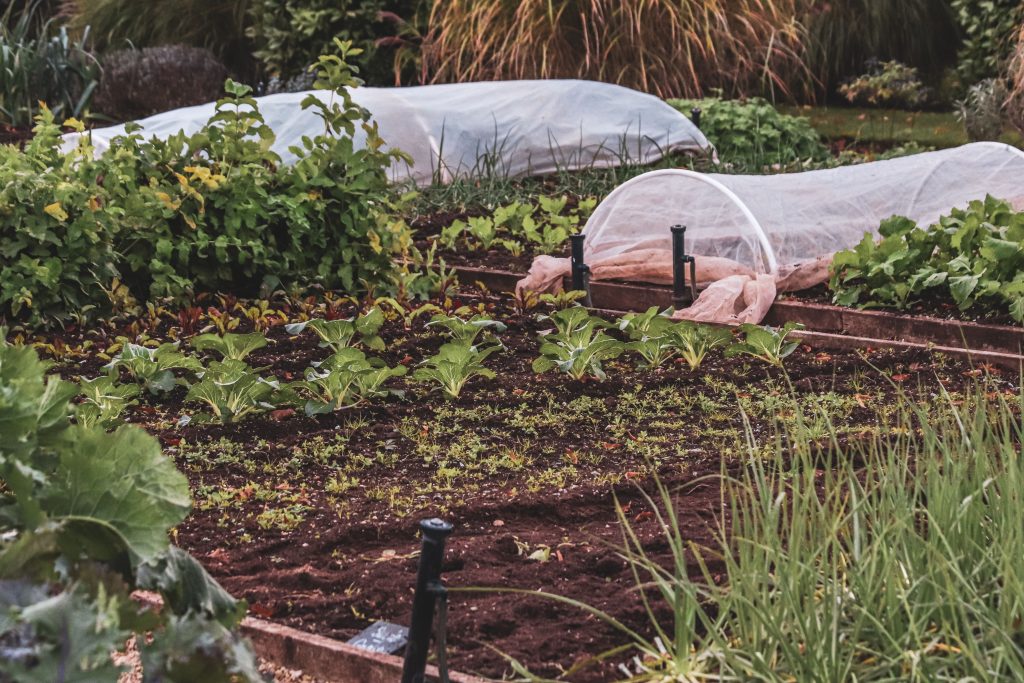
A fall garden is not simply a second spring garden planted later.
The soil is warmer.
Summer crops may still be using water and nutrients.
Beds may contain fertilizer left from tomatoes, peppers, sweet corn, or squash.
Compost and mulch have continued decomposing.
Weed roots are established, and late-summer heat can make seedling establishment difficult.
Applying another full rate of balanced fertilizer before planting may produce lush growth in some beds and salt injury or excessive phosphorus in others.
The correct preparation begins by understanding what the summer crop left behind.
Remove the Crop Without Destroying the Soil
Pull or cut declining summer plants after their useful harvest ends.
Where roots are healthy and disease-free, leaving them to decompose can preserve soil channels and organic matter.
Cut stems at the surface instead of pulling the entire root ball.
Remove plants affected by persistent soilborne disease when sanitation is part of the management plan.
Do not compost material containing mature weed seed or serious disease unless the composting system reaches conditions capable of destroying them.
Handle trellises, plastic mulch, irrigation tape, and stakes before bed preparation.
A clean bed makes it easier to evaluate soil condition.
Check Moisture Before Working the Bed
Soil should be moist enough to crumble, not smear.
Tilling or digging wet soil destroys structure and creates clods that can remain for months.
Working very dry soil produces dust and may require excessive passes.
Take a handful from the intended depth.
If it forms a sticky ribbon and smears, wait.
If it forms a ball that breaks apart with light pressure, conditions are generally more suitable.
Raised beds dry faster than ground-level beds, but the lower profile may remain wet after irrigation.
Review What Was Already Applied
Before adding fertilizer, list the nutrients the bed has received.
Include:
- Preplant fertilizer
- Sidedress nitrogen
- Liquid feeding
- Manure
- Compost
- Mulch
- Fertigation
- Foliar products
- Calcium nitrate
- Potassium products
- Previous fall amendments
A summer tomato bed may have received several feedings.
A bean bed may have received very little nitrogen.
A corn bed may have removed more nutrients than a lightly harvested herb bed.
Do not treat them as identical.
Soil Testing Prevents Repeated Phosphorus Buildup
Phosphorus accumulates in many long-term vegetable gardens.
Gardeners add compost, manure, and balanced fertilizer every year.
Plants remove some phosphorus, but often less than is applied.
High phosphorus rarely improves yield and can contribute to water-quality problems.
It may also interfere with micronutrient availability.
Soils already high in phosphorus are unlikely to benefit from additional phosphorus fertilizer.
Fertility should follow soil-test levels rather than routine product use.
A basic soil test should include:
- pH
- Phosphorus
- Potassium
- Organic matter
Additional nutrients can be tested when symptoms or field history justify them.
Nitrogen Is Handled Differently
Nitrogen changes rapidly in soil.
Nitrate can leach, be taken up by crops, be released from organic matter, or be lost under saturated conditions.
A routine garden test may not provide a stable season-long nitrogen recommendation.
Estimate nitrogen need from:
- Crop
- Previous crop
- Soil organic matter
- Compost and manure history
- Remaining crop residue
- Growth period
- Expected harvest
- Weather
- Irrigation
- Local recommendations
Leafy greens generally require more available nitrogen than radishes or established legumes.
Excess nitrogen can produce:
- Oversized, tender leaves
- Delayed root development
- Greater disease susceptibility
- Nitrate accumulation in certain vegetables
Fall Crops Have Different Nutrient Demands
Lettuce, spinach, kale, mustard, and other leafy crops depend on steady nitrogen for leaf production.
Carrots, beets, radishes, and turnips need enough nutrition for early growth but can become excessively leafy when nitrogen is too high.
Broccoli, cabbage, and cauliflower are heavier feeders with a longer season.
Peas and beans can fix atmospheric nitrogen when properly nodulated and usually do not need heavy nitrogen fertilizer.
Onions and garlic have shallow roots and specific timing needs.
Group crops with similar fertility and irrigation requirements.
Compost Is Not a Neutral Material
Compost improves:
- Structure
- Water holding
- Biological activity
- Nutrient supply
Its nutrient content varies widely.
Plant-based yard-waste compost may contain modest available nitrogen.
Composted manure can contribute substantial phosphorus, potassium, salts, and nitrogen over time.
Dark color and earthy smell do not reveal nutrient analysis.
Repeated thick applications can raise phosphorus and salts.
Use mature compost at a rate suited to the bed’s organic matter and test results.
A thin surface application may be enough in a garden that has received compost every year.
Do not assume more organic matter is always harmless.
Fresh Manure Requires Food-Safety Caution
Raw manure can contain human pathogens.
Application timing must provide an appropriate interval before harvesting edible crops.
Fresh manure should not be placed into a bed intended for near-term fall harvest.
Use properly composted manure from a reliable process.
Even composted manure may contain high salts or phosphorus.
Test the material when applying it at meaningful rates.
Prepare a Fine but Stable Seedbed
Carrots, lettuce, spinach, and other small-seeded crops need good seed-to-soil contact.
Break large clods and level the surface without pulverizing the soil.
Excess tillage destroys aggregates and creates crusting risk.
Remove rocks and undecomposed residue from the immediate seed row.
Firm the bed lightly.
Loose, fluffy soil can place seed too deep after irrigation.
For transplants, maintain structure rather than producing a powdery bed.
The objective is a surface that holds moisture around seed while allowing oxygen and emergence.
Warm Soil Changes Germination
August soil may be too warm for certain cool-season crops.
Lettuce and spinach can germinate poorly under high temperatures.
Carrot seed may dry before emergence because it is shallow and slow to establish.
Use shade cloth, light mulch, or temporary boards over seed rows where appropriate.
Remove solid coverings as soon as emergence begins.
Irrigate lightly and frequently enough to maintain moisture in the germination zone, then transition to deeper watering as roots develop.
Small-seeded vegetables are particularly sensitive to drying and crusting during germination.
Do Not Place Fertilizer Against Seed
Fertilizer salts can damage germinating seed and young roots.
Broadcast and incorporate the recommended material uniformly, or band it at a safe distance according to crop-specific guidance.
Do not pour concentrated fertilizer into transplant holes.
Water-soluble products can injure seedlings when mixed too strongly.
A fall bed may already contain elevated salts from summer fertigation.
Test EC where emergence problems have occurred.
Where 10-10-10 Fits
Supply Solutions 10-10-10 Complete Lawn and Garden Granular Fertilizer with Micronutrients contains nitrogen, phosphate, potash, and several micronutrients.
A balanced analysis is appropriate only when the bed has a balanced need.
Why it is used: It supplies all three primary nutrients and micronutrients in one granular material.
When it should be applied: It fits a garden bed where soil testing and crop history show a need for nitrogen, phosphorus, and potassium. Apply and incorporate it before planting at a rate calculated from the nutrient recommendation.
What problem it solves: It addresses a broad fertility shortage in soil that needs all three primary nutrients. It does not correct excessive phosphorus, high salts, poor drainage, compacted soil, hot seedbeds, or irregular irrigation.
The product should not be used simply because 10-10-10 is familiar.
If the bed needs nitrogen but tests high in phosphorus and potassium, a nitrogen-only source is more precise.
If potassium is low but phosphorus is high, select a potassium source without phosphorus.
Understand the Analysis
A 10-10-10 fertilizer contains 10% of each guaranteed primary nutrient by weight.
Ten pounds supplies:
- 1 pound of nitrogen
- 1 pound of available phosphate
- 1 pound of soluble potash
The garden recommendation should be converted into product weight.
Do not spread a farm-acre rate across a small bed without accurate calculation.
Measure the bed’s square footage.
Calibrate the spreader or weigh the amount.
Uneven hand application can place a concentrated band beside seed.
Micronutrients Should Also Be Test-Driven
Boron, copper, manganese, iron, and zinc are needed in small amounts.
The difference between deficient and excessive boron can be narrow.
High soil pH may make iron or manganese unavailable even when total soil levels are adequate.
A product containing micronutrients is not automatically safer than a product without them.
Count all sources, especially in beds receiving repeated complete fertilizers.
Where chlorosis has occurred, test pH and tissue rather than applying a broad micronutrient blend repeatedly.
Match Nitrogen Timing to Crop Growth
A long-season fall broccoli crop may benefit from a split nitrogen program.
A small radish crop may require little additional nitrogen in fertile soil.
Dividing nitrogen reduces the amount exposed to leaching and allows the grower to respond to crop color and growth.
Sidedress only when soil is moist and roots are active.
Keep fertilizer away from stems and foliage.
Avoid heavy late nitrogen that delays maturity as cold weather approaches.
The crop needs enough time to use the application.
Use Irrigation to Establish Deeper Roots
During germination, the upper soil must remain moist.
After establishment, gradually extend the interval and wet deeper.
Constant shallow irrigation keeps roots near the surface and increases vulnerability to heat.
Check moisture below the bed with a trowel or probe.
Drip irrigation reduces leaf wetness and can improve efficiency, but emitter spacing must wet the whole row.
One drip line may not spread far enough across a wide sandy bed.
Overhead irrigation can establish broadcast seed effectively but may increase leaf disease if foliage remains wet overnight.
Leave Room for Rainfall
Fall weather can shift from hot and dry to cool and wet.
Do not keep the bed near saturation before forecast rain.
Excess water can leach nitrate and damage young roots.
Mulch established plants lightly to moderate temperature and evaporation, but do not bury small seedlings.
Adjust irrigation as day length shortens.
Crops use less water under cooler, cloudier conditions.
A controller set for August heat may overwater in September.
Protect the Bed From Weeds
Summer weeds can establish rapidly in freshly prepared soil.
Use stale-seedbed methods where time permits:
Prepare the bed, irrigate, allow weeds to emerge, and remove them shallowly before planting.
Avoid deep cultivation that brings more seed to the surface.
Mulch between transplant rows after plants establish.
A dense crop canopy eventually suppresses weeds, but seedlings need early protection.
Keep Crop Residue Working Where Possible
Healthy residue can protect soil and return organic matter.
Chop and compost residue, use it as surface mulch, or leave roots in place.
Do not incorporate a large amount of high-carbon material immediately before direct seeding without considering temporary nitrogen immobilization.
Woody stems decompose slowly and may interfere with the seedbed.
Separate the immediate seed row from coarse residue while maintaining cover between rows.
Judge the Bed by Crop Response
Keep a simple record of:
- Soil-test values
- Compost rate
- Fertilizer product and amount
- Planting date
- Variety
- Irrigation
- Emergence
- Leaf color
- Harvest
- Pest and disease pressure
A bed that produces large tops and small roots may have excessive nitrogen.
Pale leafy greens may need nitrogen or may have damaged roots.
Poor emergence may come from heat, crusting, depth, salts, or old seed.
Do not assume every weak stand needs another feeding.
Supply Solutions can help gardeners interpret soil results and determine whether 10-10-10 fits the actual nutrient need or whether a more targeted product is appropriate.
Contact the company before adding another complete fertilizer to a bed with years of compost and manure history.
A productive fall garden begins by preserving soil structure, managing moisture, and supplying only the nutrients the next crop can use.